
EDI and B2B standards
UCS: EDI for the grocery industry
The Uniform Communication Standard (UCS) is the grocery industry's set of X12-based EDI conventions. Grocery retailers, wholesalers and direct store delivery suppliers still reference it. ECOM maps UCS documents and connects them to your ordering, delivery and invoicing systems.
- Based on
- X12 syntax and transaction sets
- Industry
- Grocery, food and beverage
- Known for
- Direct store delivery documents
- Historically published by
- Uniform Code Council (now GS1 US)
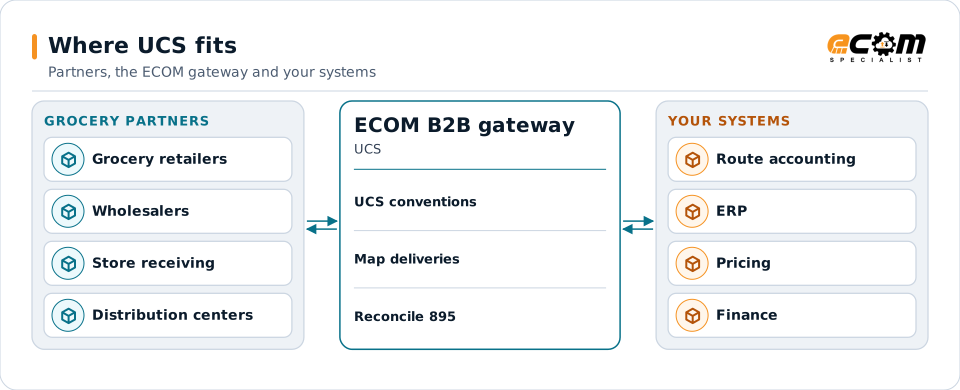
Grocery partners exchange UCS documents with the gateway, which maps deliveries and reconciles adjustments with your systems.
Overview
What UCS is
UCS began as the grocery industry's EDI standard and was published for many years by the Uniform Code Council, today GS1 US. It uses X12 syntax and transaction sets, and adds grocery conventions: which sets to use, which segments and codes, and how to identify products and stores.
Several X12 transaction sets come from grocery practice, such as the 875 grocery purchase order, the 880 grocery invoice and the 894 and 895 used for direct store delivery, where a supplier's driver delivers to the store and the delivery is reconciled electronically.
Where businesses use it
Warehouse-delivered grocery
Purchase orders, acknowledgments, ship notices and invoices between suppliers and grocery distribution centers.
Direct store delivery
Bakery, beverage and snack suppliers send delivery records to stores and receive acknowledgments or adjustments.
Price and item information
Price changes, promotions and item data shared between suppliers and grocers.
Structure
How UCS documents are structured
UCS documents use X12 envelopes and segments. What makes them UCS is the set of conventions: grocery-specific transaction sets, product identification by UPC or GTIN, store and distribution center identification, and pricing and allowance details grocery partners rely on.
In direct store delivery, the supplier transmits a delivery or return record (894) after the stop, and the retailer responds with a delivery acknowledgment or adjustment (895), so both sides agree on what was delivered before the invoice is paid.
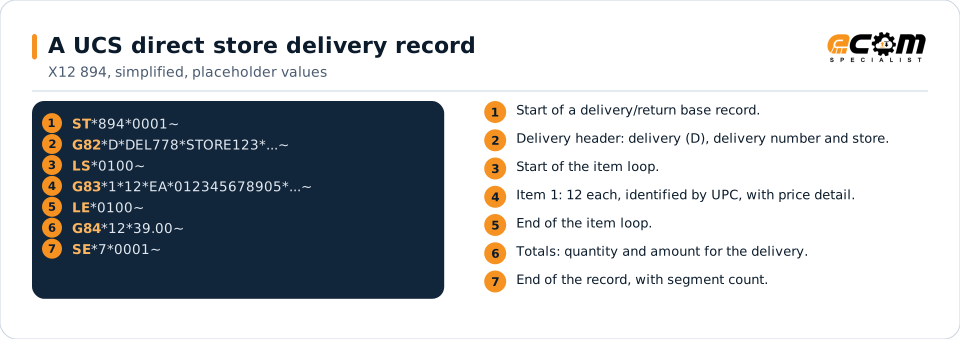
The delivery header names the store and delivery, item lines list what was delivered, and totals close the record before the store acknowledges it.
In depth
Grocery conventions ECOM handles
Grocery transaction sets
Sets such as 875 and 880 for warehouse ordering and invoicing, and 894 and 895 for direct store delivery, next to the general 850, 856 and 810.
Store-level detail
Deliveries are identified per store and route, so maps carry store numbers and route information through to your ERP.
Pricing and allowances
Unit prices, allowances and promotions travel with item lines and affect what the retailer pays.
Reconciliation
The 895 adjustment is matched against the original delivery so differences are visible before invoicing.
Product identification
UPC and GTIN identifiers are checked and converted to your item numbers.
Retailer variations
Each grocer's guide states which UCS conventions and releases it uses; maps follow that guide.
Mapping
How a mapper reads and writes UCS
UCS as input
The map reads the delivery header for the store and delivery number, repeats the item loop for each product, and checks totals against the sum of the lines before creating a delivery record in your system.
UCS as output
Outbound, route accounting or ERP delivery data becomes the 894 with the retailer's store and item identifiers, prices and totals.
What the mapping handles
Fields
Delivery number, store, date and route are mapped to your delivery record.
Loops
Each G83 item line becomes one delivered item; returns are kept separate.
Validation
Totals must match the lines; UPCs must be valid and known.
Code conversions
Retailer store numbers and UPCs are converted to your customer and item numbers.
Business rules
Adjustments from the 895 update the delivery before invoicing.
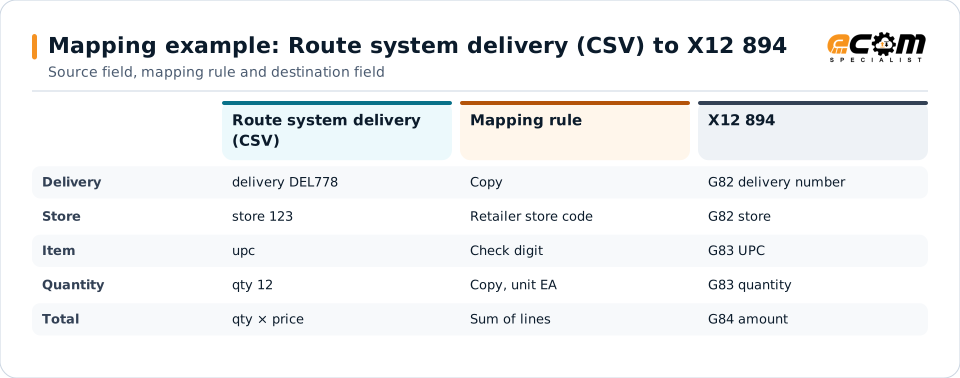
Example: source, mapping, destination
delivery,store,upc,qty,price
DEL778,123,012345678905,12,3.25G82*D*DEL778*STORE123*...~
LS*0100~
G83*1*12*EA*012345678905*...~
LE*0100~
G84*12*39.00~A route accounting export becomes the retailer's delivery record. The total is calculated from the lines so it always matches.
Connections
How UCS connects your business
Grocery retailers and wholesalers
Documents usually travel over AS2 or a VAN to the grocer's EDI system.
Route accounting and handhelds
Delivery data from drivers' devices feeds the 894.
ERP and finance
Acknowledged deliveries become invoices and receivables.
Promotions and pricing
Price and promotion data stays in step with what stores are charged.
ECOM
How ECOM supports UCS
ECOM supports UCS with dedicated implementation, mapping, communication and support teams, and with specialists who know the industries your partners work in.
Implementation team
Plans the UCS setup with you, configures it on the gateway and runs the tests with your partners and systems.
Mapping team
Builds and maintains the maps, code conversions and validation rules between partner data and your applications.
Communication team
Sets up and monitors partner connections, certificates, keys and credentials, and coordinates changes with each partner.
Support team
Watches the flows, investigates failed or missing documents, and works the issue through with you and your partner.
For UCS in particular
- Maps for UCS-based grocery documents, including 875, 880, 894 and 895.
- Direct store delivery reconciliation between route accounting and retailer adjustments.
- Grocery retailer onboarding and testing.
Frequently asked questions
Is UCS different from X12?
UCS uses X12 syntax and transaction sets. It is a set of grocery industry conventions on top of X12, so the same translator handles both; the maps follow the grocery conventions and each retailer's guide.
What are the 894 and 895?
They support direct store delivery. The supplier sends the 894 delivery or return record after delivering to a store, and the retailer replies with the 895 to acknowledge it or report adjustments.
Do grocery retailers still use UCS?
Many grocery retailers and wholesalers still reference UCS conventions and grocery transaction sets in their EDI guides. Each retailer's guide states what it requires.
Can ECOM connect our route accounting system?
Yes. ECOM maps delivery exports from route accounting or handheld systems to the retailer's documents, and brings acknowledgments and adjustments back.
Talk to an EDI/API Expert
Tell us which partners, systems and UCS requirements you are working with. An ECOM specialist will review them with you and outline the setup, the maps and the tests.