
AI automation
AI automation that starts with your costliest problem and ends with proof
AI creates value when it turns information into a timely, accountable action. It does not create value just because a company owns more AI tools. The loss comes from avoidable delays, errors and weak decisions that consume margin or customer trust while a better process is available. ECOM’s AI automation specialists work with customers across industries to pick the first workflow, connect the orders, shipments, documents and invoices it needs, keep people in control and measure the result in 90 days.
Overview
Connected data first
A fast recommendation on a stale inventory balance or a duplicate customer record spreads errors. ECOM connects your trading partner, ERP and document data before AI acts on it.
One problem, one baseline
Start with the recurring problem that costs you most, record today’s volume, effort and error cost, and compare the pilot with a simple baseline.
People stay accountable
Every automated step has an owner, an audit trail and a manual fallback. A model connected to a system is not thereby allowed to change a financial or operational record.
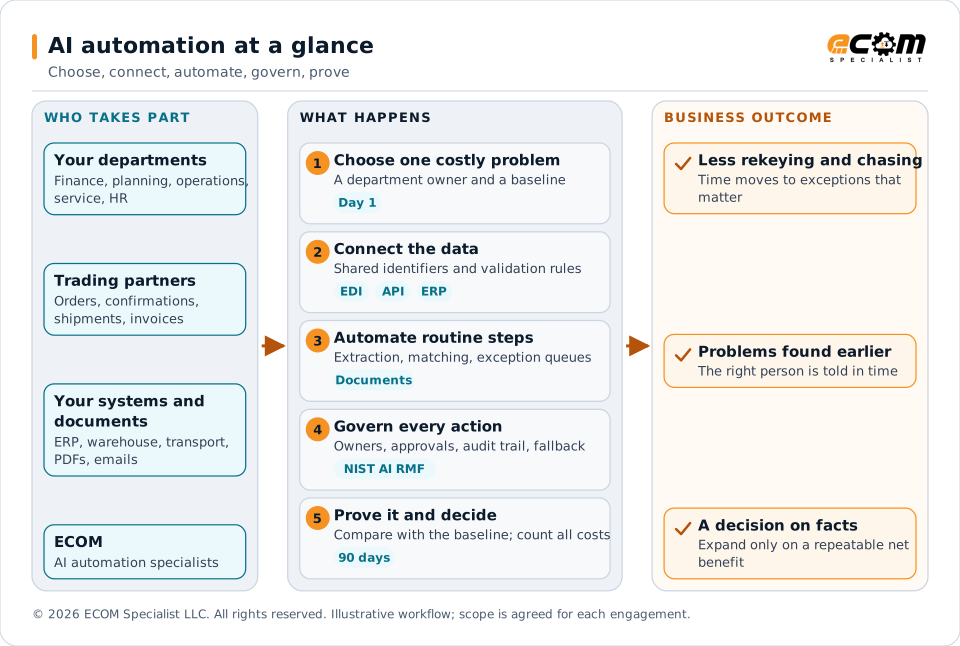
The drawing shows ECOM connecting your departments, trading partners, systems and documents: choose one costly problem, connect the data, automate routine steps, govern every action and prove the result over 90 days. The outcomes are less rekeying and chasing, problems found earlier and an expansion decision based on facts. They are goals to measure against your own baseline, not guaranteed results.
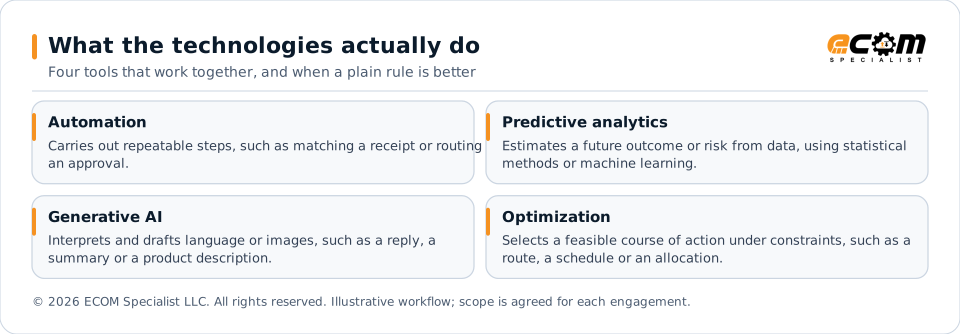
Automation carries out repeatable steps such as matching a receipt or routing an approval. Predictive analytics estimates a future outcome or risk from data. Generative AI interprets and drafts language or images. Optimization selects a feasible course of action under constraints. They work together, but not every workflow needs AI: a stable rule is often the best answer to a clear, deterministic requirement.
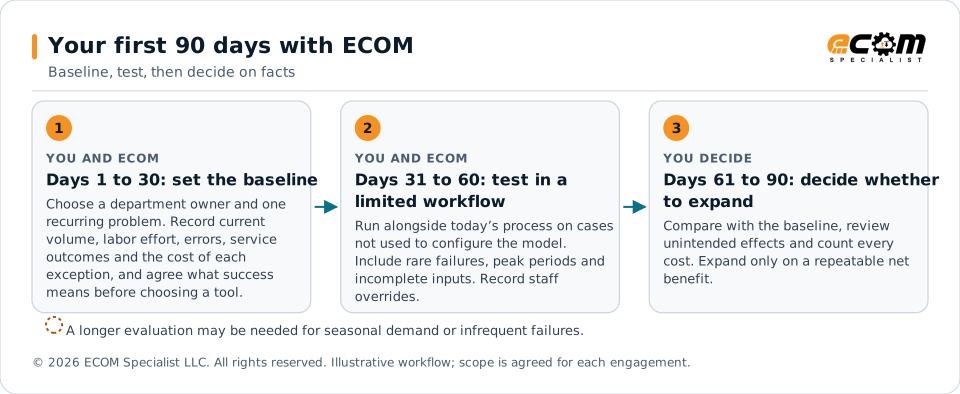
Days 1 to 30 set a baseline: a department owner, one recurring problem, current volume, effort, errors and cost per exception, confirmed data access and a definition of success. Days 31 to 60 test in a limited workflow, alongside the current process, on cases not used to configure the model, with staff overrides recorded. Days 61 to 90 compare the results with the baseline, count every cost and expand only if a repeatable net benefit is shown.
By industry
AI automation by industry
Choose your industry to see the departments where AI can help, what waiting costs you and how ECOM’s specialists help you start.
-
Retailers
Demand, invoices, supplier delays, store tasks and fulfillment: AI on connected data, proven in 90 days.
See retailers -
Manufacturers
Scheduling, maintenance, quality, supply and order capture: AI on connected plant and partner data.
See manufacturers -
Logistics and carriers
Arrival prediction, warehouse labor, fleet maintenance, billing and claims: AI on connected shipment data.
See logistics and carriers -
Automotive businesses
Quality and traceability, supplier releases, parts distribution, dealer leads and service readiness.
See automotive businesses
How it works
Choose, connect, automate, govern, prove
The same five steps apply in every industry. What changes is the department you start in and the data behind it.
| Step | What ECOM does | What you get |
|---|---|---|
| Choose | Helps you pick a department owner and one recurring problem, and defines what success means before any tool is selected | A first workflow with a baseline |
| Connect | Connects orders, confirmations, shipment events and invoices from EDI, APIs, ERP and documents with shared identifiers and validation rules | Current, traceable records for every decision |
| Automate | Brings data from PDFs, emails and images into the same workflow, with exception queues and owners | Less rekeying and chasing, more time on exceptions |
| Govern | Sets approved uses, responsible owners, escalation thresholds, audit trails and a manual fallback, using the NIST AI Risk Management Framework as a reference | Automation you can explain and reverse |
| Prove | Runs the pilot alongside your current process, compares it with the baseline and counts all costs | A net-benefit decision on whether to expand |
The technologies
Four tools, and the case for a plain rule
These tools work together, but not every workflow needs AI. A stable rule is often the best solution for a clear, deterministic requirement. ECOM recommends the simplest tool that works.
Automation
Carries out repeatable steps such as matching a receipt or routing an approval.
Predictive analytics
Estimates a future outcome or risk from data using statistical methods or machine learning.
Generative AI
Interprets and drafts language or images, such as a reply, a summary or a product description.
Optimization
Selects a feasible course of action under constraints, such as a route, a schedule or an allocation.
The business case
Measure the opportunity in dollars
What is it worth? A calculation you can reuseIllustrative arithmetic, not a promise.
- Illustrative calculation only. If a team handles 5,000 documents a month and reduces average handling time from 8 minutes to 3 minutes, it releases about 417 staff hours monthly. At an assumed loaded labor cost of $35 per hour, that is about $14,600 in monthly capacity value.
- That value becomes cash savings only if spending actually falls. Otherwise the benefit comes from useful redeployment, greater throughput or better service.
- Net annual benefit equals verified annual operating gains minus annual software, support, monitoring and other recurring costs. Simple payback equals the one-time implementation cost divided by the positive monthly net benefit.
- Keep released working capital separate from recurring profit, and avoid counting the same labor or error reduction twice. Bring your own volumes and ECOM will work through the arithmetic with you.
Governance
Build trust into daily operations
Govern with a recognized frameworkApproved uses, owners, escalation and monitoring.
- The NIST AI Risk Management Framework is a voluntary structure for governing, mapping, measuring and managing risks.
- Define approved uses, responsible owners, escalation thresholds and monitoring. Restrict access, protect sensitive records, retain evidence for important actions and maintain a manual fallback.
- Reassess accuracy as products, customers and operating conditions change.
Review employment uses carefullyHR and legal review for consequential tools.
- Review accessibility, job relevance and discriminatory outcomes before using automated assessments.
- U.S. agency guidance explains that employment discrimination protections also apply when AI is involved.
Public references
Frameworks and sources
The department opportunities on these pages are practical recommendations, not claims that every company has implemented them. They are analytical guidance, not industry benchmarks. Reference review date: November 1, 2026.
- NIST AI Risk Management Framework Voluntary structure for governing, mapping, measuring and managing AI risk.
- U.S. EEOC: Employment Discrimination and AI for Workers Employment discrimination protections also apply when AI is involved.
- NIST: Artificial Intelligence in Manufacturing Manufacturing applications and lessons learned.
- Walmart: new AI-powered tools for associates Company-reported retail example, June 2025.
- UPS: Proof over promises, AI initiatives Company-described logistics example.
- General Motors: Artificial intelligence Company-described automotive example.
Frequently asked questions
What is AI automation at ECOM?
ECOM’s AI automation specialists help customers choose a first AI-supported workflow, connect the order, shipment, document and invoice data it needs, keep people in control with approvals and audit trails, and measure the result against a baseline.
Which industries does ECOM cover?
U.S. retailers, manufacturers, logistics and carrier operators, and automotive businesses, with the department opportunities for each. Other industries can be scoped on request.
Do we need AI for every workflow?
No. A stable rule is often the best solution for a clear, deterministic requirement. ECOM recommends the simplest tool that works and keeps AI for the steps that need interpretation, prediction or optimization.
How do EDI and APIs relate to AI?
EDI and APIs supply the orders, confirmations, shipment events and invoices that AI relies on. If those records are stale, duplicated or mismatched, a fast recommendation spreads the error.
How long until we know whether it works?
ECOM plans a 90-day path: baseline in the first 30 days, a limited test in days 31 to 60 and a decision in days 61 to 90. Seasonal demand or infrequent failures may need a longer evaluation.
What does it cost to wait?
It depends on your volumes. A reusable calculation multiplies handling time saved by volume and loaded labor cost, then subtracts recurring software, support and monitoring costs. ECOM will work through it with your own numbers.
Is it safe to use AI on our data?
With defined approved uses, restricted access, owners, audit trails and a manual fallback, yes. ECOM uses the NIST AI Risk Management Framework as a reference, and consequential HR uses need HR and legal review.
Talk to an AI Automation Specialist about AI automation
Tell us the recurring problem that costs you most and the systems involved. We will outline a baseline, the data you need and a limited first workflow you can judge on facts.