
Consumer goods
Consumer Goods EDI and API Integration for Retail, Warehouse and Online Channels
Sell everywhere without multiplying your integration work
Consumer goods brands sell through retailers, distributors, marketplaces and their own stores, each with its own requirements. ECOM connects every channel to your ERP and warehouse, so growth does not mean another spreadsheet for every new account.
At a glance
Key documents
- 850 Purchase Orders
- 856 Ship Notices (ASN)
- 810 Invoices
- 846 Inventory Reports
- 852 Sales and Stock Reports
- 812 Credit and Debit Adjustments
Systems we integrate
- ERP and order management
- Warehouse or 3PL system
- Item and pricing data
- Finance and cash application
- Who we help
- Consumer product brands and their finance, customer service and logistics teams, from emerging brands landing a first national account to established brands with many retail customers.
- What we connect
- Your ERP, warehouse or 3PL and item data to each retailer’s orders, ship notices, invoices and payment data, and to the online channels you also run.
- Problems we solve
- Different rules at every retailer, deductions that nobody can explain, ship notices that do not match what shipped, and a back office that scales by hiring.
- Even without EDI
- Not every customer uses EDI. Some send orders through a portal, spreadsheet or email. ECOM works with those routes as well, and can convert them into the same order flow.
What is consumer goods EDI?
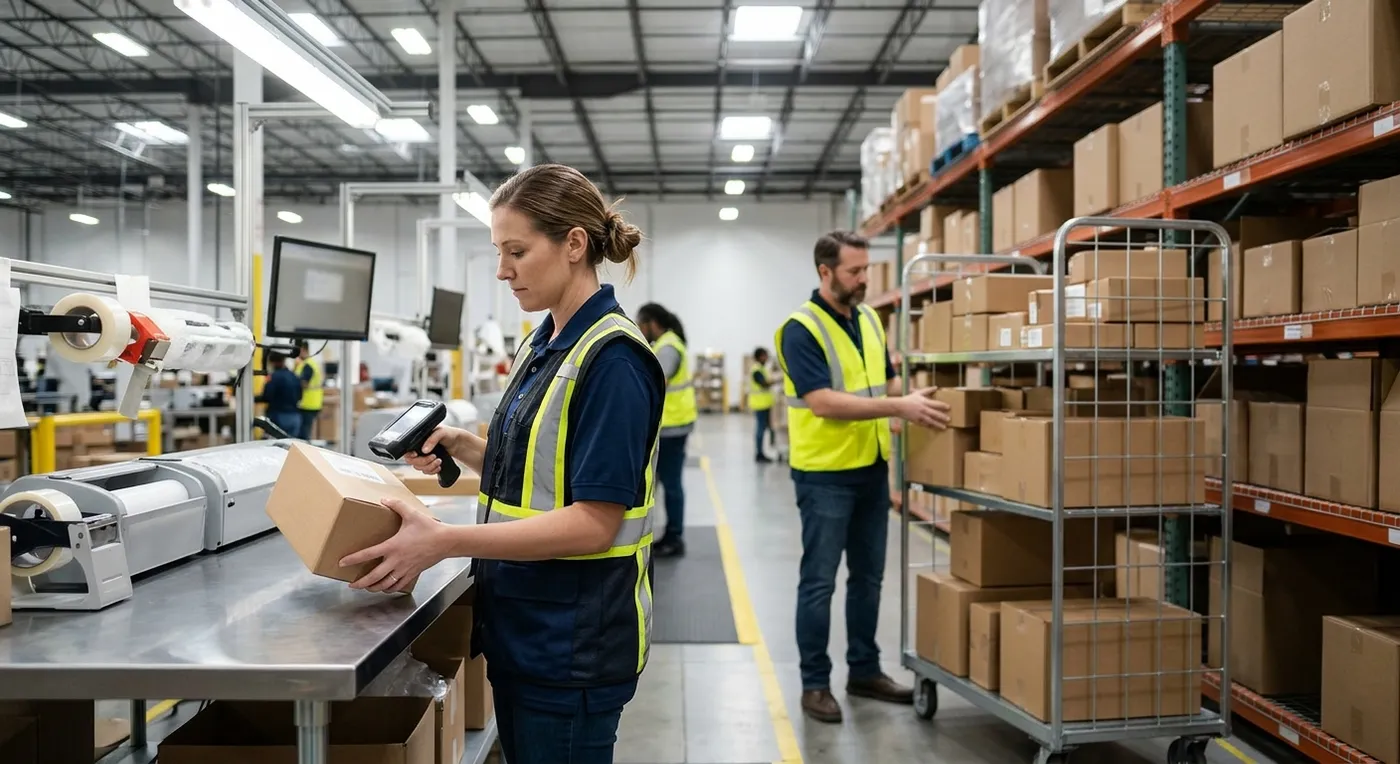
Consumer goods EDI is the exchange of orders, ship notices, invoices, inventory and sales data between consumer product brands and the retailers, distributors and logistics providers that sell and move their products. Brands often supplement EDI with marketplace and e-commerce integrations to support direct and online channels.
Who you connect with
Who a consumer goods brand exchanges data with
A brand sits between its retail customers and the warehouses and carriers that move the product.
-
Grocery and mass retailers
Orders, ship notices, invoices
X12 EDI -
Club and specialty retailers
Orders, labels, remittance
EDI and portals -
Warehouses and 3PLs
Ship requests, confirmations
EDI, API or files -
Distributors and brokers
Orders, resale reports
EDI and files -
Marketplaces and storefronts
Orders, inventory, tracking
APIs
Where brands sell
Grocery, mass, club, drug and convenience each ask for something different
Retail channels set their own routing, label and invoice rules. These are the common differences; the retailer’s own guide is always the final word.
-
Grocery and food retail
Brands selling to supermarket chains and their distribution centers.
- How it runs
- Orders arrive per distribution center. Ship notices and pallet labels are built from the warehouse confirmation and the invoice follows delivery.
- Systems
- ERP, warehouse system, label printing, retailer portals.
- Typical problem
- Delivery windows and label rules are strict, so a late or unlabeled pallet is the usual deduction.
-
Mass merchants and warehouse clubs
Brands selling to large general merchandise and club retailers.
- How it runs
- Purchase orders, ship notices and invoices run through the retailer’s supplier program, often with portal scorecards and chargeback rules.
- Systems
- ERP, warehouse, retailer supplier portal.
- Typical problem
- Scorecard metrics such as on-time and in-full depend on the acknowledgment and ship notice being right the first time.
-
Dollar, discount and convenience
Brands selling to dollar stores and convenience chains through central warehouses or direct store delivery.
- How it runs
- Orders arrive for warehouses or for stores, and some chains pay on invoice and ship notice data that must match closely.
- Systems
- ERP, route or delivery systems, retailer portals.
- Typical problem
- Small order sizes and many locations make manual handling expensive.
-
Drug, health and beauty retail
Brands selling personal care and over-the-counter products to drug and beauty chains.
- How it runs
- Orders, ship notices and invoices follow each chain’s guide, with item data that must match before the first order.
- Systems
- ERP, item master, retailer portals.
- Typical problem
- Item and price data must be set up and agreed before any order can flow.
-
Direct and online sales
Brands that sell through their own store and marketplaces as well as to retailers.
- How it runs
- Marketplace and storefront orders enter the same order flow as wholesale orders, so inventory is shared across channels.
- Documents
- Systems
- Storefront, marketplaces, ERP, 3PL.
- Typical problem
- Inventory promised online and to a retailer at the same time causes cancellations.
How to read this page: a standard or system named here shows where a requirement is published or what ECOM can connect. It does not mean ECOM has a verified partnership with any named company, and your own contracts and partners define the final requirements.
Manufacturing specialties
Specialty pages in this area
This page gives the overview. Each specialty below covers its own products, trading partners and documents. See the full manufacturing directory for every sector.
Beauty, Personal Care and Household Products
Pet, Toy and Recreation Products
Furniture, Furnishings and Housewares
Who it's for
Different roles, different workflows
-
Brands selling to grocery, mass and club retailers
You receive purchase orders from several national retailers, each with its own routing, label, advance ship notice and invoice rules, and you answer deductions after the fact.
-
Brands that use warehouses, brokers or distributors
Orders reach your warehouse or 3PL as shipment requests, and shipping confirmations must come back in time to send the retailer an accurate ship notice and invoice.
-
Direct and online brands adding wholesale accounts
You already run a storefront or marketplace and now have to meet a retailer’s supplier program without building a separate back office for it.
How the workflow runs
From retailer order to payment, with a warehouse in the middle
Most consumer goods brands do not ship from their own desk. The order, the warehouse confirmation, the ship notice and the invoice all have to agree, or the retailer deducts.
- Retailer→Brand 850 Purchase order Items, quantities, ship-to and requested dates.
- Brand→Retailer 855 Order acknowledgment Accepts, changes or rejects each line.
- Brand→Warehouse or 3PL 940 Ship request Release the order for picking and routing.
- Warehouse or 3PL→Brand 945 Shipped confirmation What was packed, cartons and tracking.
- Brand→Retailer 856 Advance ship notice Built from what actually shipped, with labels.
- Brand→Retailer 810 Invoice Matches the order and the ship notice.
- Retailer→Brand 820 Payment and remittance Often with deductions to research.
- 01
Take the order in the retailer’s format
Validate the purchase order against your item and customer data before it reaches the ERP, so bad orders are caught in minutes.
- 02
Confirm what you can ship
Send the acknowledgment with accepted quantities and dates. Many retailers measure on-time, in-full performance from it.
- 03
Ship, label and notify
The warehouse confirms what shipped. The ship notice is built from that confirmation with retailer-specific labels and carrier data.
- 04
Invoice to match
The invoice follows the order and the ship notice. Price, quantity and terms differences become deductions.
- 05
Research the payment
Remittance and adjustment data are matched to invoices, so a short payment is traced to a reason rather than written off.
Beyond EDI
Every way a consumer goods order or data feed can arrive
A brand rarely gets everything as EDI. ECOM receives each source and prepares the same clean order and shipment data for your systems.
How it arrives
- EDI850 orders, 856, 810, 820, 852
- APIMarketplace and storefront orders
- PortalRetailer vendor portals
- Flat fileWarehouse and 3PL files
- SpreadsheetPrice lists and item data
- PDF or emailCustomer orders and statements
ECOM
- Validate every file or message
- Map to each partner's rules
- Deliver, acknowledge and monitor
Where it goes
- ERP orders
- Warehouse releases
- Invoices out
- Deduction data
Challenges
Integration challenges in consumer goods
Many retail requirements
Each retail account brings its own documents, labels and penalties.
Deductions eroding margin
Compliance and pricing deductions are hard to track without good data.
Channel sprawl
Wholesale, marketplace and direct orders often run on separate processes.
How we help
How ECOM supports consumer goods companies
-
Retail EDI
Orders, ship notices, invoices and inventory with retail customers.
-
Sales and inventory data
Use 852 product activity data to understand sell-through.
-
Marketplace and direct channels
Connect marketplaces and storefronts with PRISM UniChannel and PRISM-API Gateway.
-
Deduction support
Capture 812 adjustments and remittance data for deduction research.
-
3PL connectivity
Integrate with 3PL warehouses for fulfillment.
Systems integration
The systems a consumer goods exchange touches
A brand’s retail EDI rarely stops at the ERP. The warehouse system, the item master and the finance team all depend on the same documents.
From
- Retailer orders
- Warehouse files
- Sales data feeds
- Marketplace orders
ECOM · Consumer goods hub
- Validate each order
- Map per retailer
- Secure delivery
To
- ERP orders
- Warehouse releases
- Invoices out
- Deduction data
Scroll sideways to see every column. With a keyboard, select the table and use the left and right arrow keys.
| System | What flows | What to plan for |
|---|---|---|
| ERP and order management | Purchase orders in; acknowledgments, invoices and adjustments out. | Item numbers, UPC or GTIN and customer ship-to codes must match the retailer’s records. |
| Warehouse or 3PL system | Ship requests out; shipped confirmations and carton data back. | The ship notice can only be as accurate as the confirmation it is built from. |
| Item and pricing data | Catalogs, price changes and item setup shared with retailers. | A price that differs from the retailer’s record is the most common source of invoice deductions. |
| Finance and cash application | Remittance and adjustment data matched to invoices. | Deduction reason codes need to reach the people who can dispute them in time. |
Consumer goods and retail
This page is about the brand. The retail page is about the retailer’s rules
A brand’s problems start with the retailers it sells to, but they continue into the warehouse, the item master and the deduction queue. These pages split the topic so each can go deeper.
-
Retailer supplier compliance
Routing, labels, ship notice timing and penalty prevention under each retailer’s vendor guide.
Retailer supplier compliance in detail -
Online and marketplace channels
Storefronts, marketplaces and retailer drop-ship programs for brands that also sell direct.
Online and marketplace channels in detail -
Food and beverage brands
Lot, date and temperature data for brands that sell perishable products.
Food and beverage brands in detail -
Penalty prevention
How late, short or mislabeled shipments turn into chargebacks, and how to prevent them.
Penalty prevention in detail
Deductions
Where consumer goods deductions come from and which data answers them
Deductions are the day-to-day cost of the retail relationship. Most trace back to a mismatch between two documents.
-
Shortage and receiving
The ship notice and the cartons disagree, or the carton label cannot be scanned.
-
Pricing
The invoice price differs from the price the retailer has on file for that item.
-
Timing
The shipment arrived outside the retailer’s window, or the ship notice came late.
-
Promotions and allowances
Off-invoice or billback allowances are taken against payments and have to be matched to the agreement behind them.
Documents and standards
Common transactions
Common X12 documents for consumer goods brands.
Scroll sideways to see every column. With a keyboard, select the table and use the left and right arrow keys.
| Code | Document | What it does |
|---|---|---|
| 850 | Purchase Orders | The retailer orders product. |
| 856 | Ship Notices (ASN)X12 name: Advance Ship Notice | Describes the shipment. |
| 810 | Invoices | Bills the retailer. |
| 846 | Inventory ReportsX12 name: Inventory Inquiry/Advice | Shares inventory availability. |
| 852 | Sales and Stock ReportsX12 name: Product Activity Data | Reports sales and store inventory. |
| 812 | Credit and Debit AdjustmentsX12 name: Credit/Debit Adjustment | Communicates adjustments and deductions. |
Scenarios
Typical integration scenarios
Emerging brands
Win first retail accounts without building an EDI department.
Established brands
Consolidate channel integrations and reduce deductions.
Trading partners
Consumer Goods partners we connect with
Examples of retail trading partners ECOM can connect your business with.
















Logos are trademarks of their respective owners. Their display does not imply endorsement of ECOM Specialist.
Case studies
Where ECOM provides these services today
Anonymous profiles of ECOM customers in this industry, each showing the services ECOM provides and how the work is set up.
Consumer equipment and supplies company
Meeting retailer compliance requirements while bringing suppliers into one portal
Retailer EDI compliance and a Supplier Portal for a consumer equipment company that sells through large retailers.
EDI operations · API Gateway · Supplier Portal (PRISM-WebEDI)
Read the profileHousehold appliance manufacturer
Serving national retailers, regional dealers and builders from one managed process
One managed process for retailer EDI, dealer browser access and settlement review at an appliance manufacturer.
EDI operations · API Gateway · WebEDI · Reconcile360
Read the profile
Frequently asked questions
What is an EDI 852?
The 852 product activity data document shares sales and inventory information, often by store and item, so suppliers can see sell-through and plan replenishment.
How can brands reduce retail deductions?
Accurate, timely ship notices, labels and invoices prevent many deductions, and capturing adjustment and remittance data helps resolve the rest.
Can one platform handle retail EDI and marketplaces?
Yes. PRISM handles retail EDI alongside marketplace and storefront integrations.
How is consumer goods EDI different from general retail EDI?
The documents are the same, but a brand deals with several retailers’ rules at once and also manages warehouses, item data, deductions and often online channels. This page covers the brand side; the retail page covers the retailer’s supplier programs.
What do I need ready before my first retailer asks for EDI?
Clean item data (GTINs, case packs, dimensions), a way to produce shipping labels and a plan for who sends the ship notice. A retailer’s guide, if you have it, helps, but it is not a prerequisite for talking to us.
Does a 3PL change the EDI setup?
Yes. The order is released to the warehouse and the warehouse reports back what shipped. The ship notice and invoice are then built from that confirmation, so the brand and the 3PL both have to be in the flow.
Can sales and stock data from retailers be used?
Where a retailer supplies an 852 or similar report, it can be loaded for sell-through and replenishment planning. Availability and format are set by each retailer.
How to get started
Tell us who you trade with and what you run
- Send the basics. Your trading partners, the documents they require, your ERP or other systems, and any deadline.
- We review the requirements. An ECOM specialist looks at the partner programs, document formats and connections involved.
- You decide how to proceed. We outline the options, including managed services or software, for you to compare.
Helpful to share, but not required
You do not need an implementation guide or a finished requirements list to contact us. If you have these, they speed things up:
- Your retail customers and the product categories you sell them.
- Your ERP and whether a 3PL or co-packer ships for you.
- A recent deduction or rejected-document example, if you have one.
- Your go-live date for a new retailer, if there is one.
See how ECOM works with customers: case studies ERP integrations compare delivery options (software, managed or team-based)
Talk to an EDI/API expert
Tell us about your partners, systems and goals. We will show you how PRISM and our team can help.