Executive summary
The situation and ECOM’s role
A consumer equipment and supplies company sells through large retailers and relies on its own suppliers for products and materials. Retailers are demanding trading partners. They send purchase orders, expect acknowledgments and advance ship notices that follow their routing and label rules, and apply chargebacks when documents or shipments do not match.
ECOM operates the retailer EDI exchange, provides the API Gateway for internal and external integrations, and provides a Supplier Portal, part of PRISM-WebEDI, so suppliers without EDI can manage procure-to-pay transactions through a browser.
A retailer does not care why a shipment notice was wrong. It applies the penalty either way.
Customer environment
- Industry
- Consumer equipment and supplies sold through large retailers.
- Upstream
- Its own suppliers of products and materials.
- ECOM scope
- Retailer EDI operations, API Gateway and a Supplier Portal.
About this profile: the customer is not named and details are generalized. What is stated about the customer comes from ECOM; text marked “industry context” describes how this kind of business typically works. No volumes, timelines, figures, quotes or measured results are published.
The challenge
Retail compliance leaves little room for error
Industry context: a supplier to large retailers lives inside a compliance program written by the retailer. The core flow is well known: the 850 purchase order, a 997 or 999 functional acknowledgment, the 855 purchase order acknowledgment, the 856 advance ship notice, the 810 invoice and the 820 payment or remittance advice. Each retailer sets its own timing, its own fields and its own penalties.
The details are where suppliers lose money. A ship notice must match the carton labels and the pallet configuration, an invoice must match the order and the receipt, and a late or incorrect document can trigger a chargeback long before anyone notices. Changes are constant: retailers revise requirements, add data elements and move to new communication methods, so the mapping and testing never finish.
Upstream, the same company has suppliers of its own. Large suppliers may exchange EDI, but many are small and need a simple way to send order confirmations, ship notices and invoices without installing anything. If there is no easy route, those transactions arrive by email and spreadsheet and are re-keyed.
Why ECOM
A team that works with retailer requirements every day
ECOM operates the retailer EDI exchange, so retailer requirements are handled by a team that works with them daily rather than by a small internal group that sees each change once. Which activities, such as onboarding or mapping changes, are included follows the agreed scope.
Under one integration pattern, retailer order systems and internal applications stay in step.
On the inbound side, the Supplier Portal brings small suppliers into the same managed process instead of leaving their transactions in email.
Industry context
Consumer equipment and supplies company
A consumer equipment and supplies company sells through large retailers and depends on its own suppliers for products and materials. Retailers run strict compliance programs: documents must arrive on time and in the retailer’s form, goods must be routed and labeled to their rules, and mistakes are often settled as chargebacks.
Retailer rules are specific
Purchase orders, acknowledgments, ship notices and invoices each have deadlines and format rules.
Chargebacks are a cost
Routing, labeling or timing errors can be charged back by the retailer.
Suppliers need a simple way in
The company’s own suppliers need a straightforward way to exchange documents.
Where it goes wrong
Typical problems in this kind of exchange
-
Chargebacks from small errors
A late acknowledgment, a missing label detail or a wrong routing field breaks the retailer’s rule.
The retailer deducts a fee, and finance spends time disputing it.
-
A rule change lands on a small team
Retailers revise requirements regularly.
Mapping and testing compete with everything else.
-
Suppliers’ documents are informal
Suppliers send orders, confirmations and invoices in whatever form is easy.
The company re-keys and chases information.
-
Ordering systems drift apart
Retail ordering systems and internal applications are linked separately.
Staff correct differences by hand.
What ECOM provides
The confirmed scope of services
-
EDI operations
ECOM runs the EDI exchange with the customer’s trading partners.
About EDI operations -
API Gateway
PRISM-API Gateway carries the integrations between the customer’s own applications and with outside parties, so internal and external connections follow one pattern.
About API Gateway -
Supplier Portal (PRISM-WebEDI)
The Supplier Portal, part of PRISM-WebEDI, lets suppliers without EDI work through procure-to-pay transactions in a browser.
About Supplier Portal (PRISM-WebEDI)
What ECOM is responsible for
- ECOM operates the retailer EDI exchange with the customer’s trading partners.
- The API Gateway carries integrations between the customer’s applications and with outside parties.
- The Supplier Portal, part of PRISM-WebEDI, lets suppliers without EDI manage procure-to-pay transactions through a browser.
Technical and operational detail
How retailer compliance is managed in practice (industry practice)
In practice, retailer compliance is a cycle of requirement, test, monitor and correct. A new retailer or a changed requirement triggers mapping work and a testing round with the retailer. Once live, documents are monitored: acknowledgments should return, shipment notices should arrive before the goods do, and invoices should match what was shipped. Chargebacks and scorecard reports show where something slipped, and the cause is usually traced to one data element or one timing rule.
Handling this as a managed operation matters because the work is continuous and detailed. Each retailer has its own guide, its own test process and its own definition of a clean document. A team that does this every day recognizes a recurring issue sooner than a small internal team that sees each retailer rarely.
On the inbound side, the Supplier Portal, part of PRISM-WebEDI, lets suppliers without EDI handle order confirmations, shipment information and invoices in a browser.
Architecture
Where the integration sits
Company environment
- Order and shipping systems
- Internal applications
- Supplier relationships
ECOM responsibilities
- Retailer EDI operations
- API Gateway
- Supplier Portal
Partners
- Large retailers
- Suppliers of products and materials
Educational diagram of this kind of environment, not the customer’s own architecture.
Running a similar exchange? Tell us your partners, systems and where the delays are, and a specialist will suggest where to start.
Talk to an EDI/API ExpertThe workflow
How the work flows
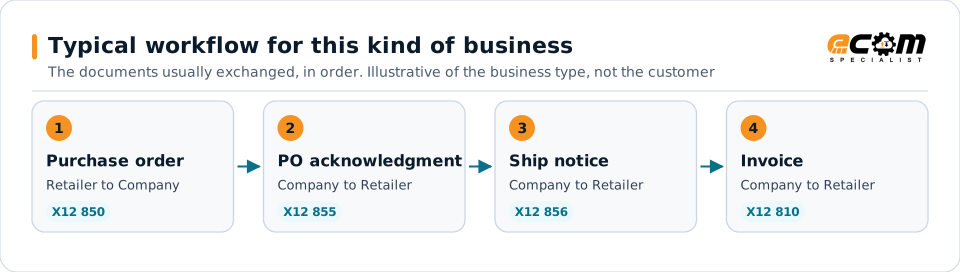
The documents typically exchanged in this kind of business, in the order they usually move. Partners vary, and some connect by API instead of EDI. The shaded line under a step shows where ECOM’s services act.
Steps are listed in the order the documents usually move, with who sends each one. Running alongside every step: Supplier exchange and internal integrations.
-
1. Order
Purchase orderX12 850
Retailer Company
The retailer places an order that carries its routing and label requirements.
ECOM operates the EDI exchange with the customer’s trading partners.
-
2. Acknowledge
Order acknowledgmentX12 855
Company Retailer
Confirms the order within the retailer’s window.
-
3. Ship notice
Advance ship noticeX12 856
Company Retailer
Announces the shipment so the retailer can receive it.
-
4. Invoice
InvoiceX12 810
Company Retailer
Bills the shipped order.
Running alongside every step
These support the exchange throughout. They are alternative routes and controls, not steps that happen after payment.
-
Keep suppliers and systems in step
Supplier exchange and internal integrations
Suppliers, ordering systems and applications Each other
Suppliers work with the company in one place while internal applications stay in step.
The Supplier Portal, part of PRISM-WebEDI, lets suppliers without EDI work through procure-to-pay transactions in a browser.
ECOM’s role
Operational needs and ECOM’s role
What this kind of exchange needs, and what ECOM does about it within the agreed scope.
Exception handling
When something goes wrong
-
A retailer rejects a document
An acknowledgment, ship notice or invoice fails the retailer’s checks.
The team that operates the exchange sees the rejection and works it with the retailer’s rules.
-
A retailer changes a rule
Requirements for a document change.
The change is made and tested as part of the service.
Business value
Confirmed scope and intended benefits
Confirmed
- ECOM operates the retailer EDI exchange and provides the API Gateway.
- ECOM provides a Supplier Portal, part of PRISM-WebEDI, for the company’s suppliers.
Intended benefits
- Retailer requirements handled by a team that works with them daily.
- Suppliers working with the company in a single place.
- Internal and external integrations following one pattern.
Systems typically involved
- Retailer systemsSend orders and receive acknowledgments, ship notices and invoices.
- The company’s order, warehouse and ERP systemsSource of order and shipment data.
- Suppliers’ browsers or systemsWork with the company through the portal.
Lessons for similar enterprises
What other organizations can take from this
Treat retailer rules as a living program
Requirements change constantly. Plan for ongoing operation rather than one implementation.
Make documents agree before they leave
A ship notice that matches labels and an invoice that matches the order avoid most chargebacks.
Include your own suppliers
A simple route for small suppliers keeps inbound transactions out of email.