Executive summary
The situation and ECOM’s role
A live-plant supplier sells through retail and online channels, and its product is seasonal, perishable and dated. Orders surge in spring, plants have to leave the grower at the right stage, and an order that ships a week late can mean stock that no longer sells.
ECOM provides PRISM UniChannel to unify orders, inventory and fulfillment data from the sales channels, complete ERP solutions, the API Gateway to connect the ERP, the channels and surrounding applications, and Reconcile360 to match remittance, deposits and invoices.
When the product is perishable, a record that arrives late is not a data problem. It is lost inventory.
Customer environment
- Industry
- Live-plant supply: seasonal, perishable, dated product.
- Channels
- Retail and online sales channels.
- ECOM scope
- PRISM UniChannel, complete ERP solutions, API Gateway and Reconcile360.
About this profile: the customer is not named and details are generalized. What is stated about the customer comes from ECOM; text marked “industry context” describes how this kind of business typically works. No volumes, timelines, figures, quotes or measured results are published.
The challenge
Availability you cannot trust is worse than no availability
Industry context: plant suppliers work against the calendar. Planting, growing and shipping windows are fixed by the season, and the same inventory may be promised to a national retailer, a regional chain and an online storefront at once. If each channel keeps its own picture of what is available, one of them is wrong, and in season there is no time to find out which.
Retail channels typically send purchase orders, expect acknowledgments that confirm quantities and ship dates, and require advance ship notices that match what actually leaves the farm, often with labeling and routing rules enforced by chargebacks. Online channels add order-level data with their own timing. In X12 terms that is the 850 purchase order, 855 acknowledgment, 856 ship notice, 810 invoice and, for inventory visibility, 846 or 852 documents. A supplier of living goods also faces substitutions and short shipments that have to be communicated early.
Settlement adds a second layer. Retail payments arrive as remittance advice with deductions for shortages, damage and compliance penalties, and the money arrives separately from the invoice it belongs to. Without a way to tie remittance back to what was shipped and invoiced, finance spends the post-season months arguing over differences that were created weeks earlier.
Why ECOM
One partner across the ERP, the channels and the connections between them
The confirmed scope here is unusually broad: ECOM provides complete ERP solutions as well as the channel and integration products. That matters because many channel problems are really item-master, customer and order-record problems inside the ERP. A single accountable partner can fix them at the source rather than patching around them in each channel.
The scope pairs channel data with connections and cash matching, so one order record can be followed from channel to payment, under one integration pattern rather than a growing set of one-off connections.
A seasonal business also gains from having a partner that already understands retail compliance and settlement, because the learning curve cannot be allowed to fall inside the selling season.
Industry context
Live-plant supplier selling through retail and online channels
A live-plant supplier sells through retail and online channels. Its product is seasonal, perishable and dated, so timing is everything: the right plants have to be in the right place in season, and anything that is wrong in the data, such as availability or an order status, becomes a physical problem very quickly.
A short selling window
Demand is concentrated in a season, and product that is not shipped in time loses value.
Many places to sell
Retail and online orders, store inventory and fulfillment data sit in different systems.
Settlements with deductions
Retail settlements arrive with deductions and remittance that must be checked against what was shipped and invoiced.
Where it goes wrong
Typical problems in this kind of exchange
-
Availability is hard to trust in season
Orders, store inventory and fulfillment data live in different systems.
Plants can be promised that are not available, or sit unsold because they were not visible.
-
Settlement differences
Settlements bring deductions and remittance separate from the invoices.
Differences are found late, if at all.
-
Systems disagree on the basics
The ERP, channels and applications each keep their own item, customer and order records.
Staff spend time reconciling records instead of fulfilling orders.
What ECOM provides
The confirmed scope of services
-
PRISM UniChannel
PRISM UniChannel unifies orders, inventory and fulfillment data from sales channels.
About PRISM UniChannel -
Reconcile360
PRISM Reconcile360 matches remittance advice, bank deposits and open invoices, and flags differences for review.
About Reconcile360 -
API Gateway
PRISM-API Gateway carries the integrations between the customer’s own applications and with outside parties, so internal and external connections follow one pattern.
About API Gateway -
Complete ERP solutions
ECOM provides complete ERP solutions for the customer.
About Complete ERP solutions
What ECOM is responsible for
- PRISM UniChannel unifies orders, inventory and fulfillment data from the retail and online channels.
- ECOM provides complete ERP solutions for the customer.
- The API Gateway connects the ERP, the channels and surrounding applications under one integration pattern.
- Reconcile360 matches remittance, deposits and invoices and flags differences for review.
Technical and operational detail
Exceptions, data checks and visibility in a seasonal business (industry practice)
In practice, the failures that matter for living goods happen at the edges of the standard flow. A retailer’s purchase order requests a quantity the grower cannot fill for a variety. A shipment goes out short, or with a substituted item. A pallet configuration does not match what the advance ship notice described. The order that was acknowledged at one quantity ships at another. Each of these needs to be seen quickly, while there is still time to correct it or warn the customer.
That is where data validation earns its place. Checks at the point of entry confirm that item numbers, units of measure, ship-to locations and requested dates are valid before an order enters the ERP. Checks at the point of shipment compare the notice with the actual picks. Checks at the point of payment compare remittance with the invoice and the receipt.
Architecture
Where the integration sits
Supplier environment
- ERP
- Inventory and fulfillment
- Surrounding applications
ECOM responsibilities
- PRISM UniChannel
- Complete ERP solutions
- API Gateway
- Reconcile360
Sales channels
- Retail channels
- Online channels
- Bank deposits and remittance
Educational diagram of this kind of environment, not the customer’s own architecture.
Running a similar exchange? Tell us your partners, systems and where the delays are, and a specialist will suggest where to start.
Talk to an EDI/API ExpertThe workflow
How the work flows
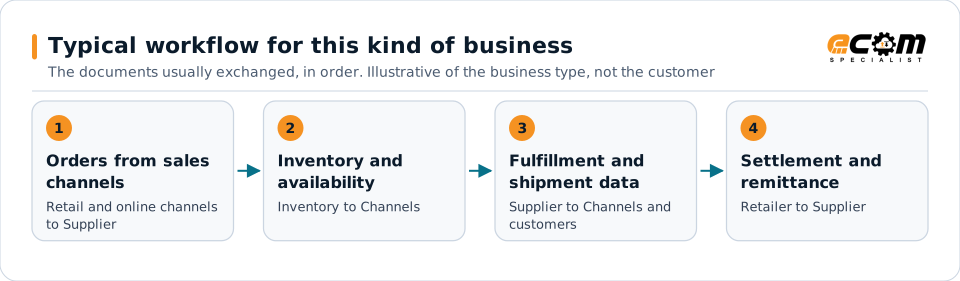
The documents typically exchanged in this kind of business, in the order they usually move. Partners vary, and some connect by API instead of EDI. The shaded line under a step shows where ECOM’s services act.
Steps are listed in the order the documents usually move, with who sends each one. Running alongside every step: ERP and applications.
-
1. Orders come in
Orders from sales channels
Retail and online channels Supplier
Orders arrive from several channels with different details.
PRISM UniChannel unifies orders, inventory and fulfillment data from sales channels.
-
2. Check availability
Inventory and availability
Inventory Channels
Availability reflects what is actually on hand in season.
-
3. Fulfill
Fulfillment and shipment data
Supplier Channels and customers
Shipping information flows back to the channel that took the order.
-
4. Get paid
Settlement and remittance
Retailer Supplier
Settlements are checked against shipments and invoices.
PRISM Reconcile360 matches this remittance advice with the bank deposit and the open invoices, and flags differences for review.
Running alongside every step
These support the exchange throughout. They are alternative routes and controls, not steps that happen after payment.
-
Keep systems aligned
ERP and applications
ERP, channels and applications Each other
The ERP, the channels and surrounding applications agree on items, customers and orders.
PRISM-API Gateway carries the integrations between the customer’s own applications and with outside parties, so internal and external connections follow one pattern.
ECOM’s role
Operational needs and ECOM’s role
What this kind of exchange needs, and what ECOM does about it within the agreed scope.
Exception handling
When something goes wrong
-
Records disagree
A channel and the ERP show different values for the same order or item.
Shared records make the difference visible so it can be fixed at the source.
-
A settlement is short
A retailer’s payment does not match the shipped and invoiced amount.
The difference goes to review.
Business value
Confirmed scope and intended benefits
Confirmed
- ECOM provides PRISM UniChannel, complete ERP solutions, the API Gateway and Reconcile360.
- The customer sells live plants through retail and online channels.
Intended benefits
- Channels and the ERP work from shared records for items, customers and orders.
- Inventory and fulfillment status is visible in one place during the season.
- Settlement differences are found by review instead of by chance.
- One accountable partner covers the ERP, the channels and the connections between them.
Systems typically involved
- Retail and online channelsSource of orders and fulfillment requests.
- ERPSystem of record for items, customers, orders and invoices.
- Inventory and fulfillment applicationsHold availability and shipping data.
Lessons for similar enterprises
What other organizations can take from this
Treat inventory as a shared record
If each channel keeps its own count of live product, overselling and write-offs are built in.
Fix records at the ERP
Item, customer and order data that disagree in the ERP will disagree in every channel.
Plan settlement before the season
Match remittance to shipments while the details are still fresh, not after the season ends.