Executive summary
The situation and ECOM’s role
A household appliance manufacturer sells through national retailers, regional dealers and builder channels. Retailers require purchase order, shipment notice and invoice exchange with their own rules, while regional dealers may not have EDI at all. Delivery and installation scheduling creates documents and changes beyond a standard shipment.
ECOM operates the EDI exchange, provides the API Gateway for internal and external integrations, provides WebEDI for dealers without EDI, and provides Reconcile360 to reconcile retail settlements and deductions against invoices.
An appliance order is not finished when it ships. It is finished when it is delivered, installed and paid for.
Customer environment
- Industry
- Household appliance manufacturing.
- Channels
- National retailers, regional dealers and builder channels.
- ECOM scope
- EDI operations, API Gateway, WebEDI and Reconcile360.
About this profile: the customer is not named and details are generalized. What is stated about the customer comes from ECOM; text marked “industry context” describes how this kind of business typically works. No volumes, timelines, figures, quotes or measured results are published.
The challenge
Large items, scheduled deliveries and mixed partner capabilities
Industry context: national retailers follow the standard order cycle of 850, 855, 856 and 810 with their own compliance rules, and many also exchange warehouse and inventory documents. Regional dealers and builder channels may use none of it. They order by phone, email or portal, and their expectations of acknowledgment and shipping updates are different.
Appliances are large, heavy and often delivered to a customer’s home or a construction site, sometimes with installation. That makes the delivery appointment part of the transaction: schedule changes, rescheduled deliveries, partial deliveries and damage claims all produce documents and status updates that a normal shipment does not. Builder channels add project-based orders with staged deliveries.
Retail settlement then arrives with deductions for damage, shortage, return allowances and promotional programs. Matching each deduction against the right invoice and the right delivery record is detailed work, and a mismatch left unresolved becomes a write-off.
Why ECOM
One managed process for retailers and dealers
ECOM operates the EDI exchange with retailers, so retailer requirements are handled by a team that works with them daily; onboarding and mapping work follow the agreed scope. One integration pattern connects the manufacturer’s applications with outside parties.
A browser route gives dealers without EDI a way into the same process, so they do not need a separate workflow, and settlement differences are reviewed with the records side by side.
Industry context
Household appliance manufacturer
A household appliance manufacturer sells through national retailers, regional dealers and builder channels. Appliances are large, delivered and often installed, so the transaction does not end when the truck leaves: delivery and installation scheduling creates documents and changes beyond a standard shipment.
Different channels, different capability
National retailers run EDI. Regional dealers may not.
Delivery and installation add steps
Scheduling and changes create documents and exceptions that a standard shipment does not.
Settlements and deductions
Retail settlements and deductions must be reconciled against invoices.
Where it goes wrong
Typical problems in this kind of exchange
-
Retailers and dealers need different routes
Retailers run EDI, dealers may not.
Two processes run side by side, and dealers’ orders are re-keyed.
-
Delivery and installation add exceptions
Scheduling and changes create documents beyond a standard shipment.
Exceptions are handled case by case.
-
Settlement differences
Deductions and remittance are separate from invoices.
Finance reconstructs what was shipped and billed.
What ECOM provides
The confirmed scope of services
-
EDI operations
ECOM runs the EDI exchange with the customer’s trading partners.
About EDI operations -
API Gateway
PRISM-API Gateway carries the integrations between the customer’s own applications and with outside parties, so internal and external connections follow one pattern.
About API Gateway -
WebEDI
PRISM-WebEDI lets trading partners without an EDI system exchange transactions through a browser.
About WebEDI -
Reconcile360
PRISM Reconcile360 matches remittance advice, bank deposits and open invoices, and flags differences for review.
About Reconcile360
What ECOM is responsible for
- ECOM operates the EDI exchange with national retailers and other trading partners.
- The API Gateway carries integrations between the manufacturer’s applications and with outside parties.
- WebEDI gives dealers without EDI a browser route.
- Reconcile360 matches remittance, deposits and invoices and flags differences for review.
Technical and operational detail
Delivery, installation and settlement exceptions (industry practice)
In practice, the standard order cycle covers only part of what happens to an appliance. After a carrier receives the goods, a delivery is scheduled, the customer or builder is contacted, access to the site is arranged and the appliance is delivered and sometimes installed. Rescheduling, partial deliveries, refused deliveries and damage reports generate updates that retailers and dealers expect to see.
Settlement is where those events become money. A retailer’s payment may be reduced for damage, shortage, an allowance or a promotional program, and the supporting records live in different systems. Reviewing each deduction against the invoice, the delivery record and the program terms is labor-intensive, so the value comes from presenting those records side by side and flagging only what does not match.
Architecture
Where the integration sits
Manufacturer environment
- Order and shipping systems
- Delivery scheduling
- Finance
ECOM responsibilities
- EDI operations
- API Gateway
- WebEDI
- Reconcile360
Channels
- National retailers
- Regional dealers
- Builder channels
Educational diagram of this kind of environment, not the customer’s own architecture.
Running a similar exchange? Tell us your partners, systems and where the delays are, and a specialist will suggest where to start.
Talk to an EDI/API ExpertThe workflow
How the work flows
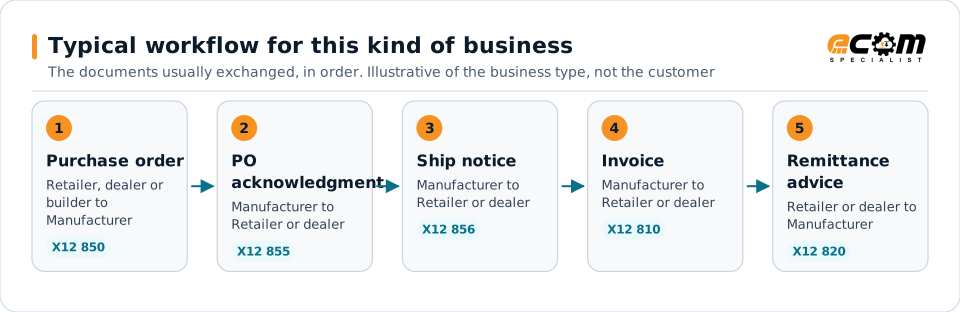
The documents typically exchanged in this kind of business, in the order they usually move. Partners vary, and some connect by API instead of EDI. The shaded line under a step shows where ECOM’s services act.
Steps are listed in the order the documents usually move, with who sends each one. Running alongside every step: Browser exchange.
-
1. Order
Purchase orderX12 850
Retailer, dealer or builder Manufacturer
Orders arrive in each channel’s own way.
ECOM operates the EDI exchange with the customer’s trading partners.
-
2. Confirm
Order acknowledgmentX12 855
Manufacturer Retailer or dealer
Confirms the orders.
-
3. Ship
Advance ship noticeX12 856
Manufacturer Retailer or dealer
Announces the shipment and its delivery.
Where a partner or internal system sends or receives this document by API instead of EDI, PRISM-API Gateway carries the same data.
-
4. Invoice
InvoiceX12 810
Manufacturer Retailer or dealer
Bills the delivered order.
-
5. Get paid
Remittance adviceX12 820
Retailer or dealer Manufacturer
Settlements are reconciled against invoices.
PRISM Reconcile360 matches this remittance advice with the bank deposit and the open invoices, and flags differences for review.
Running alongside every step
These support the exchange throughout. They are alternative routes and controls, not steps that happen after payment.
-
Dealers without EDI
Browser exchange
Regional dealers Manufacturer
Dealers send orders by browser.
PRISM-WebEDI lets trading partners without an EDI system exchange transactions through a browser.
ECOM’s role
Operational needs and ECOM’s role
What this kind of exchange needs, and what ECOM does about it within the agreed scope.
Exception handling
When something goes wrong
-
A delivery changes
A delivery or installation date moves.
The change is exchanged with the retailer or dealer as part of the same process.
-
A settlement is short
A payment does not match invoices.
It goes to review.
Business value
Confirmed scope and intended benefits
Confirmed
- ECOM operates EDI and provides the API Gateway, WebEDI and Reconcile360.
- The customer sells through national retailers, regional dealers and builder channels.
Intended benefits
- Large retailers and smaller dealers served through one managed process.
- Internal and external integrations following one pattern.
- Settlement differences reviewed with the records side by side.
Systems typically involved
- Retailer systemsSend orders and receive notices and invoices.
- Dealer browsersUsed by dealers without EDI.
- Order, shipping and finance systemsSource of order, delivery and invoice data.
Lessons for similar enterprises
What other organizations can take from this
Plan for delivery events
For large goods, scheduling and delivery status are part of the order.
Serve partners as they are
EDI for retailers and a browser route for dealers can run in one process.
Reconcile deductions with delivery records
Damage and shortage claims are easier to resolve when the evidence is in one place.