
Resources · Japanese EDI
The CII standard for Japanese EDI
CII is the Japanese cross-industry EDI standard, defined as a set of syntax rules plus a standard message set for each industry. Japanese trading partners in electronics, automotive, steel, construction and other industries use it. This page lists the syntax rule versions, the industry message sets and the mapping to XML.
- Standardized as
- JIS X 7012-1, -2, -3 (1999)
- Syntax rule versions
- 1.10, 1.11, 1.51, 2.10, 3.00
- Industry message sets
- 19 listed industries
- Maintained by
- JIPDEC
- Entries listed
- 31
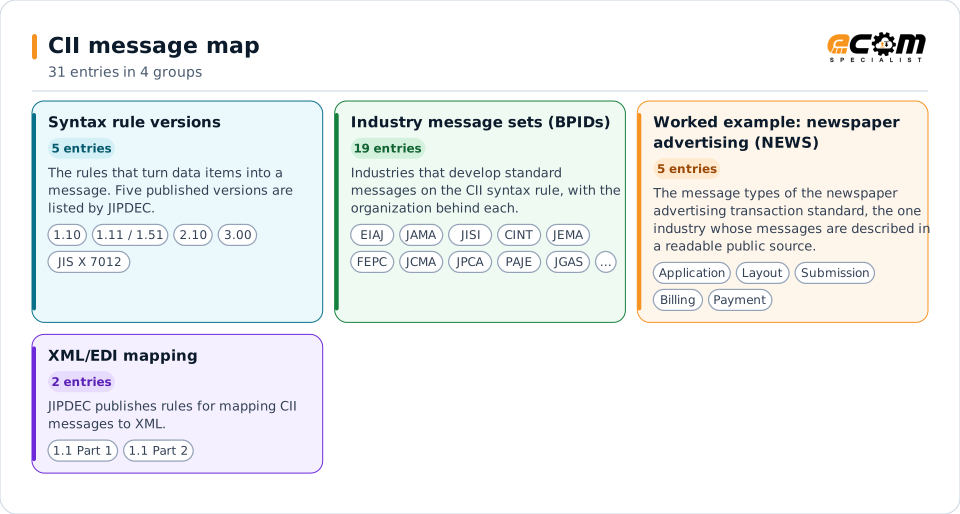
Each colored card is a part of CII: the syntax rule versions, the industries that define messages, a worked example and the XML mapping.
Overview
What CII is
CII was developed by the Center for the Informatization of Industry. The CII syntax rule, which defines how data items are assembled into messages, was set as a national standard in 1992 and became the Japanese Industrial Standard JIS X 7012 (parts 1, 2 and 3) in April 1999. The center was dissolved on March 31, 2000, and its work passed to the Electronic Commerce Promotion Center of JIPDEC.
A CII message has two ingredients. The syntax rule says how to build a message. The standard message, written by an industry body, says which data items a document such as an order or an invoice contains. Each industry has a four-letter Business Protocol ID (BPID), for example EIAJ for the electronics industry, and registers the numbers of its data tags with JIPDEC.
ECOM's B2B gateway reads and writes CII messages by applying the syntax rule and the industry's published message definitions, so a Japanese customer can be connected without a separate Japanese EDI tool.
Suppliers to Japanese manufacturers
Exchange orders, delivery information, invoices and payment notices in the format the customer's industry defined.
Japanese subsidiaries and partners abroad
Connect a Japanese parent's CII messages to a local ERP or to X12 and EDIFACT partners.
Industry networks
Take part in the message sets of industries such as construction (CI-NET), steel, electric power or newspapers.
Syntax rule versions
The rules that turn data items into a message. Five published versions are listed by JIPDEC.
| Item | Name | What it is | Notes |
|---|---|---|---|
| 1.10 | CII syntax rule version 1.10 | The early published syntax rule. | |
| 1.11 / 1.51 | CII syntax rule versions 1.11 and 1.51 | Published together in one document. | |
| 2.10 | CII syntax rule version 2.10 | Second-generation syntax rule. | |
| 3.00 | CII syntax rule version 3.00 | Current syntax rule; its logical record types are defined in JIS X 7012-1, -2 and -3. | |
| JIS X 7012 | JIS X 7012-1, -2, -3 | The Japanese Industrial Standard of the CII syntax rule, April 1999. | Commentary published by JIPDEC |
Industry message sets (BPIDs)
Industries that develop standard messages on the CII syntax rule, with the organization behind each.
| Item | Name | What it is | Notes |
|---|---|---|---|
| EIAJ | Electronics | JEITA EC Center. | |
| JAMA | Automotive | Japan Automobile Manufacturers Association. | |
| JISI | Steel | Japan Iron and Steel Federation. | |
| CINT | Construction (CI-NET) | Construction industry information center of the Foundation for Promoting Construction Industry. | |
| JEMA | Heavy electrical | Japan Electrical Manufacturers' Association. | |
| FEPC | Electric power | Federation of Electric Power Companies. | |
| JCMA | Electric wire | Japan Electric Cable Manufacturers Association. | |
| JPCA | Petrochemical | Japan Petrochemical Industry Association. | |
| PAJE | Petroleum | Petroleum Association of Japan. | |
| JGAS | Gas | Japan Gas Association. | |
| JALF | Aluminium | Japan Aluminium Association. | |
| SJAC | Aerospace | Society of Japanese Aerospace Companies. | |
| HIIS | Housing | Housing industry training foundation. | |
| JDIY | Home centre | Japan Do-It-Yourself Industry Association. | |
| TFCA | Telecommunications | Telecommunications Association. | |
| NEWS | Newspapers | Japan Newspaper Association. | |
| WAVE | Advertising | Japan Advertising Agencies Association. | |
| TRPT | Logistics EDI | Logistics EDI promotion organization. | |
| JTRN | Domestic logistics standard | JILS and the logistics EDI center. |
Worked example: newspaper advertising (NEWS)
The message types of the newspaper advertising transaction standard, the one industry whose messages are described in a readable public source.
| Item | Name | What it is | Notes |
|---|---|---|---|
| Application | New, change, cancel, acceptance confirmation | The order side: place, change or cancel an advertising application, and confirm acceptance (OK or NG). | |
| Layout | Layout (allocation) information | Where the advertisement is placed. | |
| Submission | Application check, submission, schedule, manuscript receipt | Delivery of the advertising material and its receipt. | |
| Billing | Invoice, schedule, amendment, total, correction, correction approval | The invoice side, including corrections and their approval (OK, NG or hold). | |
| Payment | Scheduled payment total and detail, payment notice | The payment side. |
XML/EDI mapping
JIPDEC publishes rules for mapping CII messages to XML.
| Item | Name | What it is | Notes |
|---|---|---|---|
| 1.1 Part 1 | CII standard-based XML/EDI mapping rule 1.1, part 1 | Mapping of CII messages to XML. | |
| 1.1 Part 2 | CII standard-based XML/EDI mapping rule 1.1, part 2 | Simplified messages. |
Structure
Syntax rule, standard message and BPID
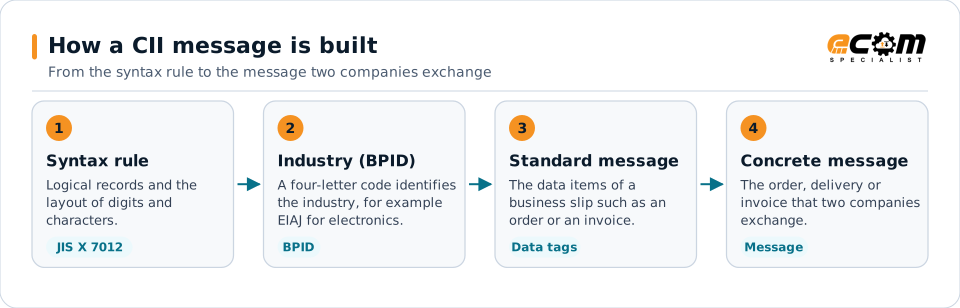
The syntax rule defines logical records and how digits and characters are arranged. A standard message is the set of data items that matches a business slip, such as the order date, the receiver and the sender. Used together, the syntax rule and the standard message produce the concrete messages two companies exchange.
Each data item has a data tag number that identifies its meaning and attributes. An industry applies to JIPDEC for a block of numbers; for example the newspaper standard holds 40,000 to 40,999 and defines 40,001 to 40,182 in its version 1.3.
The syntax rule says how to build a message. The industry's BPID and data tags say what the data items mean. The standard message lists the data items of a business slip. Together they produce the message.
Versions
Versions
The syntax rule has been published in several versions, and each industry versions its own standard messages.
| Item | Detail |
|---|---|
| Syntax rule | 1.10; 1.11 and 1.51; 2.10; 3.00 |
| JIS X 7012 | Parts 1, 2 and 3, April 1999 (syntax rule 3.00 defines the logical records) |
| XML/EDI mapping rule | Version 1.1, parts 1 and 2 |
| Industry messages | Versioned by each industry, for example the newspaper standard message collection versions 1.1, 1.2 and 1.3 |
ECOM B2B Gateway
How ECOM handles CII
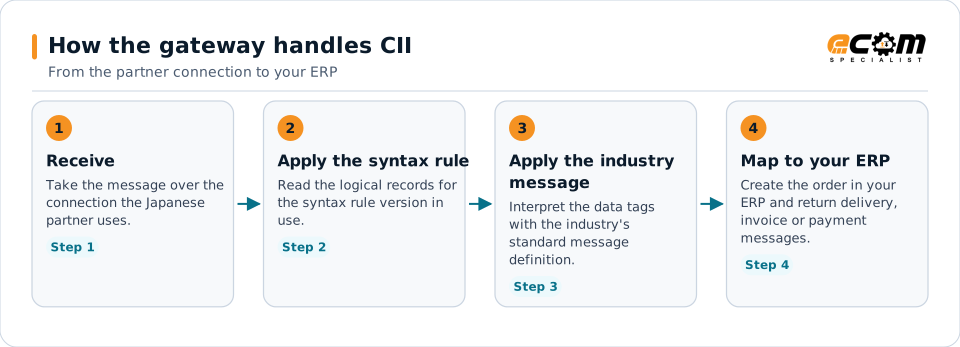
The gateway applies the CII syntax rule and the industry's message definition, so a CII order or invoice reaches your ERP like any other document.
- 1
Receive
Take the message over the connection the Japanese partner uses.
- 2
Apply the syntax rule
Read the logical records for the syntax rule version in use.
- 3
Apply the industry message
Interpret the data tags with the industry's standard message definition.
- 4
Map to your ERP
Create the order in your ERP and return delivery, invoice or payment messages.
The gateway applies the CII syntax rule and the industry's message definition, so a CII order or invoice reaches your ERP like any other document.
Good to know
What this page does and does not cover
- The CII syntax rule documents and the industry message catalogs are published by JIPDEC and the industry bodies, mostly in Japanese. They were not readable as text when this page was prepared, so only the syntax rule versions, the industry list and the newspaper advertising message types are listed here.
- For every other industry, ECOM loads the industry's published standard message definitions and confirms the version with the partner during scoping.
- Version dates for the individual syntax rules are not shown on JIPDEC's index pages, so none are given here.
Sources, read November 3, 2026
Frequently asked questions
What does CII stand for?
The Center for the Informatization of Industry, the Japanese body that developed the standard. It was dissolved in 2000 and its work passed to the Electronic Commerce Promotion Center of JIPDEC.
What is a BPID?
A Business Protocol ID, a four-letter code that identifies an industry's standard message set, such as EIAJ for electronics and NEWS for newspaper advertising. JIPDEC manages them.
Which CII syntax rule version do I need?
The one your Japanese partner uses. JIPDEC lists versions 1.10, 1.11 and 1.51, 2.10 and 3.00. ECOM confirms the version and the industry message set with your partner during scoping.
Can CII messages be converted to XML or X12?
Yes. The gateway maps CII to your ERP format, to X12, EDIFACT or XML, and JIPDEC also publishes its own CII-to-XML mapping rule.
Connect a CII partner
Tell us which CII messages and versions your partner requires. An ECOM specialist confirms the connection, the map and the test plan.