
Industrial manufacturing
Industrial Manufacturing EDI and API Integration for Distributors, OEMs and Quotes
Integration for complex industrial supply chains
Industrial manufacturers sell through distributors and directly to OEMs, while sourcing from global suppliers. ECOM connects those relationships to your ERP, from quotes and orders to schedules, shipments and invoices.
At a glance
Key documents
- 840 Requests for Quotation
- 843 Quotation Responses
- 850 Purchase Orders
- 855 Order Acknowledgments
- 830 Planning Schedules and Forecasts
- 856 Ship Notices (ASN)
- 810 Invoices
Systems we integrate
- Manufacturing ERP
- Quoting and configuration tools
- Distributor and customer portals
- Shipping and label systems
- Who we help
- Industrial equipment, component and materials manufacturers, and their sales operations, planning and IT teams.
- What we connect
- Your ERP to distributor and OEM orders, schedules, quotes, ship notices and invoices, and to your own suppliers.
- Problems we solve
- Order changes applied to the wrong revision, catalogs that differ at every distributor, and schedules and labels that must match each customer.
- Even without EDI
- Not every distributor or supplier uses EDI. ECOM works with portals, files, email and PDF as well, and brings them into the same flow.
What is industrial manufacturing EDI?
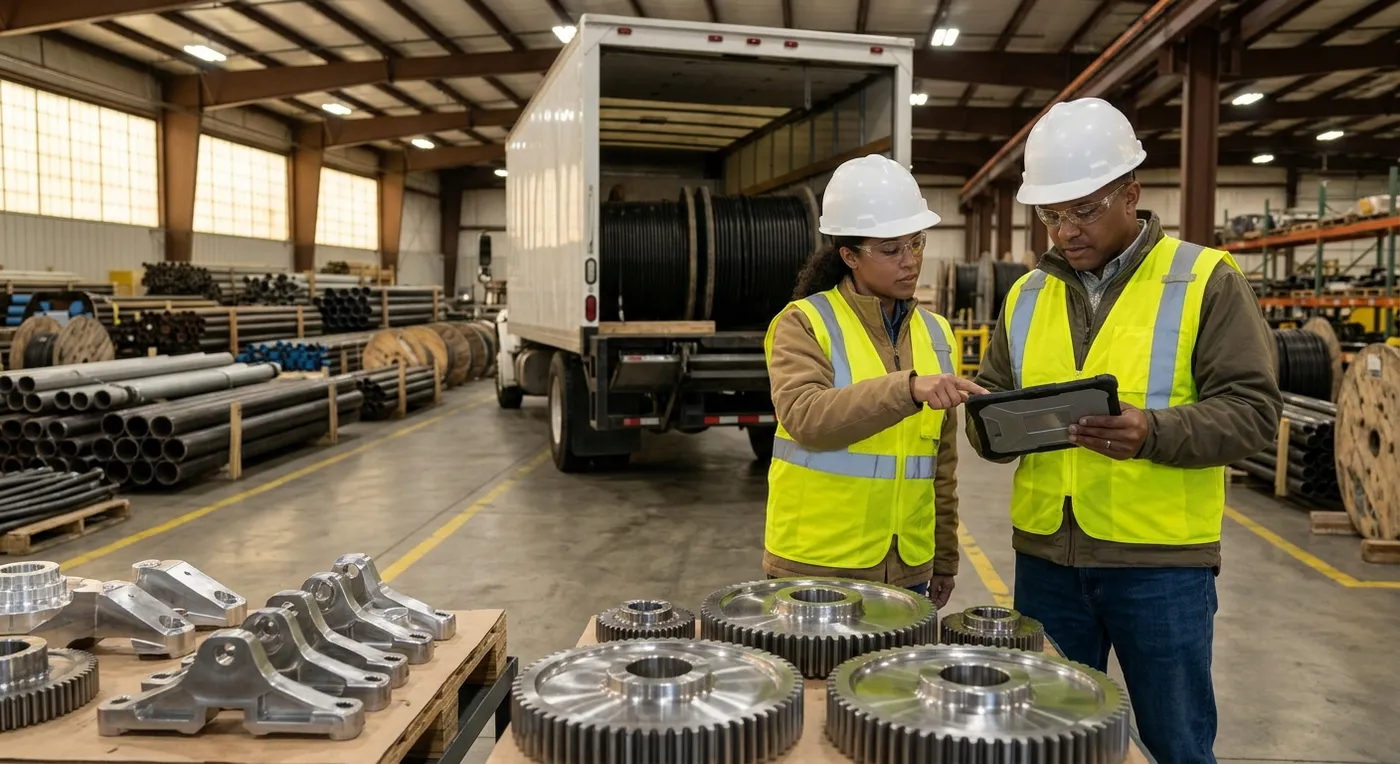
Industrial manufacturing EDI covers transactions with distributors, OEM customers and suppliers of industrial equipment, components and materials. Beyond orders, ship notices and invoices, it can include price catalogs for distributors, planning schedules for OEM programs, and quote requests and responses for configured or engineered products.
Who you connect with
Who an industrial manufacturer exchanges data with
You sit between your suppliers and a mix of distributors and OEM customers.
-
Distributors and dealers
Catalogs, orders, status
EDI, portals -
OEM customers
Schedules, ship notices
X12 EDI -
Material suppliers
POs, ship notices
EDI and files -
Carriers
Shipments, tracking
EDI and APIs -
Quoting customers
RFQs, quotes
EDI and email
How you sell
Distributor sales, OEM supply, configured products and global sourcing each need their own flow
Industrial manufacturers rarely fit one pattern. These are the ones we see most.
-
Selling through distributors
Manufacturers whose products reach plants and contractors through distributors.
- How it runs
- You publish catalogs and prices, receive distributor orders, ship direct or to the distributor, and report on resale where programs require it.
- Documents
- Systems
- ERP, catalog data, distributor portals.
- Typical problem
- Each distributor has its own item numbers and update schedule.
-
Supplying OEM programs
Component and subassembly suppliers with OEM customers that release by schedule.
- How it runs
- Planning schedules set forecasts and shipping schedules set releases. Ship notices and labels follow each customer’s rules.
- Documents
- Systems
- ERP, planning, shipping and label systems.
- Typical problem
- Schedule changes arrive often, so planners need the difference, not the whole file.
-
Engineered and configured products
Makers of equipment built to a specification.
- How it runs
- A request for quote and a quote come first. The purchase order then references the quote and changes follow as the specification is refined.
- Systems
- Quoting or configuration tool, ERP.
- Typical problem
- The order must be checked against the quote, and changes applied to the right revision.
-
Global supplier base
Manufacturers buying from suppliers in several regions.
- How it runs
- Orders and schedules go to suppliers by EDI, portal or file, and ship notices come back in the supplier’s format.
- Systems
- ERP, supplier portals, EDIFACT and X12 translation.
- Typical problem
- Suppliers use different standards and releases.
How to read this page: a standard or system named here shows where a requirement is published or what ECOM can connect. It does not mean ECOM has a verified partnership with any named company, and your own contracts and partners define the final requirements.
Manufacturing specialties
Specialty pages in this area
This page gives the overview. Each specialty below covers its own products, trading partners and documents. See the full manufacturing directory for every sector.
Metals, Machinery and Industrial Equipment
- Steel, Aluminum and Primary Metal
- Foundry, Casting, Forging and Fabricated Metal
- Tool, Fastener and Hardware
- Industrial Machinery and Robotics
- Pump, Compressor and Fluid Handling Equipment
- Conveyor, Forklift and Material Handling Equipment
- Agricultural Machinery and Irrigation Equipment
- Construction, Mining and Heavy Equipment
- Electric Motor, Drive and Motion Control
- Industrial Control and Test Equipment
- Food and Beverage Processing Machinery
- Packaging Machinery
- Machine Tool and Metalworking Equipment
- Bearing, Gear and Power Transmission
- Industrial Ceramic and Refractory
- Abrasive and Cutting Product
Who it's for
Different roles, different workflows
-
Manufacturers selling through distributors
Distributors need catalogs, prices and availability, and send orders in their own formats. The manufacturer confirms, ships and reports back.
-
Suppliers to OEM programs
OEM customers send planning schedules and shipping schedules for the parts you build. Your ship notices and labels have to match their receiving rules.
-
Engineered and configured-product makers
Quotes, specifications and order changes move between you and the customer before a standard order exists, and the order that follows must match the quote.
How the workflow runs
From quote to invoice for engineered and made-to-order products
A made-to-order sale starts earlier than a standard order. The quote, the order, the changes and the shipment all have to agree.
- Customer or distributor→Manufacturer 840 Request for quotation Specification, quantity, date.
- Manufacturer→Customer or distributor 843 Quote Price, lead time and terms.
- Customer or distributor→Manufacturer 850 Purchase order References the quote.
- Manufacturer→Material supplier 850 Material order Raw materials and components.
- Customer or distributor→Manufacturer 830 Planning schedule Forecast for recurring programs.
- Manufacturer→Customer or distributor 856 Ship notice Packing and shipment details.
- Manufacturer→Customer or distributor 810 Invoice Billed against the order.
- 01
Quote with the right data
Requests for quote and responses carry the specification and price so the order that follows can be checked against them.
- 02
Order, then change
Purchase orders and later changes are applied to the right order and revision, not to the wrong one.
- 03
Plan from schedules
Planning schedules update forecasts. Differences between schedule versions are shown to planners.
- 04
Ship with the customer’s labels
Ship notices and labels follow the customer’s receiving rules. A mismatch holds the shipment at the dock.
- 05
Invoice and reconcile
The invoice matches the order revision, and any difference is returned for correction.
Beyond EDI
Every way industrial orders, schedules and quotes arrive
ECOM receives each source and prepares the same validated order, schedule or quote for your ERP.
How it arrives
- EDI850, 830, 840, 856, 810
- PortalDistributor and OEM portals
- XMLcXML and procurement files
- Flat fileAgreed order and schedule files
- SpreadsheetQuote and price sheets
- PDF or emailEmailed orders and quotes
ECOM
- Validate every file or message
- Map to each partner's rules
- Deliver, acknowledge and monitor
Where it goes
- ERP orders
- Production plans
- Ship notices
- Invoices out
Challenges
Integration challenges in industrial manufacturing
Distributor channel data
Distributors need accurate catalogs, prices and availability.
Long and variable lead times
Order changes and schedule updates must reach planning quickly.
Global supplier base
Suppliers use X12, EDIFACT, portals and email.
How we help
How ECOM supports industrial manufacturing companies
-
Distributor integration
Orders, acknowledgments, ship notices, invoices and 832 catalogs.
-
OEM schedules
Planning and shipping schedules integrated with ERP.
-
Quotes
Exchange 840 requests for quotation and 843 responses where partners use them.
-
Supplier connectivity
X12, EDIFACT, portal and document-based suppliers in one flow.
-
ERP integration
Connect Epicor, Infor, QAD, SAP, SAP Business One, Oracle, Sage and other manufacturing ERPs.
Systems integration
The systems an industrial manufacturer connects
Industrial manufacturers often run a long-lived ERP, a quoting or configuration tool and separate shop-floor systems.
From
- Distributor orders
- OEM schedules
- Quote requests
- Supplier files
ECOM · Industrial exchange
- Validate each document
- Map per partner
- Secure delivery
To
- ERP orders
- Production plans
- Ship notices
- Invoices out
Scroll sideways to see every column. With a keyboard, select the table and use the left and right arrow keys.
| System | What flows | What to plan for |
|---|---|---|
| Manufacturing ERP | Orders, schedules, shipments and invoices. | Order revision control matters, because changes arrive after the original order. |
| Quoting and configuration tools | Requests for quote in, quotes out, and the order matched back to them. | The quote reference is carried through so the order and quote can be compared. |
| Distributor and customer portals | Orders, status and catalogs. | Not every partner uses EDI, so portal and file formats are mapped too. |
| Shipping and label systems | Ship notices, labels and carrier data. | Labels and ship notices must carry the same identifiers. |
Industrial, manufacturing and automotive
How this page differs from the manufacturing and automotive pages
The three pages overlap, but the problems are different enough to separate.
-
Manufacturing
The umbrella page for manufacturers and its sector pages, covering plants, suppliers and customers.
Manufacturing in detail -
Industrial manufacturing
This page: distributor catalogs and orders, OEM schedules, and quotes for configured products.
-
Automotive
Stricter, more standardized requirements: just-in-time schedules, returnable containers and labels.
Automotive in detail -
Wholesale distribution
The other side of the distributor relationship: how distributors handle orders from you and their customers.
Wholesale distribution in detail
Documents and standards
Common transactions
Common X12 documents in industrial manufacturing.
Scroll sideways to see every column. With a keyboard, select the table and use the left and right arrow keys.
| Code | Document | What it does |
|---|---|---|
| 840 | Requests for Quotation | The customer requests a quote. |
| 843 | Quotation ResponsesX12 name: Response to Request for Quotation | The supplier returns a quote. |
| 850 | Purchase Orders | Orders equipment or parts. |
| 855 | Order AcknowledgmentsX12 name: Purchase Order Acknowledgment | Confirms the order. |
| 830 | Planning Schedules and ForecastsX12 name: Planning Schedule | Shares forecasts for programs. |
| 856 | Ship Notices (ASN)X12 name: Advance Ship Notice | Describes shipments. |
| 810 | Invoices | Bills for goods. |
Scenarios
Typical integration scenarios
Manufacturers selling through distributors
Keep distributor catalogs and orders in sync.
Component suppliers to OEMs
Integrate OEM schedules and shipping requirements.
Trading partners
Industrial Manufacturing partners we connect with
Examples of manufacturing trading partners ECOM can connect your business with.










Logos are trademarks of their respective owners. Their display does not imply endorsement of ECOM Specialist.
Case studies
Where ECOM provides these services today
Anonymous profiles of ECOM customers in this industry, each showing the services ECOM provides and how the work is set up.
Automotive components supplier
Managing a very large EDI network across plants and ERP instances at a global automotive supplier
Managed EDI operations for a global automotive components manufacturer across multiple QAD instances and new real-time OEM requirements.
EDI operations · API Gateway · WebEDI · Supplier Portal (PRISM-WebEDI) · Self-Service Onboarding · Reconcile360
Read the profileElectronic components manufacturer
Handling forecast changes, orders and many small payments for a global components maker
Forecast and order-change EDI, browser access and cash matching for a components maker serving equipment makers and distributors.
EDI operations · API Gateway · WebEDI · Reconcile360
Read the profile
Frequently asked questions
How is industrial manufacturing EDI different from automotive EDI?
Both use schedules and ship notices, but automotive requirements are typically stricter and more standardized, while industrial manufacturers often deal with more distributor and catalog data.
Can you integrate with Epicor or Infor?
Yes. ECOM integrates with ERPs common in industrial manufacturing, including Epicor and Infor, using APIs, files or connectors.
Do you support quote documents?
Yes, where partners exchange 840 and 843 documents, they can be integrated with your ERP or quoting system.
How should planning schedule changes be handled?
Compare the new schedule with the previous one, show planners the differences and keep history. Whether a schedule is a forecast or a commitment depends on the customer’s agreement, not on the document alone.
How do quotes connect to the order that follows?
Carry the customer’s quote reference on the order, then compare price, quantity and terms with the quote before the order enters the ERP.
Do distributors all want the same catalog format?
No. Each distributor sets its own item identifiers, fields and update schedule. A catalog is mapped per distributor from one maintained source.
What if a supplier does not support EDI?
Many suppliers use portals, spreadsheets or email. ECOM can bring those into the same order flow, and a supplier can often use a browser-based option instead of building EDI.
How to get started
Tell us who you trade with and what you run
- Send the basics. Your trading partners, the documents they require, your ERP or other systems, and any deadline.
- We review the requirements. An ECOM specialist looks at the partner programs, document formats and connections involved.
- You decide how to proceed. We outline the options, including managed services or software, for you to compare.
Helpful to share, but not required
You do not need an implementation guide or a finished requirements list to contact us. If you have these, they speed things up:
- Whether you sell mainly through distributors, to OEMs or both.
- Your ERP and quoting tools.
- A distributor or OEM requirement you must meet, if you have it.
- Your key suppliers and their formats.
See how ECOM works with customers: case studies ERP integrations compare delivery options (software, managed or team-based)
Talk to an EDI/API expert
Tell us about your partners, systems and goals. We will show you how PRISM and our team can help.