Executive summary
The situation and ECOM’s role
A global automotive components manufacturer, with a large footprint of plants across several regions, ran its business on multiple QAD instances. Its EDI environment was exceptionally large, with a very large number of trading partners and EDI maps spread across customers, suppliers, logistics providers and plant systems.
The company had strong EDI requirements but could not keep a stable internal EDI team. Staff turnover was persistent, and each departure meant another round of knowledge transfer across many maps and several ERP instances. At the same time, vehicle makers began asking for real-time information, including inventory availability and how quickly parts could be supplied.
ECOM provides managed EDI operations, the API Gateway, WebEDI, a Supplier Portal, Self-Service Onboarding and Reconcile360.
At enterprise scale, EDI is not simply a technical integration function. It is part of the manufacturing operating model.
Customer environment
- Industry
- Global automotive components manufacturing.
- ERP
- QAD, in multiple instances across different regions and operating environments.
- Trading partners
- A very large number, including vehicle makers, suppliers and logistics providers.
- EDI maps
- A very large inventory.
- Footprint
- Plants across North America, Europe and Asia.
- New requirement
- Real-time inventory availability and part-supply information requested by vehicle makers.
About this profile: the customer is not named and details are generalized. What is stated about the customer comes from ECOM; text marked “industry context” describes how this kind of business typically works. No volumes, timelines, figures, quotes or measured results are published.
The challenge
Complexity that outlasts the people who understand it
Automotive EDI is demanding even for a single plant. Each vehicle maker defines its own release schedules, shipping notices, labeling and invoicing rules, and failures carry real penalties. Multiply that by many plants, several QAD instances and a very large partner base and the environment becomes a governance problem as much as a technical one.
A very large map inventory cannot be maintained consistently without shared standards for how maps are built, tested, named and changed. Without them, each plant or developer solves the same problem differently, and the cost shows up whenever someone new must understand the work of someone who left.
That is what persistent turnover produces: knowledge never accumulates, and recruiting people skilled in both EDI and automotive requirements is slow and competitive.
Then the requirements changed. Vehicle makers asked for real-time inventory availability and for how quickly parts could be made available. A batch EDI exchange cannot answer that. It needs an API connection to the plant and ERP data, built in a way that stays consistent across instances.
Why ECOM
Operational accountability, not another mapping tool
Adding a mapping tool does not fix turnover. The risk is that a very large map inventory depends on a rotating team. ECOM takes operational accountability for the EDI environment: consistent mapping practices, structured trading-partner management and a team that carries knowledge forward.
The API Gateway connects real-time customer requests to enterprise applications and operational data, so inventory and supply-speed questions are answered through the same integration approach as the rest of the environment.
Because several QAD instances and many plants must work together, an integrated approach matters more than any single connection. The scope also covers supplier access, partner setup and cash matching (listed below).
Industry context
Automotive components supplier
An automotive components supplier delivers parts to vehicle makers on tight schedules. The customer sets the rules: how releases arrive, how shipments are announced, how parts are labeled and how invoices are formed. A late or wrong document is not an administrative slip, because it can disrupt a customer’s line and carry a penalty.
Customer-defined rules
Each vehicle maker has its own requirements for release schedules, advance ship notices, labels and invoices.
Penalties for misses
Late or incorrect shipping documents can lead to chargebacks or other penalties under the customer’s terms.
A supply base of its own
The supplier buys materials and services from its own suppliers and needs a straightforward way to exchange documents with them.
Where it goes wrong
Typical problems in this kind of exchange
-
Documents that must be right the first time
Customer requirements are specific and change.
A late or wrong ship notice can lead to penalties and a difficult conversation.
-
The exchange depends on a few specialists
Each customer’s rules are learned, not documented.
Change or absence puts compliance at risk.
-
Suppliers send documents their own way
Smaller suppliers lack EDI.
Inbound documents are slower to process and easier to get wrong.
-
Deductions are hard to reconcile
Remittance and deductions arrive apart from the shipments they relate to.
Finance has to reconstruct what was shipped and billed to challenge a deduction.
What ECOM provides
The confirmed scope of services
-
EDI operations
ECOM runs the EDI exchange with the customer’s trading partners.
About EDI operations -
API Gateway
PRISM-API Gateway carries the integrations between the customer’s own applications and with outside parties, so internal and external connections follow one pattern.
About API Gateway -
WebEDI
PRISM-WebEDI lets trading partners without an EDI system exchange transactions through a browser.
About WebEDI -
Supplier Portal (PRISM-WebEDI)
The Supplier Portal, part of PRISM-WebEDI, lets suppliers without EDI work through procure-to-pay transactions in a browser.
About Supplier Portal (PRISM-WebEDI) -
Self-Service Onboarding
Self-service onboarding lets new trading partners register and be set up without a long coordination cycle. It is distinct from EDI testing and certification (SmartCert).
About Self-Service Onboarding -
Reconcile360
PRISM Reconcile360 matches remittance advice, bank deposits and open invoices, and flags differences for review.
About Reconcile360
What ECOM is responsible for
- ECOM runs the company’s EDI operations with consistent mapping practices, structured trading-partner management and operational accountability.
- The API Gateway connects real-time customer requests, such as inventory availability, with enterprise applications and operational data.
- WebEDI and its Supplier Portal give suppliers without EDI a straightforward browser route through procure-to-pay.
- Self-Service Onboarding lets new partners register and be set up without a long coordination cycle, separate from EDI testing and certification.
- Reconcile360 matches customer remittance, deposits and invoices and flags differences for review.
Technical and operational detail
Governing a very large map inventory across plants and ERP instances
Industry context: automotive customers communicate through demand documents that change constantly. In X12 these are typically the 830 planning schedule and 862 shipping schedule, followed by the 856 advance ship notice with label data and the 810 invoice. European customers often use EDIFACT or industry-specific messages for the same purposes. A supplier has to respond within defined windows, ship against the latest schedule and send notices that match the labels on the parts.
Multiply that by many plants and several QAD instances and the question becomes governance. Who owns a map? What naming and versioning convention does it follow? How is a change tested before a production plant depends on it? How does a map built for one plant’s configuration behave in another instance? Without answers, each plant develops its own variations, and the cost appears when someone has to work out why two maps for the same customer behave differently.
In practice, governance means shared standards for how maps are built and documented, a defined change and test process, a current inventory of partners and maps, and monitoring that detects a failed document early. The confirmed scope is ECOM’s managed EDI operations for this customer. A team that works under one set of standards is designed not to lose its knowledge each time one person leaves.
Answering real-time inventory and supply-speed requests
Industry context: a batch schedule tells a supplier what the vehicle maker expects to need. Increasingly, vehicle makers also ask direct questions such as how many of a part are available now, or how quickly more could be supplied. Those questions are answered best by a live request to the supplier’s systems rather than by a file exchanged later.
That requires an integration layer that can reach inventory and production-capacity data in each ERP instance and return a consistent answer, with security controls and an audit trail. If each instance is connected differently, the same question can have different answers depending on which plant is asked. The confirmed approach is to carry these requests through the API Gateway, alongside the managed EDI operation, so the real-time and batch channels follow the same operating model.
WebEDI and its Supplier Portal extend the same approach to suppliers without EDI, and Self-Service Onboarding lets new partners register and be set up, and Reconcile360 matches customer remittance, deposits and invoices.
Architecture
Where the integration sits
Manufacturer environment
- Multiple QAD instances
- Plants in North America, Europe and Asia
- Inventory and supply data
ECOM responsibilities
- Managed EDI operations
- API Gateway for real-time requests
- WebEDI, Supplier Portal, Self-Service Onboarding
- Reconcile360
Partners
- Vehicle makers (EDI and real-time requests)
- Suppliers
- Logistics providers
Educational diagram of this kind of environment, not the customer’s own architecture.
Running a similar exchange? Tell us your partners, systems and where the delays are, and a specialist will suggest where to start.
Talk to an EDI/API ExpertThe workflow
How the work flows
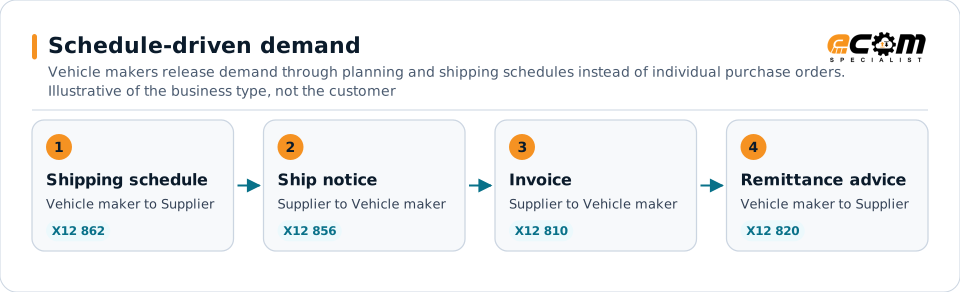
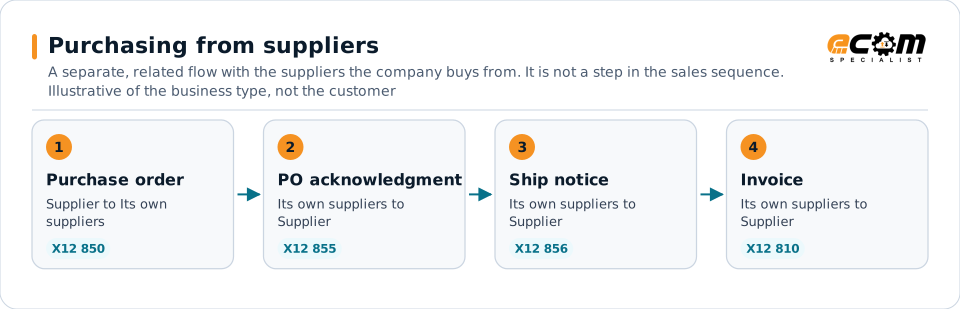
The documents typically exchanged in this kind of business, in the order they usually move. Partners vary, and some connect by API instead of EDI. The shaded line under a step shows where ECOM’s services act.
Steps are listed in the order the documents usually move, with who sends each one.
Steps are listed in the order the documents usually move, with who sends each one.
Schedule-driven demand
Vehicle makers release demand through planning and shipping schedules instead of individual purchase orders.
-
1. Release
Shipping scheduleX12 862
Vehicle maker Supplier
Releases set what to ship and when.
ECOM operates the EDI exchange with the customer’s trading partners.
-
2. Ship notice
Advance ship noticeX12 856
Supplier Vehicle maker
Announces the shipment before it arrives, in the customer’s required form.
Where a partner or internal system sends or receives this document by API instead of EDI, PRISM-API Gateway carries the same data.
-
3. Invoice
InvoiceX12 810
Supplier Vehicle maker
Bills against the releases and shipments.
-
4. Get paid
Remittance adviceX12 820
Vehicle maker Supplier
Remittance detail is tied back to shipments and invoices; deductions are handled separately.
PRISM Reconcile360 matches this remittance advice with the bank deposit and the open invoices, and flags differences for review.
Purchasing from suppliers
A separate, related flow with the suppliers the company buys from. It is not a step in the sales sequence.
-
1. Order
Purchase orderX12 850
Supplier Its own suppliers
Material and service suppliers connect by browser or EDI.
A partner without an EDI system can send or receive this document through PRISM-WebEDI in a browser.
-
2. Confirm
Order acknowledgmentX12 855
Its own suppliers Supplier
Suppliers confirm what they will deliver and when.
-
3. Ship notice
Advance ship noticeX12 856
Its own suppliers Supplier
Suppliers announce inbound shipments so receiving can plan.
-
4. Invoice
Supplier invoiceX12 810
Its own suppliers Supplier
Suppliers bill against orders and receipts.
ECOM’s role
Operational needs and ECOM’s role
What this kind of exchange needs, and what ECOM does about it within the agreed scope.
Exception handling
When something goes wrong
-
A customer changes a requirement
A vehicle maker updates a document rule.
The team that runs the exchange makes and tests the change.
-
A supplier cannot do EDI
A supplier has no EDI system.
It uses the browser route and the portal.
-
A deduction is questioned
A remittance shows a deduction.
It is flagged for finance to review against the shipment and invoice.
Business value
Confirmed scope and intended benefits
Confirmed
- ECOM is responsible for managed EDI operations.
- ECOM provides the API Gateway, WebEDI, a Supplier Portal, Self-Service Onboarding and Reconcile360.
Intended benefits
- Consistent mapping and partner management across plants and ERP instances.
- Knowledge held by a team, not by individuals who may leave.
- Real-time requests answered through a managed interface.
- Suppliers connected through a standard route.
- Finance reviewing exceptions instead of matching every payment by hand.
Systems typically involved
- Vehicle makers’ systemsSend releases, receive ship notices and invoices, and send remittance.
- Plant, shipping and ERP systemsSource of production, shipment and billing data.
- Suppliers’ systems or browsersSend and receive documents for material and services.
Lessons for similar enterprises
What other organizations can take from this
Treat EDI as part of the operating model
Releases, ship notices and invoices are how a plant gets paid. They need owners, standards and continuity.
Standardize how maps are built
Large map inventories are manageable when they follow common practices. They are a liability when each one is unique.
Plan around turnover
If skilled staff turn over, design the operation so knowledge stays when they leave.
Prepare for OEM API requests
Real-time inventory and supply questions are growing. Build an integration layer that can answer them consistently across instances.