Executive summary
The situation and ECOM’s role
A global tire manufacturer running SAP needed more than traditional EDI. It exchanged orders, shipments, invoices and payments with many trading partners across tire retail channels and vehicle-maker supply chains. It also had partners who needed real-time answers about inventory availability and pricing, which scheduled batch EDI cannot provide.
ECOM took on the company’s EDI operations and provides the API Gateway, WebEDI, a Supplier Portal, Self-Service Onboarding and Reconcile360. The existing EDI environment moved to ECOM’s cloud in a lift-and-shift.
One integration strategy can serve both ends of the partner spectrum, from large vehicle makers and retailers that require EDI to smaller partners that need a browser, and SAP EDI integration increasingly includes real-time APIs.
Manufacturers can no longer assume every trading partner will communicate only through scheduled EDI exchanges.
Customer environment
- Industry
- Global tire manufacturer selling through retail channels and into automotive supply chains.
- ERP
- SAP.
- Trading partners
- Many trading partners, from large vehicle makers and tire retailers to smaller partners.
- Transactions
- Orders, shipments, invoices and payments by EDI, plus real-time requests for inventory availability and pricing.
- Transition
- A lift-and-shift of the existing EDI environment to ECOM’s cloud.
About this profile: the customer is not named and details are generalized. What is stated about the customer comes from ECOM; text marked “industry context” describes how this kind of business typically works. No volumes, timelines, figures, quotes or measured results are published.
The challenge
Two integration models, one set of systems
Traditional EDI is asynchronous and suits the question “what was ordered and what was shipped.” Some questions partners now ask do not fit that rhythm: whether a product is available, and at what price, right now. That answer has to come from the ERP in real time, through an API connection rather than a batch file.
Doing both in-house is difficult. EDI operations require constant partner changes, mapping updates and monitoring. APIs add security, availability and versioning concerns. If each is handled by a separate project, the company ends up with two disconnected integration environments reading from the same ERP.
Why ECOM
One responsible partner for EDI and real-time connectivity
ECOM assumes responsibility for ongoing EDI processing, which relieves the internal team of day-to-day exchange work. It also provides the API Gateway, so real-time inventory and pricing requests are handled under the same integration approach rather than through a separate stack.
Not every partner can or will use EDI. WebEDI gives partners without an EDI system a browser route into the same process. The Supplier Portal, part of PRISM-WebEDI, lets suppliers without EDI work through procure-to-pay in a browser. Self-Service Onboarding lets new partners register and be set up without a long coordination cycle; EDI testing and certification (SmartCert) is a separate capability.
Reconcile360 addresses the money side by matching remittance, deposits and invoices and flagging differences for review.
Industry context
Tire manufacturer and supplier to vehicle makers and dealers
A tire manufacturer sells to vehicle makers, distributors and dealers and buys from a supplier base of very different sizes. Vehicle makers run on schedules and strict document rules, while smaller distributors, dealers and suppliers often cannot run an EDI system at all, yet all of them need to exchange orders, shipments and invoices.
Large and small partners together
Vehicle makers expect EDI. Smaller partners may only be able to use a browser.
Onboarding takes coordination
Setting up and testing a partner usually involves several people over several weeks.
Payments need matching
Customers pay in volume, with deductions and remittance that must be tied back to invoices.
Where it goes wrong
Typical problems in this kind of exchange
-
Partners cannot all do EDI
Smaller distributors, dealers and suppliers lack EDI systems.
They fall back to email and phone, which means re-keying and errors on the manufacturer’s side.
-
Slow partner setup
Each new partner needs setup, testing and coordination.
Setup depends on staff time, so adding partners is slow and the backlog grows.
-
Supplier exchange is informal
Suppliers send documents in whatever way is easiest for them.
Material orders and confirmations are harder to track and verify.
-
Deductions and short payments
Customers pay in batches and take deductions.
Finance matches by hand and can miss items that should be disputed.
What ECOM provides
The confirmed scope of services
-
EDI operations
ECOM runs the EDI exchange with the customer’s trading partners.
About EDI operations -
API Gateway
PRISM-API Gateway carries the integrations between the customer’s own applications and with outside parties, so internal and external connections follow one pattern.
About API Gateway -
WebEDI
PRISM-WebEDI lets trading partners without an EDI system exchange transactions through a browser.
About WebEDI -
Supplier Portal (PRISM-WebEDI)
The Supplier Portal, part of PRISM-WebEDI, lets suppliers without EDI work through procure-to-pay transactions in a browser.
About Supplier Portal (PRISM-WebEDI) -
Self-Service Onboarding
Self-service onboarding lets new trading partners register and be set up without a long coordination cycle. It is distinct from EDI testing and certification (SmartCert).
About Self-Service Onboarding -
Reconcile360
PRISM Reconcile360 matches remittance advice, bank deposits and open invoices, and flags differences for review.
About Reconcile360
What ECOM is responsible for
- ECOM runs the company’s EDI operations, taking responsibility for ongoing processing with its trading partners.
- The API Gateway handles internal and external integrations, including real-time requests for inventory availability and pricing that connect to SAP and related systems.
- WebEDI and its Supplier Portal let smaller partners and suppliers without EDI work through a browser.
- Self-Service Onboarding lets new trading partners register and be set up, separate from EDI testing and certification.
- Reconcile360 matches remittance, deposits and invoices and flags differences for review.
- The existing EDI environment moved to ECOM’s cloud in a lift-and-shift.
Technical and operational detail
How EDI and real-time APIs coexist with SAP
Industry context: SAP exchanges business documents with external translators through intermediate documents (IDocs). A purchase order arrives as an EDI message, is translated to an order IDoc, posts in the ERP and generates a confirmation, and later a delivery and an invoice go back out the same way. The exchange is asynchronous and tolerant of delay, because the partner expects an acknowledgment, not an immediate answer.
A real-time question works differently. When a retailer or vehicle maker asks whether a product is available and at what price, the answer is expected in seconds and has to come from current ERP data. That is a request and response over an API, with its own concerns: authentication, rate limits, availability, versioning and what happens when the ERP is slow or offline. It should return the same figures the EDI process would confirm later, or the two channels will contradict each other.
The confirmed approach for this customer is to handle both under one integration strategy. EDI processing, a lift-and-shift of the existing environment to ECOM’s cloud, is operated by ECOM, and the API Gateway carries real-time inventory and pricing requests along with other internal and external integrations.
Serving different customer communities
Industry context: a tire manufacturer sells into at least two quite different communities. Vehicle makers typically send release schedules and shipping requirements (such as X12 830 and 862, or EDIFACT DELFOR and DELJIT) with strict labeling and shipping rules, while tire retailers and distributors order through purchase orders, expect shipment notices and invoices, and increasingly expect live availability. Smaller partners may have no EDI capability at all.
The confirmed services cover that range. Self-service onboarding lets new partners register and be set up without a long coordination cycle (EDI testing and certification is separate). Reconcile360 matches remittance, deposits and invoices.
The common thread is that each community needs a different front door, while the data behind them has to be consistent. That is the argument for managing EDI, portal and API access as one program.
Architecture
Where the integration sits
Manufacturer environment
- SAP
- Inventory and pricing data
- Accounting and receivables
ECOM responsibilities
- Managed EDI operations
- API Gateway for real-time inventory and pricing
- WebEDI, Supplier Portal, Self-Service Onboarding
- Reconcile360
Partners
- Vehicle makers (EDI and real-time requests)
- Tire retailers
- Smaller partners (browser)
Educational diagram of this kind of environment, not the customer’s own architecture.
Running a similar exchange? Tell us your partners, systems and where the delays are, and a specialist will suggest where to start.
Talk to an EDI/API ExpertThe workflow
How the work flows
The documents typically exchanged in this kind of business, in the order they usually move. Partners vary, and some connect by API instead of EDI. The shaded line under a step shows where ECOM’s services act.
Steps are listed in the order the documents usually move, with who sends each one.
Steps are listed in the order the documents usually move, with who sends each one.
Steps are listed in the order the documents usually move, with who sends each one.
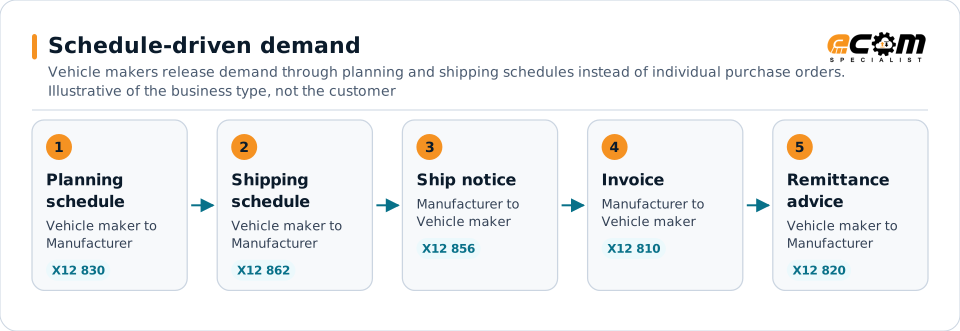
Schedule-driven demand
Vehicle makers release demand through planning and shipping schedules instead of individual purchase orders.
-
1. Demand signal
Planning scheduleX12 830
Vehicle maker Manufacturer
Forecasts tell the plant what to plan to build.
ECOM operates the EDI exchange with the customer’s trading partners.
-
2. Release
Shipping scheduleX12 862
Vehicle maker Manufacturer
Releases set what to ship and when, without a purchase order for each delivery.
-
3. Ship
Advance ship noticeX12 856
Manufacturer Vehicle maker
The shipment is announced in the vehicle maker’s required form.
Where a partner or internal system sends or receives this document by API instead of EDI, PRISM-API Gateway carries the same data.
-
4. Bill
InvoiceX12 810
Manufacturer Vehicle maker
Billing follows each vehicle maker’s rules.
-
5. Get paid
Remittance adviceX12 820
Vehicle maker Manufacturer
Remittance detail arrives separately from the bank payment.
PRISM Reconcile360 matches this remittance advice with the bank deposit and the open invoices, and flags differences for review.
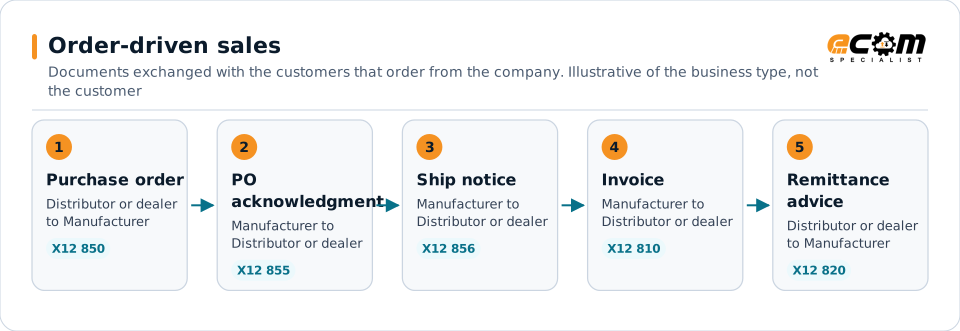
Order-driven sales
Documents exchanged with the customers that order from the company.
-
1. Order
Purchase orderX12 850
Distributor or dealer Manufacturer
Distributors and dealers place individual purchase orders.
A partner without an EDI system can send or receive this document through PRISM-WebEDI in a browser.
-
2. Confirm
Order acknowledgmentX12 855
Manufacturer Distributor or dealer
The manufacturer confirms what it will ship and when.
-
3. Ship
Advance ship noticeX12 856
Manufacturer Distributor or dealer
Tells the customer what is on the truck.
-
4. Bill
InvoiceX12 810
Manufacturer Distributor or dealer
Bills the shipped order.
-
5. Get paid
Remittance adviceX12 820
Distributor or dealer Manufacturer
Remittance detail is matched to open invoices.
PRISM Reconcile360 matches this remittance advice with the bank deposit and the open invoices, and flags differences for review.
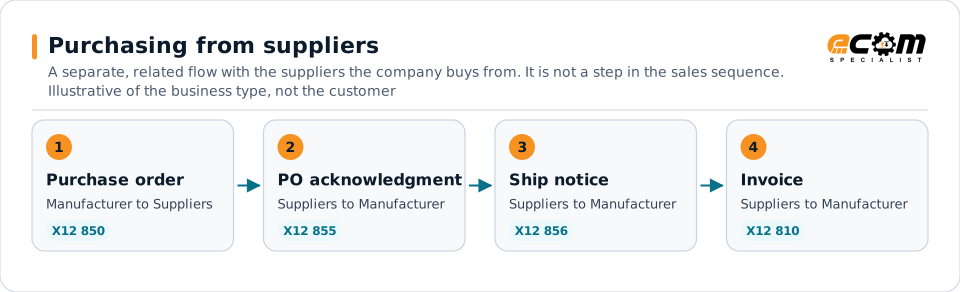
Purchasing from suppliers
A separate, related flow with the suppliers the company buys from. It is not a step in the sales sequence.
-
1. Order
Purchase orderX12 850
Manufacturer Suppliers
Material and service suppliers receive orders by EDI or in a browser.
The Supplier Portal, part of PRISM-WebEDI, lets suppliers without EDI work through procure-to-pay transactions in a browser.
-
2. Confirm
Order acknowledgmentX12 855
Suppliers Manufacturer
Suppliers confirm what they will deliver and when.
-
3. Ship notice
Advance ship noticeX12 856
Suppliers Manufacturer
Suppliers announce inbound shipments so receiving can plan.
-
4. Invoice
Supplier invoiceX12 810
Suppliers Manufacturer
Suppliers bill against orders and receipts.
ECOM’s role
Operational needs and ECOM’s role
What this kind of exchange needs, and what ECOM does about it within the agreed scope.
Exception handling
When something goes wrong
-
A partner cannot connect
A smaller partner has no EDI system.
The partner uses the browser route and its transactions join the same process.
-
A new partner fails testing
A test transaction does not pass.
Onboarding shows what failed so the partner can correct it without a long coordination cycle.
-
A payment is short
A customer’s payment does not match its invoices.
The difference goes to review.
Business value
Confirmed scope and intended benefits
Confirmed
- ECOM is responsible for managed EDI operations.
- ECOM provides the API Gateway, WebEDI, a Supplier Portal, Self-Service Onboarding and Reconcile360.
- The transition to ECOM’s cloud was a lift-and-shift.
Intended benefits
- Partners of any size can take part without a separate manual process for each.
- Real-time inventory and pricing answers drawn from the ERP through a managed interface.
- New partner setup that depends less on staff time.
- Cash application that works from matched records.
Systems typically involved
- Vehicle makers’ and distributors’ systemsSend schedules and orders, and receive shipment and billing documents.
- Browser usersSmaller partners and suppliers who work through portals instead of EDI.
- ERP, accounting and bankHold orders, invoices and deposits to be matched.
Lessons for similar enterprises
What other organizations can take from this
Plan for batch and real time together
Orders and invoices suit EDI. Availability and price questions suit APIs. One architecture should cover both.
Match the route to the partner
Large partners expect EDI. Smaller ones need a portal or a browser. Offer both under one process.
Staff for variety, not just volume
Many partners with different rules strain a small team even when the transaction count is modest.
Keep SAP at the center
Integrations should read from and write to the ERP through a managed layer instead of multiplying direct connections.