Executive summary
The situation and ECOM’s role
A large manufacturer of hard-surface flooring was building an independent technology environment at the same time as it implemented a new ERP platform, with the implementation already under way with another firm. What was still open, and kept changing, was how the company would exchange orders, shipping notices and invoices with its customers, and how its applications would connect to each other and to outside systems.
ECOM became the integration partner responsible for the company’s EDI operations and for the API Gateway that carries its internal and external integrations. The company sells through large home-improvement retailers, distributors and wholesalers, and online marketplaces, and each of those channels expects something different from a supplier.
An ERP implementation becomes harder to land when EDI and external integrations are left until the end.
Customer environment
- Industry
- Manufacturer of hard-surface flooring, sold through retail, distribution and online channels.
- Size
- A large manufacturer (size band only).
- ERP
- Implementing a new enterprise ERP platform, with the implementation handled by another firm.
- Situation
- Establishing independent systems while a new ERP is implemented.
- Channels
- Large home-improvement retailers, distributors and wholesalers, e-commerce marketplaces, and some distributors on older connection methods.
- Also needed
- API and web-service connections between internal applications and third-party analytics systems.
About this profile: the customer is not named and details are generalized. What is stated about the customer comes from ECOM; text marked “industry context” describes how this kind of business typically works. No volumes, timelines, figures, quotes or measured results are published.
The challenge
This was not an EDI software purchase. It was a new operating environment.
A company building an independent technology environment usually finds more to rebuild than it expects. Systems, interfaces and trading-partner connections that were shared or implicit have to be inventoried, tested and owned. Choosing a new ERP is one decision. Reconnecting every customer, distributor and marketplace to that ERP, without interrupting orders, is a much larger one.
Here the ERP implementation was already moving, but the integration requirements were still uncertain and changing. That is the normal state of an integration scope during an ERP program: requirements firm up as data models, item masters, ship-to structures and order flows are decided. Treating EDI as a final phase leaves the integration team to absorb every late change.
The channels made it harder. Large retailers require structured EDI with strict rules and chargebacks for errors. Distributors and wholesalers bring their own documents and connection methods, some of them older. Online marketplaces add API-style integration with different timing and data expectations. Internal applications and third-party analytics tools needed their own API and web-service connections on top of that.
Why ECOM
What a software vendor cannot do, and what an integration partner can
A tool vendor sells the mapping and communications software and leaves the running of it to the customer. An integration partner takes responsibility for the outcome: trading-partner onboarding, mapping, monitoring, exception handling and the day-to-day operation of the exchange.
That difference matters most during a transformation. The customer’s own team is already stretched across ERP data conversion, testing and cutover. ECOM brings a team that handles retail, wholesale and distributor requirements every day, so the company is not learning each channel’s rules while it is also learning a new ERP.
ECOM also approaches EDI and APIs together. The API Gateway gives internal applications, analytics systems and outside parties one integration pattern, so the company does not end up with a separate set of one-off connections beside the EDI environment.
Industry context
Building products manufacturer
A building-products manufacturer makes a physical product in several plants and sells it through distributors, dealers and retail channels. The sales cycle is order-driven: the customer who orders needs to know the order was accepted, when it will ship and what it will cost, and each channel partner has its own rules for how that information must arrive.
Channels with different rules
Distributors, dealers and retailers each publish their own requirements for orders, ship notices and invoices, and change them over time.
Several plants and systems
Order entry, plant scheduling, warehouse and shipping systems each hold part of the picture, and each needs data from the others.
A small team carries the load
Partner changes, new connections and failed documents usually land on a few people who also run everything else.
Where it goes wrong
Typical problems in this kind of exchange
-
Partner changes keep arriving
Each channel partner updates its requirements on its own schedule.
A small internal team spends its time on mapping and testing changes instead of on the business.
-
Connections multiply
Every new system or partner adds another point-to-point link.
Each link is one more thing to monitor, secure and fix, and the cost of the next change goes up.
-
Problems are found late
A rejected document or failed connection is not visible until someone asks about the order.
The order slips before anyone has seen the failure, and the partner finds out first.
-
Knowledge sits with a few people
Partner rules and workarounds live in individual heads and inboxes.
Absence or turnover puts the exchange at risk.
What ECOM provides
The confirmed scope of services
-
EDI operations
ECOM runs the EDI exchange with the customer’s trading partners.
About EDI operations -
API Gateway
PRISM-API Gateway carries the integrations between the customer’s own applications and with outside parties, so internal and external connections follow one pattern.
About API Gateway
What ECOM is responsible for
- ECOM operates the EDI exchange with the company’s trading partners and monitors failed or rejected documents; onboarding and mapping changes are handled as set out in the agreed scope.
- ECOM provides the API Gateway for the company’s internal and external integrations, including connections to third-party analytics systems.
- ECOM’s approach is to design EDI architecture alongside the ERP, with mappings and partner connections built against the new ERP’s data and order flows rather than retrofitted afterward.
- Mapping and partner onboarding are set up so each channel, from a large retailer to a smaller distributor, can connect in the way that suits it.
Technical and operational detail
Why EDI has to be designed inside the ERP program
Industry context: an ERP implementation decides the things every EDI map depends on. The item master, units of measure and packaging hierarchies, customer and ship-to structures, price lists, tax handling and order types are all defined during the ERP project. If the maps are built against a data model that is still moving, they are rebuilt each time the model changes. If they are built after go-live, orders and invoices stop flowing to customers on the day the new system starts.
In practice, the safer approach is to treat the integration layer as a workstream with its own owner, requirements and test plan, running alongside the ERP project. Trading-partner requirements are gathered early, mapped to the new ERP’s fields as they firm up, tested in stages with each partner, and cut over in a planned order. That is the role ECOM takes on: ownership of the EDI operation and of the API Gateway while another firm implements the ERP, so the two teams meet at a defined interface instead of discovering each other’s assumptions during testing.
A change in company structure can add a further requirement. Connections that ran under another entity’s identity and infrastructure may have to be re-established in the company’s own name, which can mean new partner agreements, new test cycles and, for retailers with strict onboarding, new compliance reviews.
Channels with different expectations (industry context)
Home-improvement retailers typically run the full purchase-order cycle: the 850 purchase order, 855 acknowledgment, 856 advance ship notice and 810 invoice, plus order changes (860), inventory and sales reporting (846, 852) and compliance scorecards with chargebacks. Distributors and wholesalers often use the same standards with different field conventions, or older connection methods that still have to be supported.
E-commerce marketplaces tend to work differently: orders, inventory feeds and tracking updates move by API, with tighter timing and less tolerance for stale availability. Third-party logistics providers add warehouse documents such as shipping orders and shipment confirmations (940, 945, or EDIFACT equivalents) and carrier status messages. For a flooring manufacturer with a broad range, the same catalog may be described in different ways to each of these channels.
What ECOM confirms for this customer is EDI operations and the API Gateway for internal and external integrations. The channel descriptions above explain why one integration pattern covering EDI and APIs is easier to govern than a separate project per channel.
Architecture
Where the integration sits
Customer environment
- New ERP platform
- Plant, warehouse and order systems
- Third-party analytics systems
ECOM responsibilities
- Managed EDI operations: onboarding, mapping, monitoring
- API Gateway for internal and external integrations
- Exception handling and operational ownership
Channels and partners
- Large home-improvement retailers (EDI)
- Distributors and wholesalers
- Online marketplaces (API and EDI)
Educational diagram of this kind of environment, not the customer’s own architecture.
Running a similar exchange? Tell us your partners, systems and where the delays are, and a specialist will suggest where to start.
Talk to an EDI/API ExpertThe workflow
How the work flows
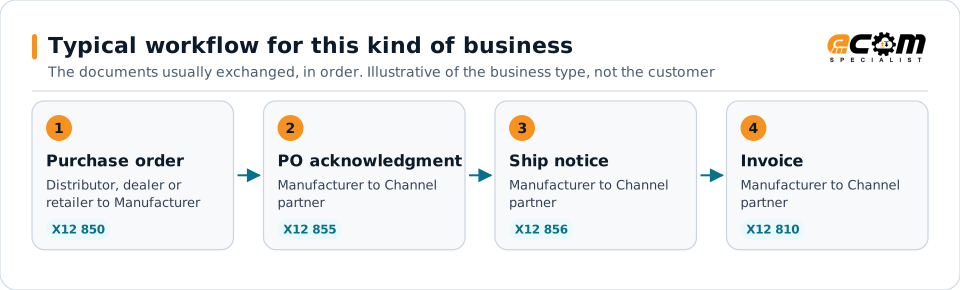
The documents typically exchanged in this kind of business, in the order they usually move. Partners vary, and some connect by API instead of EDI. The shaded line under a step shows where ECOM’s services act.
Steps are listed in the order the documents usually move, with who sends each one. Running alongside every step: Internal integrations.
-
1. Order
Purchase orderX12 850
Distributor, dealer or retailer Manufacturer
The channel partner places an order in its own format.
ECOM operates the EDI exchange with the customer’s trading partners.
-
2. Confirm
Order acknowledgmentX12 855
Manufacturer Channel partner
Confirms what the plant will ship and when, or flags changes.
-
3. Ship
Advance ship noticeX12 856
Manufacturer Channel partner
Tells the partner what is on the truck so receiving can plan.
-
4. Bill
InvoiceX12 810
Manufacturer Channel partner
Bills the shipped order against the partner’s purchase order.
Running alongside every step
These support the exchange throughout. They are alternative routes and controls, not steps that happen after payment.
-
Keep systems aligned
Internal integrations
Plant, warehouse and order systems Each other and outside parties
Data moves between the manufacturer’s own applications and to outside parties.
PRISM-API Gateway carries the integrations between the customer’s own applications and with outside parties, so internal and external connections follow one pattern.
ECOM’s role
Operational needs and ECOM’s role
What this kind of exchange needs, and what ECOM does about it within the agreed scope.
Exception handling
When something goes wrong
-
A document is rejected
A partner’s system rejects an order response, ship notice or invoice.
The ECOM team that operates the exchange sees the rejection and works it with the partner’s requirements in hand.
-
A connection stops
A link to a partner or an internal system goes down.
The team responsible for the connection is alerted, instead of the plant finding out through missing orders.
Business value
Confirmed scope and intended benefits
Confirmed
- ECOM is responsible for the company’s EDI operations.
- ECOM provides the API Gateway for its internal and external integrations.
Intended benefits
- Integration design that follows the ERP program instead of trailing it.
- Channel partners of different kinds served through one managed process.
- One integration pattern for EDI-adjacent APIs, analytics feeds and internal applications.
- Failed documents and connections watched by the team accountable for them.
Systems typically involved
- Channel partners’ systemsSend orders and receive confirmations, ship notices and invoices.
- Order management and ERPReceive orders and return confirmations and invoices.
- Plant and warehouse systemsSource of production, inventory and shipment data.
Lessons for similar enterprises
What other organizations can take from this
Design EDI with the ERP, not after it
Item, customer and order structures decided during ERP design determine what every partner document must contain. Settling them together avoids rework on both sides.
A change in company structure creates hidden integration work
Connections that were shared or implicit must be inventoried, rebuilt and assigned an owner. Do it early and deliberately.
Plan for the channel mix, not the average channel
A retailer’s EDI, a distributor’s older connection and a marketplace API behave differently. The integration approach has to handle all three.
Keep operations separate from the ERP team’s workload
The people converting data and testing the ERP should not also be running partner connections.