
AI automation · Automotive
AI automation for automotive: from the supplier line to the service bay
For U.S. automotive businesses, AI can connect decisions across suppliers, assembly plants, parts distribution, dealerships and service departments. The strongest opportunities are earlier detection of defects, more reliable material flow, faster administrative work and better service readiness. An automaker, a component supplier and a dealer should choose different starting points. ECOM’s AI automation specialists help you choose yours, connect the releases, schedules and part and lot data it needs, and prove the result.
Who it serves
Who in automotive businesses this helps
Component suppliers and plants
Link test, lot and shipment data to find a quality issue faster and contain only what you must.
Purchasing and supplier development
Reconcile releases, schedules and shipments and see a shortage before it reaches the line.
Parts distribution and aftersales
Match service part supply to local demand and appointments to parts readiness.
Dealership leaders
Respond to leads consistently and review aging inventory with accurate vehicle data.
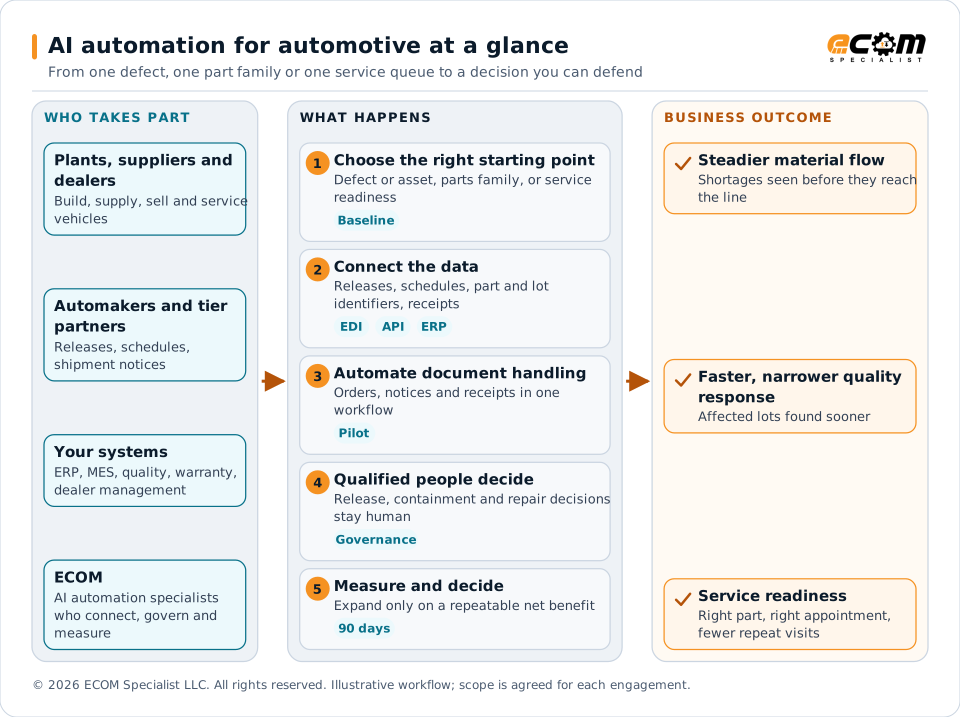
The drawing follows an automotive business from the right starting point for its role, through connecting releases, schedules and part and lot identifiers, automating document handling, keeping qualified people in the decisions and measuring the result over 90 days. The outcomes are steadier material flow, a faster and narrower quality response and better service readiness. They are goals to measure against your own baseline, not guaranteed results.
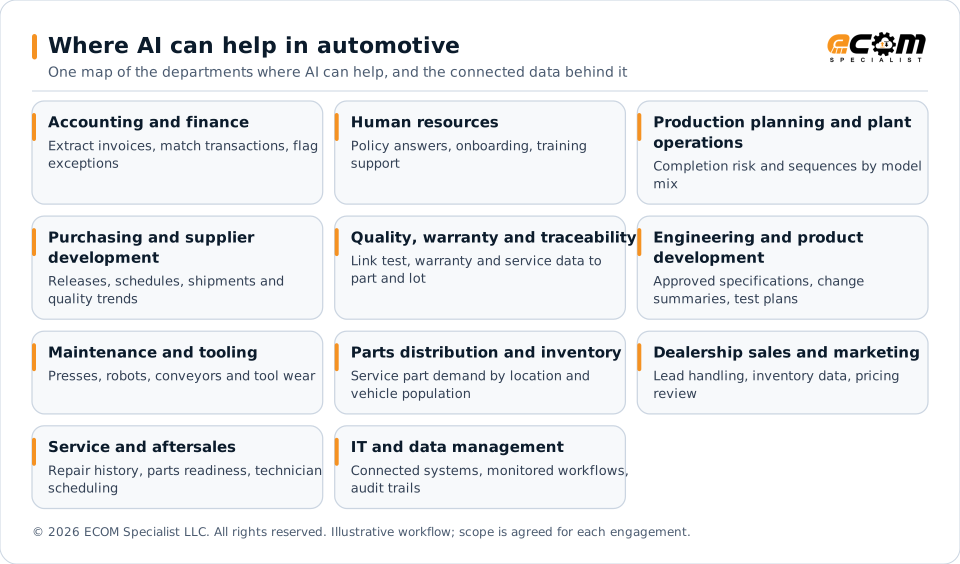
The map lists 11 departments and, for each, the kind of work AI can support: accounting and finance (extract invoices, match transactions, flag exceptions); human resources (policy answers, onboarding, training support); production planning and plant operations (completion risk and sequences by model mix); purchasing and supplier development (releases, schedules, shipments and quality trends); quality, warranty and traceability (link test, warranty and service data to part and lot); engineering and product development (approved specifications, change summaries, test plans); maintenance and tooling (presses, robots, conveyors and tool wear); parts distribution and inventory (service part demand by location and vehicle population); dealership sales and marketing (lead handling, inventory data, pricing review); service and aftersales (repair history, parts readiness, technician scheduling); it and data management (connected systems, monitored workflows, audit trails). These are practical opportunities, not claims that every company has implemented them.
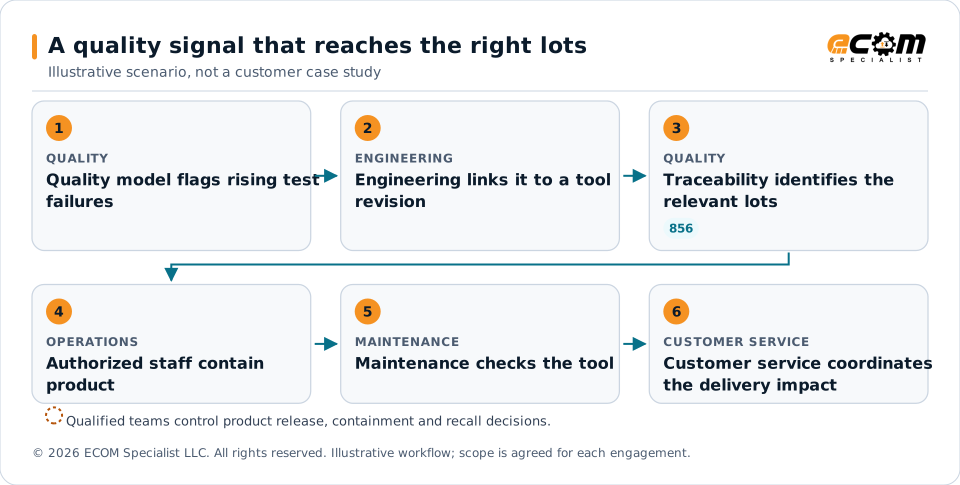
A quality model flags a rising pattern of test failures at a component supplier. Engineering links the change to a tool revision and traceability identifies the relevant lots. Authorized staff contain product, maintenance checks the tool and customer service coordinates the delivery impact. At a dealership, the starting point would be a different workflow with a different owner.
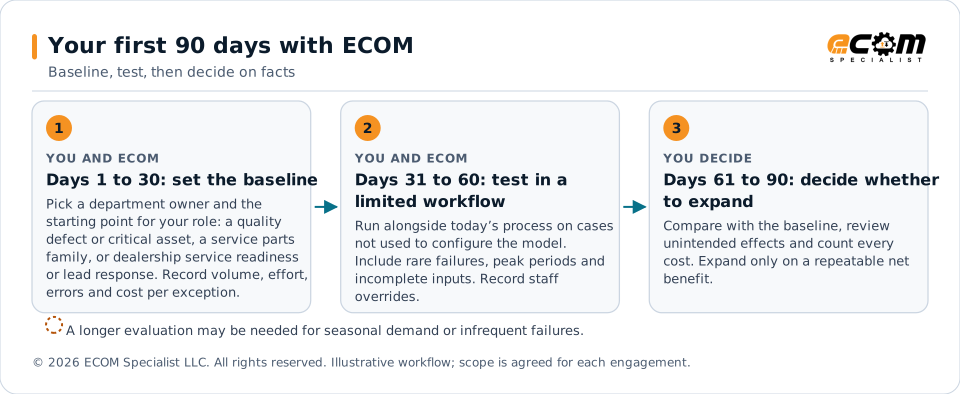
Days 1 to 30 set a baseline: a department owner, one recurring problem, current volume, effort, errors and cost per exception, confirmed data access and a definition of success. Days 31 to 60 test in a limited workflow, alongside the current process, on cases not used to configure the model, with staff overrides recorded. Days 61 to 90 compare the results with the baseline, count every cost and expand only if a repeatable net benefit is shown.
The cost of waiting
What companies miss by waiting
Tightly sequenced plans, fragile inputs
A missing component or unrealistic cycle time can force premium freight, overtime or rescheduling that creates another bottleneck.
A quality issue spread across plants
Without linked analysis, investigations take longer and you may inspect or contain more product than necessary.
Capital in the wrong parts
Slow-moving stock ties up cash while a missing critical part keeps a customer vehicle out of service.
Leads and inventory that age
Inquiries wait without consistent follow-up, and aging vehicles absorb financing and storage cost.
Repeat visits from incomplete information
Customers arrive before parts are ready, and advisors search records instead of explaining the work.
Department by department
Where AI helps, what waiting costs and how ECOM helps
The department list below comes from practical opportunities, not claims that every automotive company has implemented them. An automaker, a supplier, a distributor and a dealer start in different rows.
| Department | Where AI can help | What waiting costs | How ECOM helps, and what to measure |
|---|---|---|---|
| Accounting and finance | Extract invoice and remittance details, suggest account coding, match transactions, prioritize exceptions and flag unusual payments. | Staff rekey documents and chase routine discrepancies. Cash and margin problems show up only after the reporting cycle closes. | Connects invoices, receipts, purchase orders and remittances from EDI, APIs and documents into one matched flow with exception queues. The controller keeps approval of payments, write-offs and material adjustments. Measure: cost per transaction, exception rate, days to close, overdue receivables. |
| Human resources | Answer questions from approved policies, guide onboarding, suggest role-specific training and forecast staffing demand. | Experienced employees repeat the same procedures, new hires take longer to become productive and staffing reacts only after overtime has risen. | Starts with policy search and training support built on approved content. Hiring, pay and disciplinary decisions stay under accountable human review. Measure: onboarding time, policy response time, training completion, overtime. |
| Production planning and plant operations | Forecast completion risk and help planners evaluate sequences against labor, tooling, component availability and model mix. Find feasible alternatives when a constraint changes. | A missing component or unrealistic cycle time can disrupt a tightly sequenced plan. Teams compensate with premium freight, overtime or rescheduling that creates another bottleneck. | Links production orders, component inventory and actual process events with supplier releases and shipment notices. Plant supervisors approve actions that affect output or customer schedules. Measure: build to schedule, line stoppage minutes, throughput, premium freight. |
| Purchasing and supplier development | Monitor suppliers for deteriorating lead times, quality trends or incomplete confirmations, and reconcile customer releases, supplier schedules and shipments so buyers can investigate a shortage before it reaches the line. | Staff spend time reconciling schedules while a shortage grows. Supplier development teams treat recent incidents without seeing patterns across parts or sites. | Connects releases, schedules, advance shipping notices and receipts, with correct part revisions, units of measure and shipping locations. Measure: supplier on-time delivery, shortages, schedule reconciliation effort, supplier defects. |
| Quality, warranty and traceability | Inspect visible assembly characteristics and find unusual patterns in test results, warranty claims and service reports. Joining records to part, lot and vehicle identifiers helps quality teams focus and assess exposure. | A recurring issue stays scattered across plants and service departments. Investigations take longer and the business may inspect or contain more product than necessary. | Connects part, lot and shipment identifiers across partners and systems. Qualified teams validate findings and control product release, containment and recall decisions. Measure: first pass yield, defect escapes, warranty cost, time to identify affected lots. |
| Engineering and product development | Retrieve approved specifications, summarize engineering changes, explore design alternatives with simulation and help prepare test plans and work instructions. | Teams repeat studies or use outdated instructions. The missed opportunity is faster, better-informed engineering with clearer links between design intent and production evidence. | Helps scope retrieval from approved documents with access controls that protect intellectual property. Engineers verify outputs against the current configuration, and safety-critical outputs go through established engineering processes. Measure: change turnaround, revision-related errors, validated engineering time saved. |
| Maintenance and tooling | Identify abnormal patterns in presses, robots, conveyors and other assets from sensor and repair data, coordinate inspections, spares and planned downtime, and support tool-wear replacement decisions. | Equipment or tooling issues interrupt the line or produce avoidable scrap, and maintenance teams respond to urgent failures instead of removing recurring causes. | Builds the response workflow around each warning. Interlocks, required inspections and qualified maintenance judgment are never bypassed. Measure: unplanned downtime, tool-related defects, maintenance cost, warning precision. |
| Parts distribution and inventory | Estimate service part needs by location and vehicle population, optimize inventory against service targets and lead times, and connect orders, advance shipping notices and receipts across the network. | Slow-moving stock ties up capital while a missing critical part keeps a customer vehicle out of service. Average demand hides regional differences and rare but costly shortages. | Connects orders, shipment notices and receipts across the distribution network through EDI and APIs. Check part supersessions and compatibility before acting on a recommendation. Measure: parts fill rate, backorder duration, inventory turns, emergency transfers. |
| Dealership sales and marketing | Organize incoming leads, draft accurate replies from approved inventory data and flag vehicles that need pricing review. Lead prioritization guides follow-up, and managers confirm it improves sales rather than favoring easy customers. | Inquiries wait, aging inventory absorbs financing and storage cost and staff spend more time collecting vehicle details than helping buyers. | Connects inventory and lead data so replies reflect real availability. Verify features, availability and advertised terms; credit and financing decisions stay within approved processes. Measure: response time, appointment conversion, inventory age, contribution per sale. |
| Service and aftersales | Summarize repair history, retrieve approved technical information and schedule technicians and parts around expected workload. With permission and reliable data, predictive service signals can prompt an inspection. | Customers arrive before parts are ready or return for repeat visits because information was incomplete. Advisors search records instead of explaining the work. | Connects appointments with parts readiness. Qualified technicians diagnose the vehicle and customers authorize repairs. Measure: first-time fix rate, repair turnaround, repeat visits, appointment readiness. |
| IT and data management | Summarize incidents, help diagnose integration failures and identify unusual system behavior. | Departments keep conflicting spreadsheets and AI works from stale records, so one wrong inventory balance or customer identity spreads errors across the business. | Connects operational systems through managed EDI and API integrations with monitoring, a named owner, an audit trail and a way to reverse each action. Measure: data freshness, integration failures, duplicate records, recovery time. |
Capabilities
How ECOM’s AI automation specialists help automotive businesses
Open any item for the detail.
Start where your role in the chain startsSupplier or plant, distributor, or dealership.
- For a supplier or plant, begin with one quality defect or critical asset. For a distributor, begin with one service parts family. For a dealership, begin with service readiness or lead response.
- Pair the operational pilot with a limited document-handling workflow if the volume justifies it.
- Record current volume, labor effort, errors, service outcomes and the cost of each exception before you select a tool.
Connect the data your AI needsOrders, confirmations, shipments and invoices from the systems that already hold them.
- EDI and APIs can supply orders, order confirmations, shipment events and invoices from your trading partners and your ERP, warehouse and transportation systems.
- ECOM connects those feeds with shared identifiers, timestamps and validation rules, so every record stays traceable from the source to the decision.
- A fast recommendation built on a stale inventory balance or a duplicate customer record spreads errors. Clean, connected data comes first.
Automate the document-heavy stepsPDFs, emails and images become validated data in the same workflow.
- Document extraction brings information from PDFs, emails and images into the same workflow as your EDI and API data.
- Validation rules check the extracted data against the order, the shipment or the contract, and incomplete or unusual items go to an exception queue with an owner.
- Where a stable rule solves a clear requirement, ECOM recommends the rule. Not every workflow needs AI.
Keep people in controlApprovals, audit trails and a manual fallback.
- Connecting a model to a system does not by itself authorize it to change a financial or operational record. ECOM helps you define what each automated step may do, who approves it and how to reverse it.
- Every important action has an owner, an audit trail and a manual fallback. Staff can inspect and override a recommendation.
- The voluntary NIST AI Risk Management Framework gives a practical structure for approved uses, responsible owners, escalation thresholds and monitoring.
Prove it, then decide whether to expandA baseline, a limited pilot and a net-benefit decision.
- ECOM helps you record today’s volume, effort, errors and exception cost, run the new workflow alongside the current one and compare the results with a simple baseline.
- The business case includes software, integration, training, review time and monitoring, not only the savings. You expand only when a repeatable net benefit is shown.
- Seasonal demand or infrequent failures may need a longer evaluation. ECOM plans for that up front.
In practice
Automotive example: a rising pattern of test failures
A component supplier acts on a quality signalIllustrative scenario, not a customer case study.
- A quality model flags a rising pattern of test failures. Engineering links the change to a tool revision and traceability identifies the relevant lots.
- Authorized staff contain product, maintenance checks the tool and customer service coordinates the delivery impact.
- At a dealership, a separate starting point might be matching service appointments with parts readiness. These are different workflows with different owners.
What is it worth? A calculation you can reuseIllustrative arithmetic, not a promise.
- Illustrative calculation only. If a team handles 5,000 documents a month and reduces average handling time from 8 minutes to 3 minutes, it releases about 417 staff hours monthly. At an assumed loaded labor cost of $35 per hour, that is about $14,600 in monthly capacity value.
- That value becomes cash savings only if spending actually falls. Otherwise the benefit comes from useful redeployment, greater throughput or better service.
- Net annual benefit equals verified annual operating gains minus annual software, support, monitoring and other recurring costs. Simple payback equals the one-time implementation cost divided by the positive monthly net benefit.
- Keep released working capital separate from recurring profit, and avoid counting the same labor or error reduction twice. Bring your own volumes and ECOM will work through the arithmetic with you.
Business benefits
What this means for the business
Steadier material flow
Releases, schedules and shipments are reconciled automatically, so shortages are seen earlier.
A faster, narrower quality response
Part, lot and vehicle identifiers help find the affected product sooner.
Better service readiness
Appointments and parts are matched before the customer arrives.
Decisions with documented facts
Every pilot ends with a baseline comparison and a net-benefit calculation.
What public sources show
This is the company’s own published description. It is not an ECOM project and does not establish an expected return for a particular supplier, plant or dealership.
- General Motors describes using AI-driven predictive analytics with historical and real-time manufacturing data to improve vehicle output, and AI applications in manufacturing quality and efficiency. It shows practical industrial use, not a return you should expect.
- The NIST AI Risk Management Framework is a voluntary structure for governing, mapping, measuring and managing AI risk. It is a practical reference for approved uses, responsible owners, escalation thresholds and monitoring.
- U.S. EEOC guidance explains that employment discrimination protections also apply when AI is involved. Obtain HR and legal review for any tool that affects hiring, pay or discipline.
How to evaluate automotive AI
Pick the measures for the row you start with, record a baseline and keep the definitions fixed.
- Build to schedule, line stoppage minutes and premium freight
- Supplier on-time delivery, shortages and schedule reconciliation effort
- First pass yield, defect escapes and time to identify affected lots
- Parts fill rate, backorder duration and inventory turns
- Response time, appointment conversion and inventory age
- First-time fix rate, repair turnaround and repeat visits
Getting started
Bring your costliest recurring automotive problem
Tell ECOM which recurring problem costs you the most: one quality defect, a critical asset, a service parts family, slow lead response or hours of release and invoice reconciliation. Bring a rough monthly volume and the systems involved. ECOM’s AI automation specialists will help you define a baseline, the data you need and a limited first workflow, so you can decide on facts whether to expand. You do not need a model, a vendor or a budget line before the first conversation.
Frequently asked questions
How can AI help a U.S. automotive supplier or dealer?
AI can forecast completion risk, monitor supplier lead times and quality trends, link test and warranty records to part and lot identifiers, estimate service part demand, organize dealership leads and prepare service appointments. The right starting point depends on your role in the chain.
Where should an automotive company start with AI?
A supplier or plant starts with one quality defect or critical asset, a distributor with one service parts family, and a dealership with service readiness or lead response.
What does ECOM do for an automotive AI project?
ECOM’s AI automation specialists help you choose the first workflow, connect releases, schedules, shipment notices, receipts and part and lot identifiers from your partners and systems, automate document handling, set approvals and audit trails, and measure the result.
How do EDI and APIs connect to AI in automotive?
EDI and APIs supply orders, releases, confirmations, shipment events and invoices. With correct part revisions, units of measure and shipping locations, AI recommendations rest on the same records your partners use.
Who decides on a recall or containment?
Qualified teams. AI can help focus an investigation and assess exposure, but people control product release, containment and recall decisions.
What does waiting cost an automotive business?
Avoidable line stoppages, premium freight, larger containment than needed, capital tied up in slow stock and repeat service visits. ECOM helps you put your own volumes into a net-benefit calculation rather than guess.
AI Automation by Industry
Other industries
-
Retailers
Demand, invoices, supplier delays, store tasks and fulfillment: AI on connected data, proven in 90 days.
View retailers -
Manufacturers
Scheduling, maintenance, quality, supply and order capture: AI on connected plant and partner data.
View manufacturers -
Logistics and carriers
Arrival prediction, warehouse labor, fleet maintenance, billing and claims: AI on connected shipment data.
View logistics and carriers
Talk to an AI Automation Specialist about AI for automotive businesses
Tell us the recurring problem that costs you most and the systems involved. We will outline a baseline, the data you need and a limited first workflow you can judge on facts.