
Penalty prevention · Automotive
Keep automotive supplier penalties off the production line
An OEM or Tier 1 customer can penalize a supplier for an inaccurate ship notice, a container label that does not match, a missed schedule or the premium freight that follows. The cost is rarely the fee alone: it is the disruption at the plant. ECOM connects releases, shipments, labels and notices so your team, in most scenarios, is warned while a shipment can still be corrected.
Who it serves
Who in automotive suppliers this helps
Tier 1 and Tier 2 suppliers
Meet several customers’ schedule, label and ASN rules from the same plant.
Component manufacturers
Keep part, plant and dock data correct from release to shipment.
Supply chain and logistics planners
See which shipments are at risk before they leave the dock.
Quality and compliance leads
Trace a customer scorecard result or penalty to the transactions that caused it.
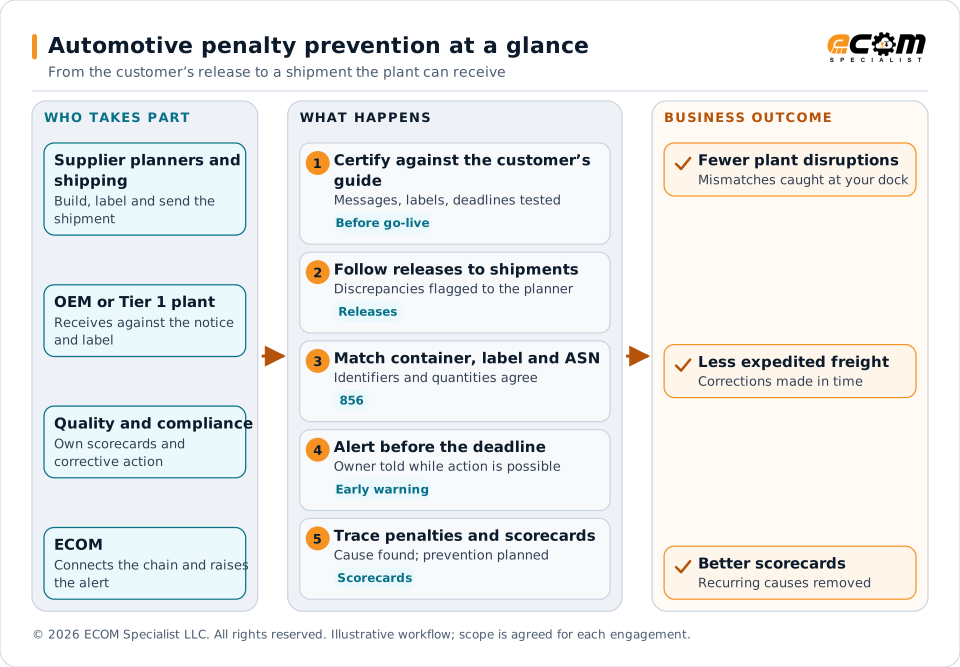
The drawing follows an automotive release to a shipment: certification against the customer’s guide, release-to-shipment checks, container, label and ASN matching, an alert before the deadline, and tracing of penalties and scorecard results to their cause. The result is fewer plant disruptions, less expedited freight and better scorecards.
The problem
Where penalties come from
ASNs that do not match the container
The plant receives against the ship notice. If container, part or quantity data disagrees with the label, receiving stops and the customer records a defect.
Misread releases
Forecasts and firm releases look similar. A shipment built on the wrong interpretation arrives early, late or in the wrong quantity.
Label errors at the dock
Customer-specific label formats and identifiers must be right on every container and rack.
Premium freight
A miss that is caught too late can force expedited transport, and customers may charge the cost back.
Scorecards without a cause
A poor delivery or ASN score shows up on a customer scorecard with no clear route back to the transaction behind it.
Problem to solution
The problem, what ECOM does, and when you find out
Each row starts with the problem an automotive supplier is trying to solve. The customer’s implementation guide decides the exact messages, versions and responses; ECOM configures the checks against it.
| The problem you are trying to solve | What ECOM does about it | When you find out |
|---|---|---|
| The ASN disagrees with the container or label | Validates shipment, container, part and quantity relationships and keeps label identifiers consistent with the ASN | Before the shipment leaves the dock |
| A release is misread and the shipment is wrong | Follows releases and changes with the shipment built from them and flags discrepancies for the planner | Before the shipment is built or sent |
| A label format is wrong for this customer | Applies the customer’s approved label template and validates required identifiers before printing | Before the label is printed |
| The ASN is late | Tracks the transmission deadline and alerts the responsible team as it approaches | Before the deadline, in most scenarios |
| A shipment problem is found too late to avoid expedited freight | Raises the exception with its owner and deadline while corrective action is still possible | Early enough to act, in most scenarios |
| A penalty or poor scorecard result appears | Tracks it to the underlying transactions and helps identify root cause and prevention | After the penalty, with the evidence together |
Capabilities
How ECOM solves the automotive penalty problem
Open any item for the detail.
Early warning on shipments at riskThe planner hears about it before the plant does.
- In most scenarios, ECOM can identify conditions that may lead to a customer penalty and alert the responsible team before the penalty occurs.
- Exceptions show which order or shipment needs attention, what failed, who owns it and when action is required.
Container, label and ASN agreementOne set of shipment facts.
- Validate shipment, order, pallet, container and item relationships, reconcile shipped quantities and units of measure, and check shipment references and label identifiers.
- Apply the customer’s approved label templates and support controlled printing and reprinting.
Customer-specific certificationTest before production orders depend on it.
- Configure and test required documents, data fields, business rules, label formats and response deadlines against each customer’s requirements before go-live.
- The customer’s approved implementation guide is the authority; similar messages are not assumed to behave the same way.
Scorecards that lead back to the causeFrom the customer’s result to the transaction.
- Measure late ASNs, rejected transactions, label errors and fulfillment accuracy, and trace results to the underlying transactions.
- Assign corrective actions and compare later performance. Evidence for a dispute is preserved with timestamps, acknowledgments and corrections.
Example
Automotive example: repeated ASN rejections
A plant keeps rejecting ship noticesIllustrative workflow, not a customer result.
- A supplier’s ASNs for one plant are repeatedly rejected for container data that does not match the label.
- The tracked rejections point to a packaging change that updated the label template but not the ASN mapping.
- The prevention plan adds a pre-shipment check that label and ASN agree and alerts the planner when they do not.
- Rejected-transaction counts and the customer scorecard are compared with the baseline over the next cycles.
Business benefits
What this means for the business
Fewer plant-side disruptions
Data and label mismatches are found at your dock, not theirs.
Less expedited freight
Problems surface while corrective action is still possible.
Better scorecard results
Recurring causes are traced and removed.
Documented facts in a dispute
Records and corrections are kept together.
Measure the improvement
- On-time ASN rate
- ASN rejection rate
- Label error rate
- Exception age
- Customer scorecard results by plant
Getting started
Bring a recent customer complaint
Bring the customer’s implementation guide, a recent penalty or scorecard example, sample labels and ASNs, and system details. ECOM will identify control gaps and a targeted prevention plan.
Frequently asked questions
Which automotive penalties can ECOM help prevent?
ECOM targets avoidable failures in ship notices, container labels, release responses and timing. The customer’s implementation guide defines what is penalized and how.
Does ECOM know every OEM’s requirements?
No claim is made that every customer’s guide is preconfigured. ECOM configures and tests the documents, labels and rules from the customer’s approved guide for each engagement.
How does this relate to EDI/API certification?
Certification proves the connection works against the customer’s rules before go-live. Penalty prevention continues after go-live, watching live shipments and tracking any penalty to its cause.
Penalty Prevention by Industry
Other industries
-
Retail and consumer goods suppliers
Label, ASN, invoice and response-time penalties: caught before the shipment leaves, and traced to the cause when one slips through.
View retail and consumer goods suppliers -
Food and beverage suppliers
Pallet labels, ASNs and delivery windows checked together, so a late or mismatched load is flagged before it reaches the dock.
View food and beverage suppliers -
Manufacturers and distributors
Orders, packing, ASNs, labels and invoices tied together, so a short ship or data mismatch is flagged before the customer sees it.
View manufacturers and distributors -
E-commerce and drop-ship suppliers
Order response, shipment confirmation and tracking deadlines watched across partners, with the owner alerted before the window closes.
View e-commerce and drop-ship suppliers -
3PLs and logistics providers
Client-by-client label, ASN and shipment rules enforced at the dock, with alerts and penalty tracing across every account.
View 3pls and logistics providers
Talk to an EDI/API Expert about automotive suppliers
Tell us about your partners, systems and goals. We will outline the scope, the workflow and what you would need to bring.