
Penalty prevention · 3PL and logistics
Protect your clients, and your contracts, from 3PL-generated penalties
When a 3PL labels the pallet, creates the ship notice and books the carrier, a retailer’s penalty lands on the client and a service-level question lands on you. With many clients and many partner rules, one misconfigured template can repeat across hundreds of shipments. ECOM connects warehouse and shipping data to each client’s partner requirements and, in most scenarios, alerts your team before a shipment leaves with a problem.
Who it serves
Who in 3pls and logistics providers this helps
Third-party logistics providers
Run several clients’ shipments, each with different partner rules, from the same warehouse.
Warehouse operations leads
See the shipments at risk and the exact fix before the truck leaves.
Client account managers
Show clients which penalties occurred, why, and what changed.
Carriers and freight providers
Meet status and delivery reporting expectations that customers measure.
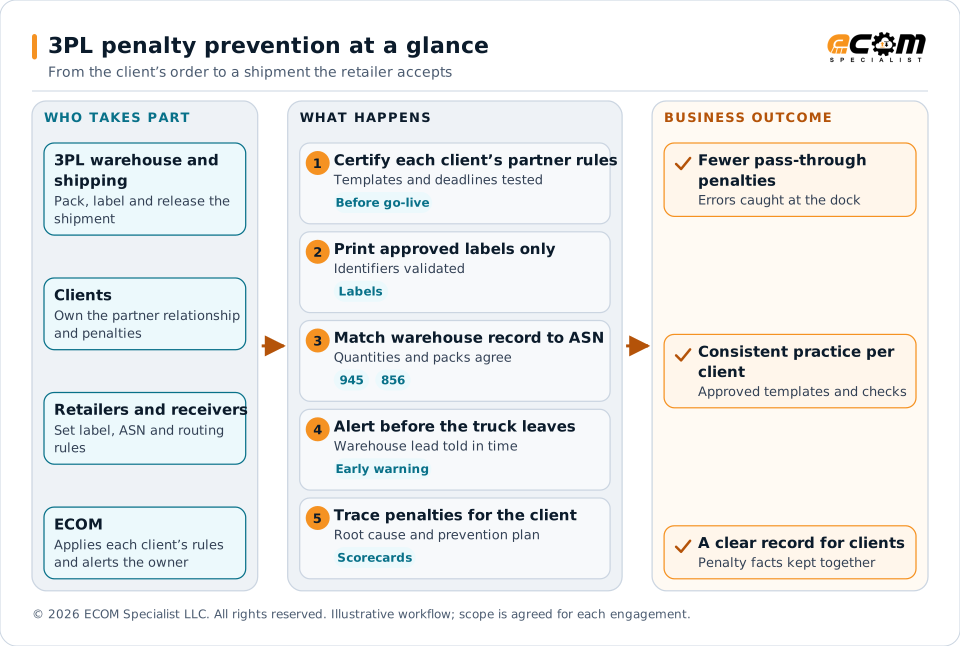
The drawing follows a client shipment through a 3PL: certification of each client’s partner rules, approved labels only, matching of the warehouse record to the ASN, an alert before the truck leaves, and tracing of penalties for the client. The result is fewer pass-through penalties, consistent practice per client and a clear record.
The problem
Where penalties come from
One template, many shipments
A label or ASN mistake at the warehouse repeats on every shipment until someone notices.
Different rules per client and partner
Each client ships to partners with their own labels, routing and notice requirements.
Warehouse records that do not match the ASN
What the warehouse reports as shipped and what the ASN says must agree.
Penalties passed through
A retailer fines the client, the client questions the 3PL, and nobody has the full record.
Late status and delivery reporting
Customers measure carriers and providers on when status and delivery events are reported.
Problem to solution
The problem, what ECOM does, and when you find out
Each row starts with the problem a 3PL or logistics provider is trying to solve. Each client’s and partner’s requirements define the rules.
| The problem you are trying to solve | What ECOM does about it | When you find out |
|---|---|---|
| A label template error repeats across shipments | Applies approved partner templates per client and validates identifiers before printing | Before the label is printed |
| The warehouse record and the ASN disagree | Validates shipment relationships and reconciles shipped quantities before the ASN is sent | Before the ASN is sent |
| An ASN or status event will miss its deadline | Tracks transmission and reporting deadlines and alerts the responsible team | Before the deadline, in most scenarios |
| A client’s partner rules change | Tests the new rules before go-live and manages approved template versions | Before live shipments depend on them |
| A client is fined and asks what happened | Tracks the penalty, links the related records and shows the root cause | After the penalty, with the evidence together |
| Performance varies by client or site | Scorecards by customer, carrier and internal team trace to the transactions behind them | Continuously, with drill-down |
Capabilities
How ECOM solves the 3PL penalty problem
Open any item for the detail.
Alert before a bad shipment leavesEarly warning at the dock.
- In most scenarios, ECOM can identify conditions that may lead to a trading partner penalty and alert the responsible team before the penalty occurs.
- Alerts and escalations can go to warehouse, logistics, customer service, finance or integration teams, each with the failure, the owner and the deadline.
Labels and ASNs that agree, client by clientControlled templates and validated data.
- Apply partner-specific carton and pallet layouts, populate them from connected systems, validate required identifiers and keep SSCCs and packing details consistent with the ASN.
- Support controlled printing and reprinting, and approved template versions.
Test each client’s partner rules before go-liveCertification for every relationship.
- Configure and test required documents, data fields, business rules, label formats and response deadlines against each trading partner’s requirements.
Penalty tracing and evidence for the clientA shared, documented account of what happened.
- Track penalties, identify the root cause and work with your team on a prevention plan to minimize recurrence and financial impact.
- Preserve related transaction records, timestamps, acknowledgments, corrections and resolution history to support the response to a chargeback.
Example
3PL example: a template error across one client’s shipments
A client is fined repeatedly for the same label problemIllustrative workflow, not a customer result.
- A 3PL’s client is fined by one retailer for labeling errors. The penalties are tracked and linked to the shipments.
- The review shows an outdated template was used for that retailer after a rules update.
- The prevention plan restricts printing to the approved template version and alerts the warehouse lead when a label and the ASN disagree.
- The 3PL shows the client the root cause, the change and the later label error rate.
Business benefits
What this means for the business
Fewer pass-through penalties
Errors are caught before the shipment leaves.
Consistent practice across clients
Approved templates and checks are applied per client and partner.
A clear record for client conversations
The facts behind a penalty are together.
Fewer repeats
The cause is removed once, not paid for repeatedly.
Measure the improvement
- Label error rate by client
- On-time ASN rate
- ASN rejection rate
- Exception age
- Documented penalty trend by client and cause
Getting started
Bring your busiest client’s requirements
Bring a client’s partner requirements, a recent penalty example, sample labels and ASNs and your warehouse system details. ECOM will identify control gaps and a targeted prevention plan.
Frequently asked questions
How does this help a 3PL specifically?
A 3PL applies many clients’ rules at one dock. ECOM applies the approved label and ASN rules for each client and partner, alerts the warehouse early and traces penalties for the client conversation.
Which documents are involved?
Typically warehouse shipping orders and advices alongside ship notices, depending on the client. The partner’s guide governs the actual exchange.
Does this replace our WMS?
No. ECOM connects to your warehouse and shipping systems. The WMS remains the source of physical facts.
Penalty Prevention by Industry
Other industries
-
Retail and consumer goods suppliers
Label, ASN, invoice and response-time penalties: caught before the shipment leaves, and traced to the cause when one slips through.
View retail and consumer goods suppliers -
Food and beverage suppliers
Pallet labels, ASNs and delivery windows checked together, so a late or mismatched load is flagged before it reaches the dock.
View food and beverage suppliers -
Automotive suppliers
Ship notices, container labels and release responses checked against each customer’s rules, before the plant sees the problem.
View automotive suppliers -
Manufacturers and distributors
Orders, packing, ASNs, labels and invoices tied together, so a short ship or data mismatch is flagged before the customer sees it.
View manufacturers and distributors -
E-commerce and drop-ship suppliers
Order response, shipment confirmation and tracking deadlines watched across partners, with the owner alerted before the window closes.
View e-commerce and drop-ship suppliers
Talk to an EDI/API Expert about 3pls and logistics providers
Tell us about your partners, systems and goals. We will outline the scope, the workflow and what you would need to bring.