
Penalty prevention · Food and beverage
Protect food and beverage margins from delivery and label penalties
Grocery and food-service buyers run tight receiving schedules, and product that arrives wrong, late or unlabeled costs more than a deduction. Pallets must carry the right label, the ASN must describe what is on the truck, and orders change quickly. ECOM brings these checks together so, in most scenarios, your team is alerted while a shipment can still be corrected.
Who it serves
Who in food and beverage suppliers this helps
Packaged food and beverage manufacturers
Ship pallets to many distribution centers with different label and ASN rules.
Fresh and perishable suppliers
Work to short windows where a late or inaccurate advance notice hurts receiving.
Direct-store-delivery teams
Keep deliveries, invoices and adjustments consistent with what the store accepted.
Logistics and customer service
Know which loads are at risk and who is responsible for the fix.
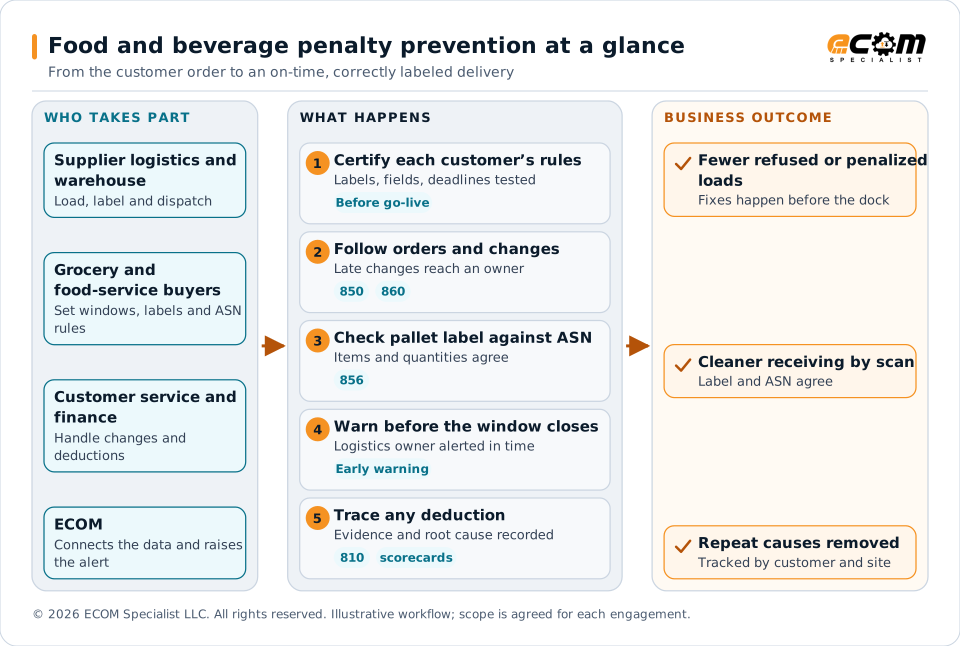
The drawing follows a food or beverage order from certification against each customer’s rules, through order changes, pallet label and ASN checks and an alert before the delivery window closes, to tracing any deduction to its cause. The result is fewer refused loads, cleaner receiving and removal of repeat causes.
The problem
Where penalties come from
Short receiving windows
A load that misses its window, or arrives without advance notice, is refused or penalized, and the product cannot wait.
Mixed-product pallets
Pallet and case labels must agree with the ASN when a pallet carries several items, lots or dates the partner asks for.
Frequent order changes
Promotions and seasonal demand change quantities late, and shipments built from stale orders create mismatches.
Many buyers, many rules
Each grocery and food-service customer publishes its own label, ASN and invoicing requirements.
Deductions with no trail
A shortage or compliance deduction arrives weeks later, and nobody can show what was sent and acknowledged.
Problem to solution
The problem, what ECOM does, and when you find out
Each row starts with the problem a food supplier is trying to solve. Retailer and distributor guides define what is required; ECOM configures the checks against them.
| The problem you are trying to solve | What ECOM does about it | When you find out |
|---|---|---|
| A load will miss its delivery window | Tracks shipment and ASN timing against the partner’s deadline and tells the logistics owner | Before the load is due, in most scenarios |
| Pallet or case labels do not match the ASN | Fills partner-specific labels from connected systems, validates identifiers and keeps SSCCs consistent with the ASN | Before the pallet is released |
| A late order change was missed | Follows orders, changes and acknowledgments together and alerts the owner to open items | As the response window runs down |
| Shipped quantities differ from the order | Reconciles shipped quantities and units of measure before the ASN and invoice are sent | Before the ASN is sent |
| A store-delivery invoice does not match the accepted delivery | Checks references and quantities across the chain before the invoice leaves | Before the invoice is sent |
| A shortage or compliance deduction arrives | Tracks it, links the related records and helps find the root cause | After the penalty, with the evidence together |
Capabilities
How ECOM solves the food and beverage penalty problem
Open any item for the detail.
Alert the right team in timeEarly warning that reaches the person who can act.
- In most scenarios, ECOM can identify conditions that may lead to a customer penalty and alert the responsible team before the penalty occurs.
- Route alerts to customer service, warehouse, logistics, finance or integration teams, with the order, the failure, the owner and the time action is needed.
Labels, ASNs and quantities that agreeOne set of shipment facts behind the pallet, the label and the notice.
- Apply partner-specific carton and pallet layouts, populate them from connected systems and validate required identifiers before release.
- Validate shipment, order, pallet, carton and item relationships, and reconcile shipped quantities and units of measure.
- Flag approaching or missed ASN transmission deadlines, and track technical acknowledgments separately from business acceptance.
Test each customer’s rules before the first shipmentCertification of documents, fields, labels and deadlines.
- Configure and test the required documents, data fields, business rules, label formats and response deadlines against each trading partner’s requirements before go-live.
Evidence and root cause when a deduction arrivesKeep the record; remove the cause.
- Preserve related transaction records, timestamps, acknowledgments, corrections and resolution history to support a response to a chargeback.
- Track penalties, identify the root cause and work with your team on a prevention plan to minimize recurrence and financial impact.
Example
Food and beverage example: a shipment-timing penalty
ASNs that arrive after the truckIllustrative workflow, not a customer result.
- A supplier’s ASNs for one distribution center repeatedly arrive after the truck. The penalties are tracked and linked to the shipments.
- The review shows the ASN waits for a manual step at the dock after loading finishes.
- The prevention plan connects the loading confirmation to the ASN workflow and alerts the logistics owner when the transmission deadline is approaching.
- On-time ASN rate for that distribution center is then compared with the pre-change baseline.
Business benefits
What this means for the business
Fewer refused or penalized loads
Timing and data problems are raised while a load can still be fixed.
Cleaner receiving
Labels and ASNs agree, so the buyer can receive by scan.
Faster answers to deductions
The shipment record is already assembled.
Fewer repeats
Causes are traced by customer, site and cause, not just invoice.
Measure the improvement
- On-time ASN rate
- Label error rate
- First-pass acceptance
- Exception age
- Documented deduction trend by customer and cause
Getting started
Start with your last few deductions
Bring customer requirements, recent deduction examples, sample pallet labels and ASNs. ECOM will identify control gaps and define a targeted prevention plan.
Frequently asked questions
Which food and beverage penalties does this address?
It addresses avoidable failures in labels, ship notices, quantities and timing. Each customer’s guide defines what is penalized, and ECOM configures the checks to match.
Does it cover direct store delivery?
ECOM supports direct-store-delivery workflows, and the same checks apply to invoices and adjustments. See the direct-store-delivery page for the scope of that solution.
How soon would we know about a problem?
In most scenarios ECOM alerts the responsible team before the penalty occurs. The warning time depends on when the source data is available and on the partner’s deadline.
Penalty Prevention by Industry
Other industries
-
Retail and consumer goods suppliers
Label, ASN, invoice and response-time penalties: caught before the shipment leaves, and traced to the cause when one slips through.
View retail and consumer goods suppliers -
Automotive suppliers
Ship notices, container labels and release responses checked against each customer’s rules, before the plant sees the problem.
View automotive suppliers -
Manufacturers and distributors
Orders, packing, ASNs, labels and invoices tied together, so a short ship or data mismatch is flagged before the customer sees it.
View manufacturers and distributors -
E-commerce and drop-ship suppliers
Order response, shipment confirmation and tracking deadlines watched across partners, with the owner alerted before the window closes.
View e-commerce and drop-ship suppliers -
3PLs and logistics providers
Client-by-client label, ASN and shipment rules enforced at the dock, with alerts and penalty tracing across every account.
View 3pls and logistics providers
Talk to an EDI/API Expert about food and beverage suppliers
Tell us about your partners, systems and goals. We will outline the scope, the workflow and what you would need to bring.