
Penalty prevention · E-commerce and drop-ship
Avoid drop-ship penalties for late confirmations, tracking and cancellations
In drop-ship programs the clock runs on every order: accept it, ship it, send the tracking number and confirm it, each inside a window set by the retailer or marketplace. Missing a step can mean a penalty, a cancelled order or a lower seller score. ECOM watches those deadlines across orders and partners and, in most scenarios, alerts the right person before the window closes.
Who it serves
Who in e-commerce and drop-ship suppliers this helps
Brands and manufacturers that drop-ship
Fulfill consumer orders on behalf of retailers and marketplaces under strict response windows.
E-commerce operations
Keep order acceptance, shipping and confirmation moving across several channels.
Warehouse and parcel teams
Know which orders are due to ship and which tracking confirmations are outstanding.
Customer service
Handle exceptions with an owner and a deadline, not a backlog.
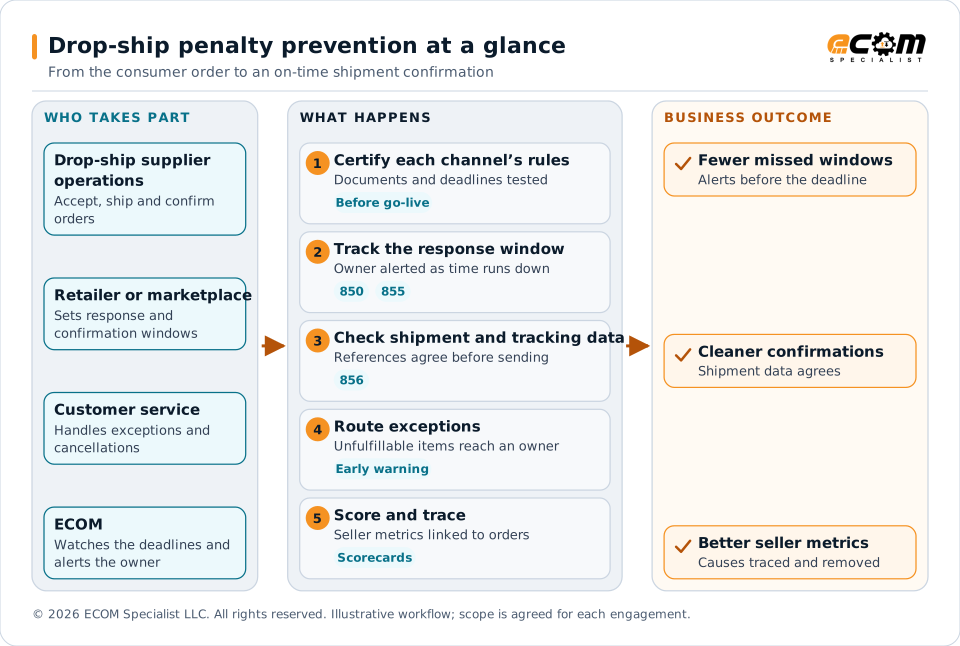
The drawing follows a drop-ship order from certification against each channel’s rules, through response-window tracking, shipment and tracking data checks, exception routing, and scorecards linked to orders. The result is fewer missed windows, cleaner confirmations and better seller metrics.
The problem
Where penalties come from
Tight response windows
Acknowledgment, shipping and tracking deadlines run per order, so a busy day can quietly miss many.
Missing or invalid tracking information
A shipment that left on time still counts as late if the confirmation and tracking never reach the partner.
Cancellations and order changes
Out-of-stock items and changed orders must be communicated promptly, or the order becomes a defect.
Different rules per channel
Each retailer or marketplace publishes its own order, confirmation and packing requirements.
Seller scores with no drill-down
A performance metric drops, but the orders behind it are hard to find.
Problem to solution
The problem, what ECOM does, and when you find out
Each row starts with the problem a drop-ship supplier is trying to solve. Each channel’s own requirements define the rules.
| The problem you are trying to solve | What ECOM does about it | When you find out |
|---|---|---|
| An order is not acknowledged in time | Tracks the response window per order and alerts the owner as it runs down | Before the window closes, in most scenarios |
| A shipment goes out but the confirmation is late | Follows shipment and confirmation together and flags missing or approaching deadlines | Before the confirmation deadline |
| Tracking is missing or inconsistent | Checks shipment references and identifiers before the confirmation is sent | Before the confirmation is sent |
| An item cannot be fulfilled | Routes the exception with its owner so the partner is told promptly | As soon as the exception is raised |
| The seller score drops | Traces measures such as late confirmations and rejected transactions to the orders behind them | Continuously, with drill-down |
| A penalty arrives | Tracks it, links the related records and helps identify the root cause and prevention plan | After the penalty, with the evidence together |
Capabilities
How ECOM solves the drop-ship penalty problem
Open any item for the detail.
Deadline alerts, order by orderEarly warning that scales with volume.
- In most scenarios, ECOM can identify conditions that may lead to a partner penalty and alert the responsible team before the penalty occurs.
- Exceptions show which order needs attention, what failed, who owns it and when action is required.
Orders, shipments and confirmations in one chainAccurate data from order to confirmation.
- Connect orders, changes, acknowledgments, packing confirmations, ship notices and invoices across configured ERP, warehouse, transportation and partner interfaces.
- Check shipment references and identifiers, and track technical acknowledgments separately from business acceptance.
Each channel’s requirements testedBefore go-live.
- Configure and test the required documents, data fields, business rules and response deadlines against each trading partner’s requirements.
Scorecards and recurring-issue preventionFix the cause behind the score.
- Measure late confirmations, rejected transactions and fulfillment accuracy, trace results to the underlying orders, assign corrective actions and compare performance afterward.
- Track any penalty to its root cause and work with your team on a prevention plan.
Example
Drop-ship example: missed confirmations on peak days
Confirmations arrive after the window on busy daysIllustrative workflow, not a customer result.
- A drop-ship supplier’s confirmations are late on high-volume days, and the retailer penalizes the late ones.
- Tracking shows that tracking numbers are keyed in batches at the end of the shift.
- The prevention plan sends confirmations from the carrier label step and alerts the shift lead when orders approach their deadline without a confirmation.
- Late-confirmation rates on peak days are then compared with the baseline.
Business benefits
What this means for the business
Fewer missed windows
The owner is told before the deadline, not after.
Cleaner confirmations
Shipment data and references agree before they are sent.
Better seller metrics
Recurring causes are traced and removed.
Less manual monitoring
Staff are alerted by exception, not by watching a list.
Measure the improvement
- On-time confirmation rate
- Rejected transaction rate
- Fulfillment accuracy
- Exception age
- Documented penalty trend by channel and cause
Getting started
Bring your channel rules and a recent penalty
Bring each channel’s requirements, a recent penalty or seller-score example and your fulfillment system details. ECOM will identify control gaps and a targeted prevention plan.
Frequently asked questions
Which drop-ship penalties can ECOM help prevent?
ECOM targets avoidable failures in order response, shipment confirmation, tracking data and timing. Each retailer or marketplace defines what is penalized.
Can ECOM connect to our order and shipping systems?
ECOM connects configured ERP, warehouse, transportation and partner interfaces. What is included depends on your systems and scope.
How is this different from drop-ship automation?
Drop-ship automation moves the orders and confirmations. Penalty prevention adds the early warning, penalty tracking and root-cause work on top of that flow.
Penalty Prevention by Industry
Other industries
-
Retail and consumer goods suppliers
Label, ASN, invoice and response-time penalties: caught before the shipment leaves, and traced to the cause when one slips through.
View retail and consumer goods suppliers -
Food and beverage suppliers
Pallet labels, ASNs and delivery windows checked together, so a late or mismatched load is flagged before it reaches the dock.
View food and beverage suppliers -
Automotive suppliers
Ship notices, container labels and release responses checked against each customer’s rules, before the plant sees the problem.
View automotive suppliers -
Manufacturers and distributors
Orders, packing, ASNs, labels and invoices tied together, so a short ship or data mismatch is flagged before the customer sees it.
View manufacturers and distributors -
3PLs and logistics providers
Client-by-client label, ASN and shipment rules enforced at the dock, with alerts and penalty tracing across every account.
View 3pls and logistics providers
Talk to an EDI/API Expert about e-commerce and drop-ship suppliers
Tell us about your partners, systems and goals. We will outline the scope, the workflow and what you would need to bring.