
EDI/API Certification · Automotive
Automotive EDI and API certification, from release to receipt
ECOM tests the exact operating rules of each automotive trading relationship: demand and schedule integrity, shipment and receiving accuracy, and the responses that keep production moving. Forecasts, releases, ship notices, receipts and invoices are certified as one connected process, not as separate files.
Who it serves
Built for automotive programs
OEMs and program owners
Certify supplier readiness against your implementation guides, with reusable requirements and clear approval evidence.
Tier 1 and Tier 2 suppliers
Prove that releases are read correctly and that shipments, labels and invoices match what the customer expects.
Component manufacturers and distributors
Test part, plant, dock and packaging data against the customer’s rules before production orders depend on it.
Automotive logistics partners
Verify the shipment and receipt events that connect suppliers, carriers and plants.
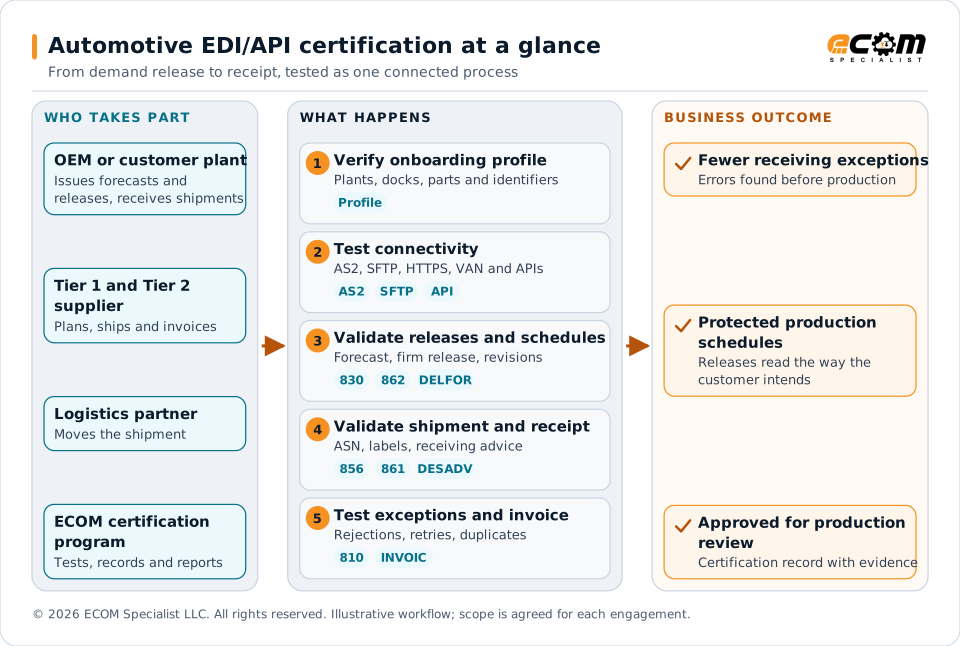
Automotive participants (the OEM or customer plant, the supplier and the logistics partner) work through ECOM’s certification stages: onboarding verification, connectivity testing, release and schedule validation, shipment and receipt validation, and exception and invoice testing. The business outcome is fewer receiving exceptions, protected production schedules and a certification record that supports production review.
Challenges
What goes wrong without a tested, connected process
Schedule misinterpretation
Forecasts and firm releases look alike. Date buckets, replacement rules and changes to issued demand must be applied exactly as the customer intends.
Plant and dock routing errors
A valid message sent to the wrong plant or dock still disrupts receiving. Part numbers, plant codes and delivery locations must match.
Inconsistent cumulative quantities
Shipped and received cumulative quantities drift apart when baselines, reset dates or receipt adjustments are handled differently.
Shipment identification defects
Container, pallet and packaging data on the ASN must align with the shipment labels, or receiving exceptions follow.
Similarly named messages that are not interchangeable
Implementation guides decide the exact message versions and required responses. ECOM does not assume that similar messages behave the same way.
Workflows and documents
The workflow and the documents behind it
Programs can cover X12 planning and shipping schedules, ship notices, receiving advice and invoices, together with partner-required EDIFACT or other automotive formats. The implementation guide determines the exact versions and required responses.
| Business process | Illustrative messages or interfaces |
|---|---|
| Forecast and material releases | X12 830; EDIFACT DELFOR; partner scheduling APIs |
| Shipping schedules and sequence | X12 862 or 866 where specified; EDIFACT DELJIT; partner sequence or call-off interfaces |
| Shipping and receipt | X12 856 and 861; EDIFACT DESADV and RECADV where specified; shipment and receiving APIs |
| Commercial completion | X12 810 or EDIFACT INVOIC; agreed acknowledgments and business responses |
Capabilities
What ECOM certifies for automotive programs
Open any item for the detail.
Demand and schedule integrityForecasts, firm releases and revisions are applied the way the customer’s rules require.
- Verify customer and supplier part numbers, plant and dock codes, delivery locations, packaging references and units of measure.
- Distinguish forecasts from firm releases and validate date buckets, schedule replacement rules and changes to previously issued demand.
- Test cumulative quantities, reset dates and reconciliation logic where required, including receipt adjustments and revised schedules.
- Validate time zones, shift or delivery windows and the difference between shipment dates and required delivery dates.
Shipment and receiving integrityAccepted demand is connected to the shipment and to the receiving response.
- Verify part quantities, container or pallet identification and the packaging hierarchy.
- Check lot or serial references where required.
- Check alignment between the ASN and the shipment labels. Automotive labels are tested against the applicable customer or industry specification; GS1 rules are applied only where required.
Connectivity and API testingBoth directions of every agreed route are verified, not just an open session.
- AS2: partner IDs, signing and encryption, certificate trust, MDN handling and correlation to the original message.
- SFTP: host key verification, authentication, authorized folders, file naming and duplicate pickup prevention.
- HTTPS and APIs: TLS trust, approved authentication, request and response contracts, callbacks, timeouts and error responses.
- VAN and other routes: mailbox or route configuration, interchange addressing and delivery evidence.
Validation in layersSyntax is checked first; business meaning decides the result.
- Document layer: required values, totals and code lists, for example a missing ship-to identifier.
- Partner rules layer: an allowed standard code that this partner’s implementation guide prohibits.
- Transaction chain layer: an ASN that references the wrong order or release.
- Application outcome layer: a message that is received but does not create or update the intended ERP, WMS or TMS record.
- Exception and recovery layer: a retry that creates a second invoice, or a delayed event that overwrites a newer shipment status.
Onboarding verificationA verified partner profile is in place before testing begins.
- The profile records the legal entity, locations, technical and business contacts, escalation owners, partner identifiers, required documents, connection methods and target production dates.
- Sender and receiver identifiers, qualifiers, routing values and environment-specific endpoints are checked against the approved setup.
- Required fields and approvals prevent an incomplete profile from advancing unnoticed.
In practice
Automotive full-cycle scenarios
Forecast through firm release and shipmentReceive a forecast, apply a firm release, ship, send the ASN and reconcile the receipt.
- Receive an initial forecast, apply a firm shipping release, acknowledge as required, create the shipment, generate the ASN and reconcile the receiving result.
- Pass criteria: the correct part, plant, release reference, quantity, packaging structure and timing, with consistent identifiers across every message and system record.
Schedule revision after demand is loadedA revised schedule replaces the old one without leaving duplicate demand.
- Replace or revise a prior schedule and verify that the receiving application applies the agreed replacement or net-change rules.
- Include reduced quantities, moved dates and deleted demand.
- Confirm that superseded requirements do not remain as additional demand and that valid firm commitments follow the customer’s rules.
Cumulative quantity discrepancyA shipped-versus-received difference is found and corrected without rewriting history.
- Introduce a difference between shipped and received cumulative quantities.
- Verify the discrepancy is detected, the correct baseline and reset date are used, and the approved adjustment resolves it without rewriting unrelated history.
- Include a year-end or model-year reset where applicable.
Sequence-sensitive replenishmentValid, missing, duplicate and out-of-order sequence references are all handled.
- Submit valid, missing, duplicate and out-of-order sequence references.
- Check the response to a revised sequence, a late transmission or an unavailable part.
- Verify escalation and disposition against the customer’s operating rules, including whether a correction is allowed after shipment preparation.
ASN rejection and corrected resubmissionA bad ASN is rejected, corrected and retested without creating two inbound shipments.
- Submit an ASN with an invalid container reference or a quantity mismatch.
- Confirm rejection or quarantine, actionable diagnostics, correction and retest.
- Verify the corrected ASN keeps the right business relationships and does not create two inbound shipments.
Connectivity interruption during a release cycleRetry and recovery preserve order and prevent duplicate processing.
- Interrupt transmission while a schedule or shipment is being exchanged.
- Confirm that alerts, retry and recovery preserve the agreed ordering and prevent duplicate processing.
- Demonstrate that the operations team can identify the last accepted release and any outstanding response.
Business benefits
What this means for the business
Find schedule and routing errors before production does
Misread releases, plant-routing errors and inconsistent cumulative quantities are exposed in testing, ahead of receiving exceptions or production disruption.
Less manual reconciliation
Shipment identification defects are caught before they turn into manual reconciliation work.
Measured, not promised
Customer-specific deductions and operational impacts are measured from actual results rather than promised as eliminated.
One view of readiness
Business and technical teams share the same view of readiness, blockers, ownership and the next action.
Automotive certification evidence
The certification record states what was approved and under which conditions.
- Approved plant, part, dock, packaging and schedule profiles with the tested guide versions.
- Correlated forecast, release, shipment and receipt results, including application evidence for the systems in scope.
- Completed exception and recovery cases, with unresolved items assigned an owner and an approved disposition.
- A certification record stating the business models, sites, documents and versions approved for production review.
Getting started
Start with one plant or one customer program
Bring the customer’s implementation guides, the interfaces required, your business models, sample transactions, connection requirements and the systems involved. ECOM uses them to set the test scope, define success and assign the self-service workflow.
Frequently asked questions
What does automotive EDI and API certification cover?
It covers onboarding verification, connectivity testing, document and API validation, and full-cycle business scenarios from forecast and firm release through shipment, receipt and invoice, plus exception and recovery cases. The customer’s implementation guides decide the exact scope.
Which automotive documents can be tested?
Programs can include X12 830, 862 or 866, 856, 861 and 810, EDIFACT DELFOR, DELJIT, DESADV, RECADV and INVOIC, and partner scheduling, sequence, call-off, shipment and receiving APIs. Message versions and required responses follow the implementation guide.
Does a passing certification guarantee production acceptance?
No. Certification confirms the tested scope and version. The customer’s own production authorization remains a separate approval where required, and results should be measured from actual production performance.
Can we use our own EDI translator or ERP?
Yes. ECOM supports organizations using their own EDI translator, integration platform, ERP, WMS, TMS or external service provider. Tests focus on the agreed interface and the business outcome.
Can we start with one customer or plant?
Yes. You can start with a single partner or launch a broader program organized by supplier group, plant, customer or carrier.
EDI/API Certification Program by Industry
Other industries
-
Retail
Orders, acknowledgments, labels, ASNs, invoices and inventory tested against each retailer’s guide.
View retail -
Trucking and carriers
Tenders, responses, status events, delivery evidence and freight invoices tested across EDI and API.
View trucking and carriers
Talk to an EDI/API Expert about automotive
Tell us about your partners, systems and goals. We will outline the scope, the workflow and what you would need to bring.