
EDI/API Certification · Retail
Retail EDI and API certification, from purchase order to payment
ECOM tests the order model that you and your retailer actually use, including distribution center replenishment, direct-to-store, cross-dock and direct-to-consumer fulfillment. Orders, labels, ship notices and invoices are validated against the retailer’s current guide and connected to the related business records.
Who it serves
Built for retail programs
Retailers and program owners
Run repeatable supplier certification with reusable test plans, clear status and recorded approvals.
Manufacturers and brands
Prove you can meet a retailer’s order, label, ASN and invoice requirements before the first live order.
Distributors and marketplaces
Test the order model your program uses, from replenishment to marketplace fulfillment.
Fulfillment partners and 3PLs
Certify the handoff of order, carton and tracking data when a warehouse ships on a seller’s behalf.
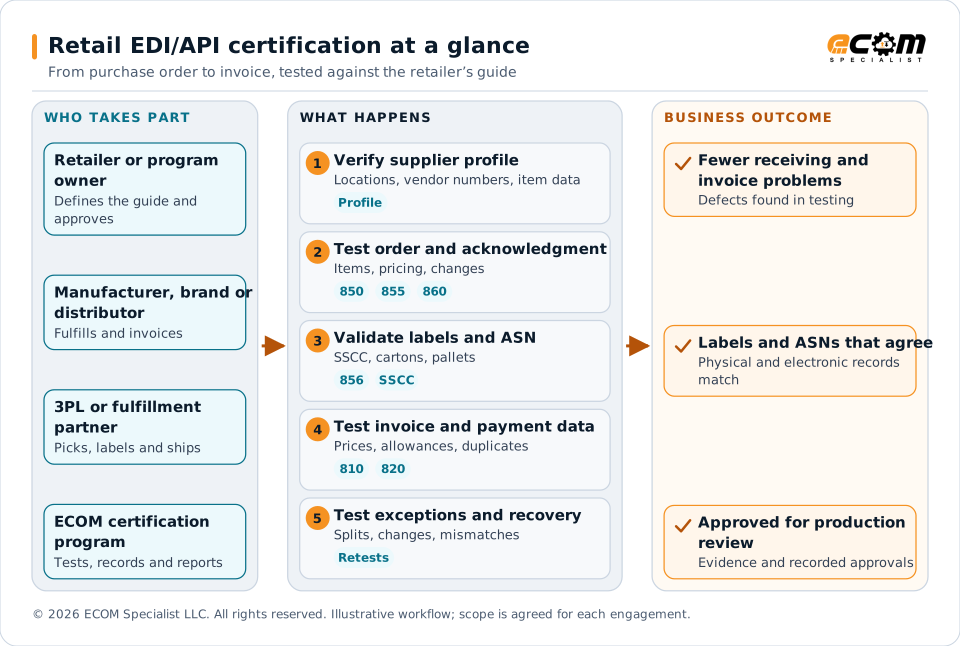
Retail participants (the retailer, the supplier and any fulfillment partner) work through ECOM’s certification stages: supplier profile verification, order and acknowledgment testing, label and ASN validation, invoice and payment data testing, and exception and recovery testing. The business outcome is fewer receiving and invoice problems, labels and ASNs that agree, and an evidence package for production review.
Challenges
What goes wrong without a tested, connected process
Order and item accuracy
Retailer and supplier item identifiers, GTINs, case packs, units of measure, pricing, allowances and ship-to locations must all agree.
Label and ASN mismatches
Shipment, order, item, carton and pallet information must stay consistent across the shipping process, labels included.
Rejected invoices and manual work
Price, allowance, quantity and reference errors lead to rejected invoices, manual follow-up and chargebacks.
Changes and cancellations
An old order version must not silently overwrite an accepted update, and a cancellation must not create an unsupported shipment or invoice.
Many order models
Replenishment, direct-to-store, cross-dock and direct-to-consumer fulfillment each have different rules and timing.
Workflows and documents
The workflow and the documents behind it
An assigned test plan can cover purchase orders, order acknowledgments, changes, ship notices, invoices, inventory, returns and remittance data. Each document is tested against the retailer’s current implementation guide and connected to the related business records.
| Business purpose | Illustrative X12 documents |
|---|---|
| Place and confirm orders | 850 purchase order, 855 purchase order acknowledgment, 860 purchase order change and 865 response where required |
| Ship and receive goods | 856 ship notice and 861 receiving advice where used |
| Invoice and reconcile payment | 810 invoice and 820 payment order or remittance advice as applicable |
| Inventory and product information | 846 inventory inquiry or advice and 832 price or sales catalog where required |
| Coordinate warehouse execution | 940 warehouse shipping order and 945 warehouse shipping advice for applicable 3PL flows |
Capabilities
What ECOM certifies for retail programs
Open any item for the detail.
Order and item accuracyOrders are tested against the retailer’s item, price and location rules.
- Verify retailer and supplier item identifiers, GTINs where required, case packs, units of measure, pricing, allowances, tax and freight rules, ship-to locations, requested dates and order references.
- Exercise accepted quantities, backorders, rejected lines, substitutions and changes within the retailer’s permitted workflow.
Shipping labels and ASN accuracyLabels and the ASN are checked against each other, not in isolation.
- Check that shipment, order, item, carton and pallet information stays consistent across the shipping process.
- Where GS1 logistics labeling applies, validate SSCC structure and uniqueness rules, label-to-ASN correlation and the required packaging hierarchy.
- Label content and layout review can be included. Physical barcode print-quality verification requires the agreed scan or verifier evidence.
Retail operating readinessASN timing, shipment accuracy, invoice reconciliation and response deadlines are measurable conditions.
- Evaluate ASN timing, shipment accuracy, invoice reconciliation and response deadlines as measurable conditions.
- Test the defects that can lead to receiving exceptions, rejected invoices, manual work or chargebacks.
- A certification pass demonstrates the agreed scenarios. It does not guarantee that all later production transactions will be accepted.
Connectivity and API testingBoth directions of every agreed route are verified.
- AS2, SFTP, HTTPS and API, VAN and other routes are tested for authentication, routing, payload delivery and the expected technical responses.
- Technical receipts, AS2 MDNs, EDI acknowledgments, API responses and business acceptance each prove something different, and ECOM tests the layers the retailer requires.
Onboarding verificationA verified supplier profile comes first.
- Collect ship-to locations, vendor or customer numbers, item references and the other master data needed for realistic tests.
- Separate partner-submitted information from information verified by the program owner.
In practice
Retail full-cycle scenarios
Distribution center replenishmentA multi-item order flows through acknowledgment, labels, ASN and invoice.
- Issue a purchase order containing multiple items and pack sizes, validate the acknowledgment, prepare a shipment, generate labels and an ASN, and submit the invoice.
- Pass criteria: consistent item and location references, quantities, shipment hierarchy, agreed pricing and invoice totals, with technical and business responses inside the defined windows.
Split shipment and partial fulfillmentOne order across several shipments or dates, with open quantities tracked correctly.
- Fulfill one order across multiple shipments or dates and check that each shipment and invoice references the correct order lines.
- Check that cumulative shipped quantities do not exceed the permitted quantity and that remaining quantities stay open or close under the retailer’s rules.
- Include mixed cartons and multiple pallets where relevant.
Order change or cancellationChanges before and after warehouse execution begins.
- Apply a change before picking and another after the warehouse has begun execution.
- Confirm the required acknowledgment, the permitted operational response and any escalation.
- An old order version must not silently overwrite an accepted update, and a cancellation must not create an unsupported shipment or invoice.
Direct-to-consumer fulfillmentConsumer delivery details, shipment confirmation and cancellation timing.
- Test consumer delivery details, item availability, shipment confirmation, tracking references, packing slip requirements and cancellation timing.
- Use masked consumer information in the test environment.
- Validate that customer-facing data and carrier information follow the retailer’s contract without leaking data to another partner.
Label and ASN mismatchA missing SSCC or duplicated carton identifier is caught before approval.
- Submit a shipment where an SSCC is missing from the ASN, a carton identifier is duplicated, or carton contents differ from the shipment data.
- Verify the issue is identified before approval, then correct and retest the affected labels and ASN together.
Invoice discrepancy and recoveryPrice, allowance, quantity or reference errors, with duplicate-invoice controls.
- Introduce a price, allowance, quantity or reference error and verify the required rejection or exception response, the correction method and the duplicate-invoice controls.
- Where credit or debit documents are in scope, test the approved adjustment flow. An EDI acknowledgment does not confirm payment approval.
Inventory and 3PL coordinationInventory updates, warehouse instructions and confirmations reconciled.
- Compare inventory updates with order allocation rules, send a warehouse shipping instruction and reconcile the warehouse confirmation.
- Test stock shortages, partial picks and duplicate confirmations.
- When the warehouse generates the ASN, certify the ownership and handoff of order, carton and tracking data explicitly.
Business benefits
What this means for the business
Fewer preventable receiving problems
Order, label, ASN and invoice defects are found in testing, before they cause receiving exceptions, rejected invoices or chargebacks.
Faster, repeatable supplier onboarding
Reusable test plans and evidence reduce repeated onboarding work for each new supplier.
Labels and ASNs that agree
Correcting and retesting labels and the ASN together keeps the physical carton and the electronic record consistent.
A shared view of readiness
Retailer, supplier and ECOM see the same status, open issues and next action.
Retail certification evidence
The final package records what was certified and what remains for the retailer to approve.
- The certified order models and the retailer guide versions used.
- Item and location test data, and validated labels.
- Transaction chains and exception results.
- Approvals, with retailer acceptance recorded separately when the retailer or its designated program must give final authorization.
Getting started
Start with one retailer’s requirement guide
Bring the retailer’s implementation guide, your order model, sample transactions, label requirements and the systems involved. ECOM defines the scope, success criteria and the self-service workflow from those inputs.
Frequently asked questions
What is retail EDI certification?
It is the process of proving that a supplier can exchange the documents a retailer requires and produce the expected business result. ECOM tests orders, acknowledgments, changes, labels, ship notices, invoices, inventory and related documents against the retailer’s current guide.
Does ECOM test shipping labels and SSCCs?
Yes. Where GS1 logistics labeling applies, ECOM validates SSCC structure and uniqueness rules, label-to-ASN correlation and the packaging hierarchy. Label content and layout review can be included; physical barcode print-quality verification requires agreed scan or verifier evidence.
Does passing certification prevent chargebacks?
No. A pass demonstrates the agreed scenarios. It does not guarantee that every later production transaction will be accepted, so results should be measured from actual performance.
Which order models can be certified?
ECOM tests the model the parties actually use, including distribution center replenishment, direct-to-store, cross-dock and direct-to-consumer fulfillment where applicable.
Can retailers use this to onboard many suppliers?
Yes. Program owners create reusable certification templates, assign mandatory and optional scenarios, coordinate onboarding waves and see which partners are blocked and why.
EDI/API Certification Program by Industry
Other industries
-
Automotive
Forecasts, shipping schedules, ASNs, receiving advice and invoices tested as one chain, against each customer’s rules.
View automotive -
Trucking and carriers
Tenders, responses, status events, delivery evidence and freight invoices tested across EDI and API.
View trucking and carriers
Talk to an EDI/API Expert about retail
Tell us about your partners, systems and goals. We will outline the scope, the workflow and what you would need to bring.