
EDI/API Certification · Trucking and carriers
Carrier EDI and API certification, from load tender to freight invoice
Carrier certification verifies the flow from load tender through acceptance, execution, shipment visibility, delivery and freight billing. It supports trucking companies, asset-based carriers, brokers, logistics providers and shipper transportation teams using TMS applications, EDI, APIs or a combination.
Who it serves
Built for trucking and carriers programs
Trucking companies and asset-based carriers
Show a shipper that tenders, status events and invoices work before you carry live freight.
Brokers and logistics providers
Certify tender, status and billing flows across the shippers and carriers you connect.
Shipper transportation teams
Onboard carriers in waves with clear requirements and visible blockers.
TMS and API users
Test EDI interfaces, APIs and webhooks together, without treating the transport as proof of readiness.
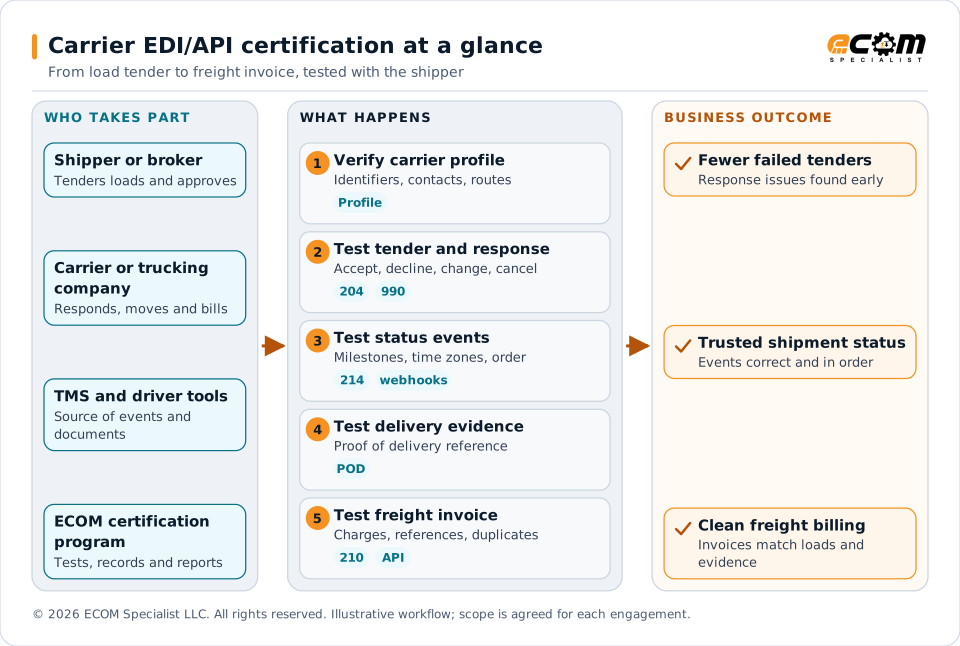
Carrier participants (the shipper or broker, the carrier and its TMS and driver tools) work through ECOM’s certification stages: carrier profile verification, tender and response testing, status event testing, delivery evidence testing and freight invoice testing. The business outcome is fewer failed tenders, trusted shipment status and clean freight billing.
Challenges
What goes wrong without a tested, connected process
Tender response failures
Late, missing or mismatched responses leave loads unassigned. Acceptance, decline, change and cancellation behavior must follow the shipper’s rules.
Visibility gaps
Milestone codes, event time, time zone and location must be correct, and duplicate, missing or out-of-order events must be handled.
Mismatched load references
Status events and invoices must match the load, stop and reference numbers the shipper recognizes.
Freight billing defects
Base charges, fuel surcharges, accessorials, currency and totals must reconcile with the load and its supporting evidence.
Mobile and telematics handoffs
A source event is not delivered to the shipper until the handoff and downstream representation are certified.
Workflows and documents
The workflow and the documents behind it
Carrier certification covers the core transportation exchanges, whether they run through EDI, APIs or both.
| Business activity | Illustrative interface |
|---|---|
| Offer a load | X12 204 Motor Carrier Load Tender or a load-tender API |
| Accept or decline | X12 990 Response to a Load Tender or the agreed API response |
| Report shipment milestones | X12 214 Transportation Carrier Shipment Status Message, or tracking events through APIs and webhooks |
| Submit freight charges | X12 210 Motor Carrier Freight Details and Invoice, or a freight-billing API |
| Supporting exchanges | Agreed acknowledgments, bill of lading data, delivery evidence and other partner-required messages |
Capabilities
What ECOM certifies for carrier programs
Open any item for the detail.
Tender and response accuracyTender acceptance, decline, changes and cancellation follow the shipper’s requirements.
- Test carrier identifiers, load and shipment references, pickup and delivery locations, stop sequence, equipment requirements, appointment windows, commodity and handling details, and response deadlines.
Reliable shipment visibilityStatus events carry the right milestone, time, location and shipment.
- Verify milestone codes, event time, time zone, location and shipment correlation.
- Evaluate event occurrence time and transmission time separately, so a delayed message does not imply the delivery occurred late.
- Test duplicate, missing and out-of-order events against the agreed status progression rules.
Freight billing and delivery evidenceInvoices connect to the right loads, references and proof of delivery.
- Connect invoices to the correct loads, bills of lading, purchase orders or other required references.
- Validate base charges, fuel surcharges, accessorials, currency and totals.
- Where proof of delivery is in scope, verify the required document or reference, its association to the shipment and the retrieval or delivery process.
Connectivity and API testingAuthentication, routing, payloads and behavior in each direction.
- Test AS2, SFTP, HTTPS and APIs, and VAN or other routes for authentication, authorization, routing and expected technical responses.
- For APIs, test idempotency, duplicate requests, retries, throttling, webhook authentication, duplicate event handling and correlation of callbacks to the right business object.
- Confirm that invalid requests produce actionable errors without creating partial or duplicate records.
Mobile and telematics handoffsCertification includes the event handoff and what the shipper sees.
- For integrations that rely on mobile capture or telematics, certification includes the event handoff and its downstream representation.
- The existence of a source event does not guarantee successful delivery to the shipper.
In practice
Carrier full-cycle scenarios
Tender through delivery and invoiceThe full chain, linked to the original load.
- Receive a load tender, accept it, report pickup and in-transit milestones, confirm delivery, provide the required delivery evidence and submit the freight invoice.
- Pass criteria: consistent carrier and shipment references, valid stop information, milestone timing and reconciled charges, with each receipt and business response linked to the original load.
Decline and response deadlineA decline with an approved reason, and a tender with no response.
- Decline a tender using an approved reason, then test a tender with no response before the deadline.
- Verify the shipper’s required status, alert and escalation behavior.
- A late acceptance must not silently reactivate a load already reassigned under the agreed rules.
Multi-stop load and revised appointmentsStop-specific references and updated windows.
- Test multiple pickups and deliveries, stop-specific references and updated appointment windows.
- Confirm that events identify the correct stop and that changes reach the relevant system without duplicating the load.
- Include an event that is valid for one stop but invalid for another.
Delayed and out-of-order status eventsOriginal event history kept, wrong current status prevented.
- Submit a delivery event before a delayed pickup event, resend an event, and provide an invalid time zone or location.
- Verify the contract’s handling rules: keep the original event history while preventing an incorrect current shipment status.
- Missing required milestones should remain visible as exceptions.
Offline capture and restored connectivityEvents captured while disconnected arrive once and in order.
- Where the connected driver application supports offline operation, capture events while disconnected and synchronize later.
- Verify original event timestamps, uniqueness, delivery sequence and acknowledgment after reconnection.
- The certification tests the integration’s observable behavior and identifies any dependence on manual correction.
Tender revision and cancellation after acceptanceEquipment, stops or windows change, then the load is cancelled.
- Change the equipment, stop details or delivery window, then exercise a cancellation.
- Confirm the carrier response, TMS update and business escalation required at each stage.
- An obsolete tender version must not overwrite the accepted revision or incorrectly release an active movement.
Freight invoice exception and correctionDuplicate, invalid-reference and unsupported-accessorial invoices.
- Submit a duplicate invoice, an invalid load reference and an unsupported accessorial, and confirm detection and the required disposition.
- Retest a corrected invoice or adjustment and verify that charges are applied once, with supporting evidence attached or referenced as required.
Business benefits
What this means for the business
Tender-response problems found early
Response failures, visibility gaps, mismatched load references and billing defects are identified before production.
Status you can trust
Event time, transmission time and status progression are tested separately, so the shipper’s view reflects what happened.
Cleaner freight billing
Invoices tie to the right load, charges and delivery evidence, with duplicate protection.
Clear ownership of open items
Open operational exceptions are visible to the production approver with owners and acceptance conditions.
Carrier certification evidence
The final record identifies:
- The certified shipper-carrier relationship and the transport profile.
- TMS endpoints, tender response rules and milestone definitions.
- Billing scenarios and recovery cases.
- Open operational exceptions, with clear ownership and acceptance conditions for the production approver.
Getting started
Start with one shipper or one lane
Bring the shipper’s implementation guide or API contract, sample tenders, the status events required, a freight invoice example and details of your TMS. ECOM defines the scope and the self-service workflow from those inputs.
Frequently asked questions
What does carrier EDI and API certification include?
It covers carrier onboarding verification, connectivity testing, tender and response, status events, delivery evidence and freight invoicing, tested across EDI, APIs or both, plus exception and recovery cases.
Which transportation documents are tested?
Programs commonly include X12 204, 990, 214 and 210, or the equivalent load-tender, response, tracking and freight-billing APIs, together with the acknowledgments and delivery evidence the shipper requires.
Can ECOM test status events from a mobile driver app?
Yes, where the connected application supports it. ECOM tests the event handoff and downstream representation, including offline capture and synchronization, without assuming that a source event guarantees delivery to the shipper.
Do you test API webhooks as well as EDI?
Yes. For APIs, scenarios cover webhook authentication, duplicate event handling, delivery retry and correlation of callbacks to the correct business object.
Does certification replace shipper approval?
No. Certification confirms the tested scope and version. Shipper or customer production authorization remains a separate approval where required.
EDI/API Certification Program by Industry
Other industries
-
Automotive
Forecasts, shipping schedules, ASNs, receiving advice and invoices tested as one chain, against each customer’s rules.
View automotive -
Retail
Orders, acknowledgments, labels, ASNs, invoices and inventory tested against each retailer’s guide.
View retail
Talk to an EDI/API Expert about trucking and carriers
Tell us about your partners, systems and goals. We will outline the scope, the workflow and what you would need to bring.