
AI automation · Retailers
AI automation for retailers: start where waiting costs you most
For a retailer, AI pays off when it improves the decisions that decide whether a product is available, an order is profitable and a customer returns. That reaches well beyond a shopping chatbot. Accounting, merchandising, store operations, HR and fulfillment can all work from the same connected information and catch problems earlier. ECOM’s AI automation specialists help you pick the first workflow, connect the data, keep people in control and prove the result before you spend more.
Who it serves
Who in retailers this helps
Finance and controllers
Cut invoice rekeying and surface exceptions while you can still act on them.
Merchandising and supply planning
Compare forecasts with a simple baseline and see supplier delays before a promotion depends on them.
Store, ecommerce and service leaders
Prioritize tasks, answer status questions faster and tell customers about delays first.
IT and data owners
Connect orders, shipments and inventory so every automated step works from current records.
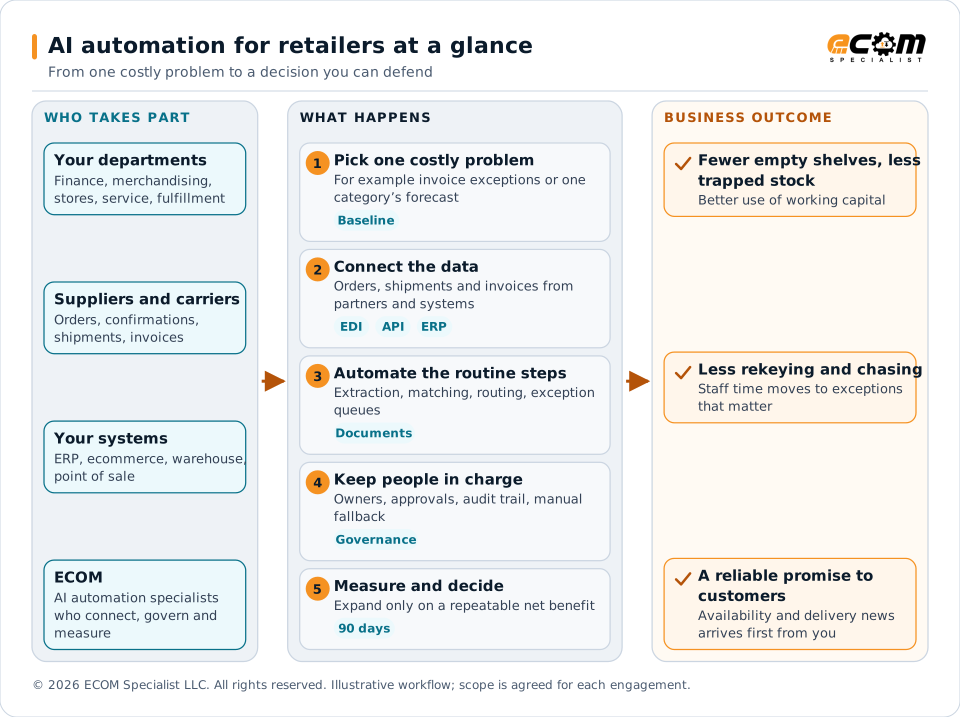
The drawing follows a retailer from one costly recurring problem, through connecting data from partners and systems, automating routine steps, keeping people in charge and measuring the result over 90 days. The outcomes are better use of working capital, less rekeying and a more reliable promise to customers. These are goals to measure against your own baseline, not guaranteed results.
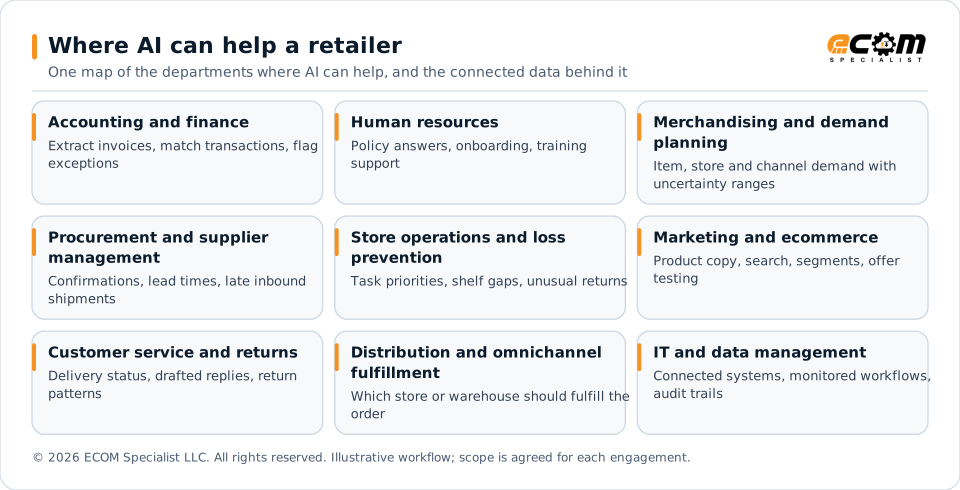
The map lists 9 departments and, for each, the kind of work AI can support: accounting and finance (extract invoices, match transactions, flag exceptions); human resources (policy answers, onboarding, training support); merchandising and demand planning (item, store and channel demand with uncertainty ranges); procurement and supplier management (confirmations, lead times, late inbound shipments); store operations and loss prevention (task priorities, shelf gaps, unusual returns); marketing and ecommerce (product copy, search, segments, offer testing); customer service and returns (delivery status, drafted replies, return patterns); distribution and omnichannel fulfillment (which store or warehouse should fulfill the order); it and data management (connected systems, monitored workflows, audit trails). These are practical opportunities, not claims that every company has implemented them.
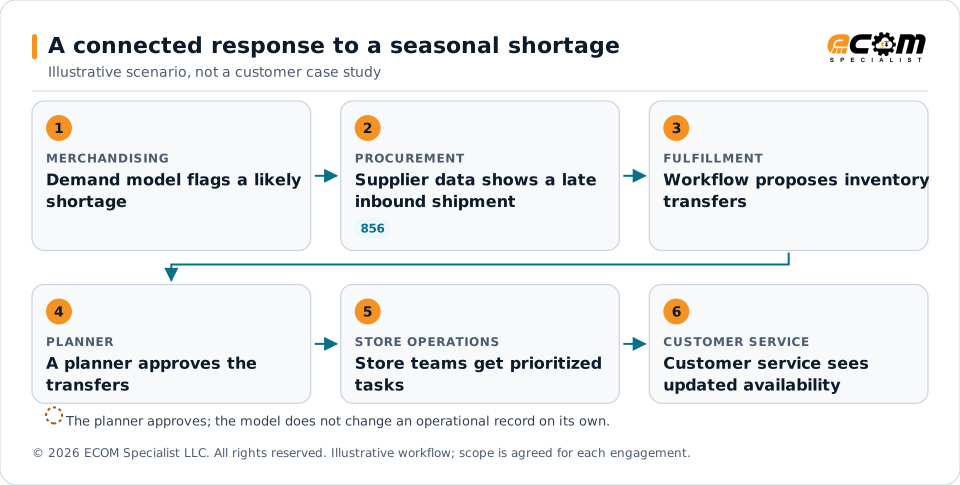
A demand model flags a likely shortage at several stores. Supplier data shows a late inbound shipment, and a fulfillment workflow proposes inventory transfers. A planner approves the transfers, store teams receive prioritized tasks and customer service receives updated availability. Connecting the departments means each learns about the shortage once, before customers do.
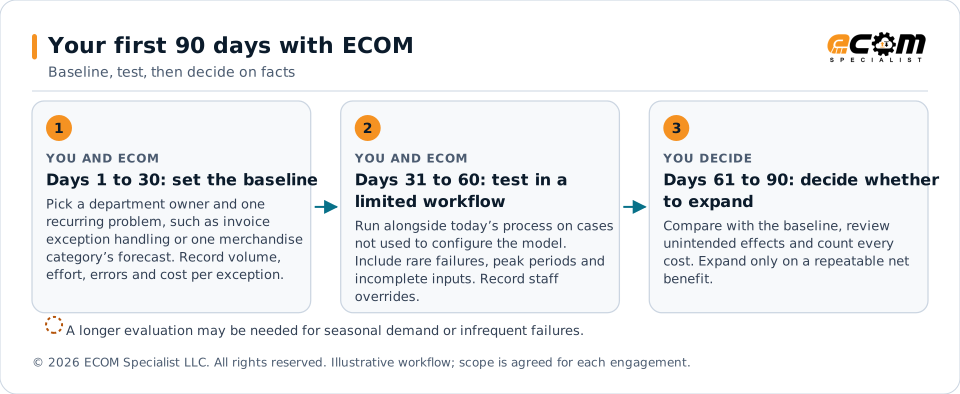
Days 1 to 30 set a baseline: a department owner, one recurring problem, current volume, effort, errors and cost per exception, confirmed data access and a definition of success. Days 31 to 60 test in a limited workflow, alongside the current process, on cases not used to configure the model, with staff overrides recorded. Days 61 to 90 compare the results with the baseline, count every cost and expand only if a repeatable net benefit is shown.
The cost of waiting
What companies miss by waiting
Documents are rekeyed by hand
Staff spend time keying invoices and chasing routine discrepancies, and management sees cash and margin problems only after the close.
Buyers repeat last year’s quantities
Without demand analysis, working capital is trapped in slow sellers while fast-selling locations run empty.
Shortages are found by email chase
Purchasing learns about a late inbound shipment from a missed receipt, with no time to rebalance stock or find another source.
Customers hear about delays first
Service answers the same tracking questions repeatedly, and defects stay buried in individual cases.
Each department finds the same problem separately
Without a connected process, one seasonal shortage is discovered by planning, stores and service one after another, after customers meet it.
Department by department
Where AI helps, what waiting costs and how ECOM helps
The department list below comes from practical opportunities, not claims that every retailer has implemented them. Start with one row, not seven.
| Department | Where AI can help | What waiting costs | How ECOM helps, and what to measure |
|---|---|---|---|
| Accounting and finance | Extract invoice and remittance details, suggest account coding, match transactions, prioritize exceptions and flag unusual payments. | Staff rekey documents and chase routine discrepancies. Cash and margin problems show up only after the reporting cycle closes. | Connects invoices, receipts, purchase orders and remittances from EDI, APIs and documents into one matched flow with exception queues. The controller keeps approval of payments, write-offs and material adjustments. Measure: cost per transaction, exception rate, days to close, overdue receivables. |
| Human resources | Answer questions from approved policies, guide onboarding, suggest role-specific training and forecast staffing demand. | Experienced employees repeat the same procedures, new hires take longer to become productive and staffing reacts only after overtime has risen. | Starts with policy search and training support built on approved content. Hiring, pay and disciplinary decisions stay under accountable human review. Measure: onboarding time, policy response time, training completion, overtime. |
| Merchandising and demand planning | Estimate demand by item, store and channel from sales, promotions, availability and seasonal patterns. Summarize category performance and flag assortments that no longer match local demand. | Buyers repeat last year’s quantities after customer behavior has changed. Working capital sits in slow sellers while fast-selling locations run empty. | Brings sales, order, inventory and shipment data together from your systems and trading partners, and sets up the comparison of each forecast with a simple seasonal baseline. Correct for lost sales during stockouts so suppressed sales do not look like low demand. Measure: forecast error and bias, stockout rate, inventory turns, gross margin return on inventory. |
| Procurement and supplier management | Compare supplier confirmations with purchase orders, spot changing lead times and prioritize late or incomplete inbound shipments. Combine delivery reliability, defects and shortages into a supplier score. | Purchasing finds shortages through email chases or missed receipts, with no time to rebalance inventory or secure another source before a promotion. | Links supplier identifiers, order confirmations, advance shipping notices and receiving records so a late or short shipment surfaces as an exception with an owner. Measure: supplier on-time-in-full delivery, purchase order exceptions, expedite spend. |
| Store operations and loss prevention | Recommend replenishment, shelf-check and fulfillment tasks from actual demand. Computer vision or anomaly detection can flag possible shelf gaps, scanning mistakes or unusual returns for review. | Employees spend time searching for work or stock while shoppers meet empty shelves. Loss investigations stay reactive and too broad to find the process failure. | Supplies the order, shipment and inventory events that make task recommendations accurate. An alert is a lead for investigation, not evidence that a customer or employee acted improperly. Measure: shelf availability, replenishment time, shrink, alert precision. |
| Marketing and ecommerce | Draft product copy from approved attributes, improve search relevance and segment campaigns. Estimate purchase propensity and churn risk, and test offers against a control group. | Campaigns reach customers with irrelevant offers and product content takes longer to publish. Promotions keep buying volume with little incremental profit. | Connects ecommerce, order and inventory data so offers reflect real availability. Generated descriptions are checked for inaccurate materials, sizing, compatibility and unsupported claims. Measure: incremental contribution margin, conversion, repeat purchases, acquisition cost. |
| Customer service and returns | Explain delivery status and prepare responses from approved order and policy data, route complex cases and identify products or suppliers linked to repeated returns. | Service teams answer the same tracking questions again and again, product defects stay buried in single cases and customers learn about a delay before you tell them. | Feeds order and shipment events to the service workflow. Exceptions to refund policy need approval, and there is a clear handoff to a person. Measure: first contact resolution, handling time, repeat contacts, return reasons. |
| Distribution and omnichannel fulfillment | Suggest which store or warehouse should fulfill an order from inventory confidence, capacity, delivery cost and the promised date. Route returns toward inspection, resale or another disposition. | Uncoordinated decisions split shipments unnecessarily and sell inventory that is not really available. The lost opportunity is a more reliable promise at a lower cost to serve. | Connects point of sale, ecommerce, order management, warehouse and carrier events through EDI and APIs so allocation works from one version of the truth. Measure: order accuracy, cost per order, split shipment rate, on-time fulfillment. |
| IT and data management | Summarize incidents, help diagnose integration failures and identify unusual system behavior. | Departments keep conflicting spreadsheets and AI works from stale records, so one wrong inventory balance or customer identity spreads errors across the business. | Connects operational systems through managed EDI and API integrations with monitoring, a named owner, an audit trail and a way to reverse each action. Measure: data freshness, integration failures, duplicate records, recovery time. |
Capabilities
How ECOM’s AI automation specialists help retailers
Open any item for the detail.
Start with the right first workflowInvoice exceptions and one category’s forecast are common starting points.
- Choose a department owner and one recurring problem. For many retailers that means invoice exception handling, demand forecasting for one merchandise category, or a limited supplier group.
- Compare the forecast against your current method across a full replenishment cycle, and test the administrative workflow on a limited supplier group.
- Record current volume, labor effort, errors, service outcomes and the cost of each exception before you select any tool.
Connect the data your AI needsOrders, confirmations, shipments and invoices from the systems that already hold them.
- EDI and APIs can supply orders, order confirmations, shipment events and invoices from your trading partners and your ERP, warehouse and transportation systems.
- ECOM connects those feeds with shared identifiers, timestamps and validation rules, so every record stays traceable from the source to the decision.
- A fast recommendation built on a stale inventory balance or a duplicate customer record spreads errors. Clean, connected data comes first.
Automate the document-heavy stepsPDFs, emails and images become validated data in the same workflow.
- Document extraction brings information from PDFs, emails and images into the same workflow as your EDI and API data.
- Validation rules check the extracted data against the order, the shipment or the contract, and incomplete or unusual items go to an exception queue with an owner.
- Where a stable rule solves a clear requirement, ECOM recommends the rule. Not every workflow needs AI.
Keep people in controlApprovals, audit trails and a manual fallback.
- Connecting a model to a system does not by itself authorize it to change a financial or operational record. ECOM helps you define what each automated step may do, who approves it and how to reverse it.
- Every important action has an owner, an audit trail and a manual fallback. Staff can inspect and override a recommendation.
- The voluntary NIST AI Risk Management Framework gives a practical structure for approved uses, responsible owners, escalation thresholds and monitoring.
Prove it, then decide whether to expandA baseline, a limited pilot and a net-benefit decision.
- ECOM helps you record today’s volume, effort, errors and exception cost, run the new workflow alongside the current one and compare the results with a simple baseline.
- The business case includes software, integration, training, review time and monitoring, not only the savings. You expand only when a repeatable net benefit is shown.
- Seasonal demand or infrequent failures may need a longer evaluation. ECOM plans for that up front.
In practice
Retail example: a seasonal promotion that does not run short
One shortage, one connected responseIllustrative scenario, not a customer case study.
- A demand model flags a likely shortage at several stores before a seasonal promotion. Supplier data shows a late inbound shipment.
- A fulfillment workflow proposes inventory transfers. A planner approves them, store teams receive prioritized tasks and customer service receives updated availability.
- Without that connected process, each department may discover the same shortage separately, after customers meet it.
What is it worth? A calculation you can reuseIllustrative arithmetic, not a promise.
- Illustrative calculation only. If a team handles 5,000 documents a month and reduces average handling time from 8 minutes to 3 minutes, it releases about 417 staff hours monthly. At an assumed loaded labor cost of $35 per hour, that is about $14,600 in monthly capacity value.
- That value becomes cash savings only if spending actually falls. Otherwise the benefit comes from useful redeployment, greater throughput or better service.
- Net annual benefit equals verified annual operating gains minus annual software, support, monitoring and other recurring costs. Simple payback equals the one-time implementation cost divided by the positive monthly net benefit.
- Keep released working capital separate from recurring profit, and avoid counting the same labor or error reduction twice. Bring your own volumes and ECOM will work through the arithmetic with you.
Business benefits
What this means for the business
Better use of working capital
Fewer empty shelves in fast-selling locations and less inventory trapped in slow-selling ones.
Less time on routine work
Document handling and status questions move to exception queues with owners.
Problems found earlier
Late shipments, mismatches and unusual returns reach the right person before customers notice.
Decisions you can defend
Every pilot ends with a baseline comparison and a net-benefit calculation.
What public sources show
These are the named companies’ own published descriptions. They are not ECOM projects and not forecasts for your business.
- Walmart reported in June 2025 that early results from an AI task management tool reduced estimated shift planning time for team leads from 90 minutes to 30. It is a company-reported result in one workflow. It shows that frontline administration can be a practical place to start.
- The NIST AI Risk Management Framework is a voluntary structure for governing, mapping, measuring and managing AI risk. It is a practical reference for approved uses, responsible owners, escalation thresholds and monitoring.
- U.S. EEOC guidance explains that employment discrimination protections also apply when AI is involved. Obtain HR and legal review for any tool that affects hiring, pay or discipline.
How to evaluate retail AI
Pick the measures for the row you start with, record a baseline and keep the definitions fixed.
- Cost per transaction, exception rate and days to close
- Forecast error and bias, stockout rate and inventory turns
- Supplier on-time-in-full delivery and purchase order exceptions
- Shelf availability, replenishment time and shrink
- Order accuracy, cost per order and split shipment rate
- Data freshness, integration failures and duplicate records
Getting started
Bring your costliest recurring retail problem
Tell ECOM which recurring problem costs you the most: invoice exceptions, forecast misses, late supplier shipments, shelf gaps or repeated tracking questions. Bring a rough monthly volume and the systems involved. ECOM’s AI automation specialists will help you define a baseline, the data you need and a limited first workflow, so you can decide on facts whether to expand. You do not need a model, a vendor or a budget line before the first conversation.
Frequently asked questions
How can AI help a U.S. retailer?
AI can extract and match invoices, estimate demand by item and store, flag late supplier shipments, prioritize store tasks, answer delivery-status questions and suggest which location should fulfill an order. Benefits depend on data quality, process design and adoption, so ECOM starts with one measurable problem.
Where should a retailer start with AI?
With one recurring, costly problem that has usable data, such as invoice exception handling or demand forecasting for one merchandise category. Compare against your current method and decide with a baseline.
What does ECOM do for a retailer’s AI project?
ECOM’s AI automation specialists help you choose the first workflow, connect orders, shipments and invoices from your trading partners and systems, automate document-heavy steps, set approvals and audit trails, and measure the result.
How do EDI and APIs connect to AI?
EDI and APIs supply the orders, confirmations, shipment events and invoices that AI needs to be accurate. With shared identifiers and validation rules, each record stays traceable from source to decision.
What does waiting cost a retailer?
Avoidable rekeying, empty shelves in fast-selling locations, inventory trapped in slow sellers and delays customers discover first. ECOM helps you put your own volumes into a simple net-benefit calculation rather than guess.
Is AI safe to use with customer and employee data?
It can be, with defined approved uses, restricted access, owners, audit trails and a manual fallback. The NIST AI Risk Management Framework is a useful structure, and consequential HR tools need HR and legal review.
AI Automation by Industry
Other industries
-
Manufacturers
Scheduling, maintenance, quality, supply and order capture: AI on connected plant and partner data.
View manufacturers -
Logistics and carriers
Arrival prediction, warehouse labor, fleet maintenance, billing and claims: AI on connected shipment data.
View logistics and carriers -
Automotive businesses
Quality and traceability, supplier releases, parts distribution, dealer leads and service readiness.
View automotive businesses
Talk to an AI Automation Specialist about AI for retailers
Tell us the recurring problem that costs you most and the systems involved. We will outline a baseline, the data you need and a limited first workflow you can judge on facts.