
AI automation · Logistics
AI automation for logistics: protect commitments, cut preventable miles
For a carrier, third-party logistics provider or distribution operator, AI can protect delivery commitments while improving the use of vehicles, warehouse space and employee time. The opportunity covers dispatch, customer service, billing and HR as well as route planning. Operators without connected automation keep absorbing preventable miles, delayed invoices and repeated exception handling. ECOM’s AI automation specialists connect your shipment and document data and help you prove the first workflow.
Who it serves
Who in logistics and carriers this helps
Dispatchers and transportation planners
Warn earlier about late loads and inspect, then override, every recommendation.
Warehouse and fleet managers
Anticipate workload, receipt mismatches and maintenance needs before they cause delays.
Customer service and sales
Answer status questions from one source and price freight by real lane contribution.
Billing, claims and IT
Link delivery proof to invoices faster and keep the integrations AI depends on healthy.
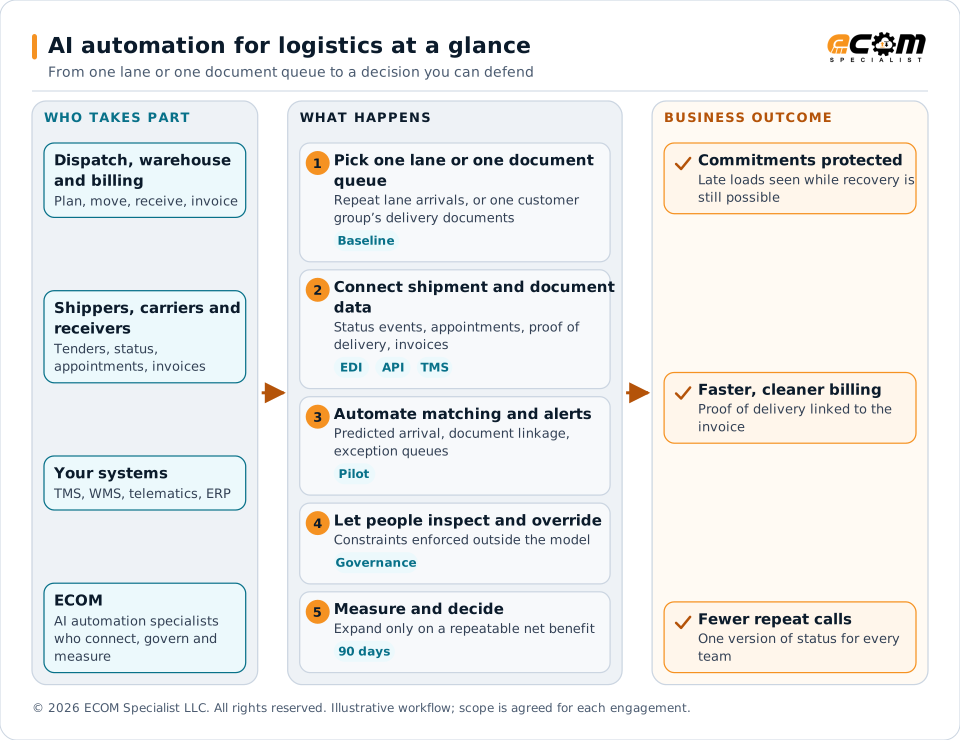
The drawing follows a logistics operator from one repeat lane or one document queue, through connecting shipment and document data, automating matching and alerts, letting people inspect and override, and measuring the result over 90 days. The outcomes are protected delivery commitments, faster billing and fewer repeat calls. They are goals to measure against your own baseline, not guaranteed results.
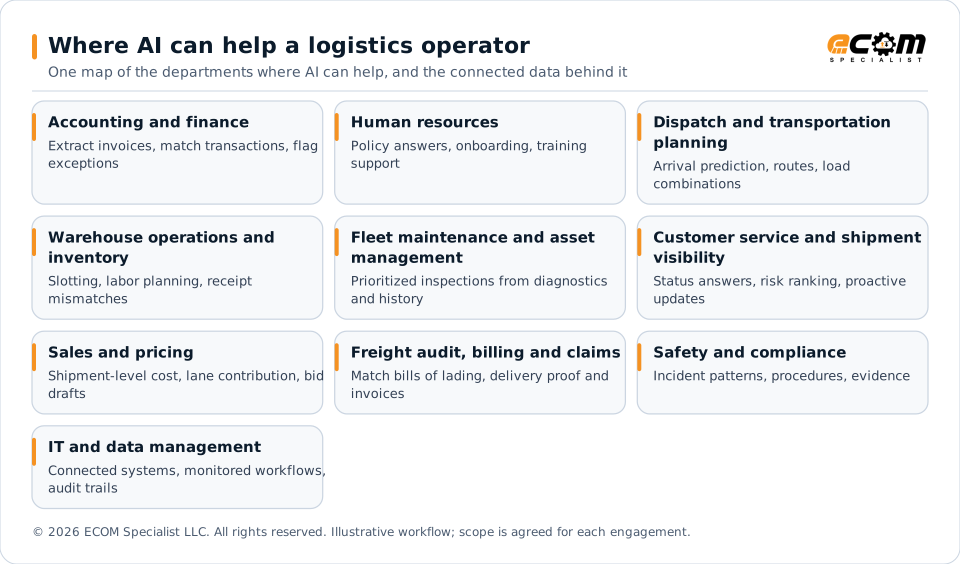
The map lists 10 departments and, for each, the kind of work AI can support: accounting and finance (extract invoices, match transactions, flag exceptions); human resources (policy answers, onboarding, training support); dispatch and transportation planning (arrival prediction, routes, load combinations); warehouse operations and inventory (slotting, labor planning, receipt mismatches); fleet maintenance and asset management (prioritized inspections from diagnostics and history); customer service and shipment visibility (status answers, risk ranking, proactive updates); sales and pricing (shipment-level cost, lane contribution, bid drafts); freight audit, billing and claims (match bills of lading, delivery proof and invoices); safety and compliance (incident patterns, procedures, evidence); it and data management (connected systems, monitored workflows, audit trails). These are practical opportunities, not claims that every company has implemented them.
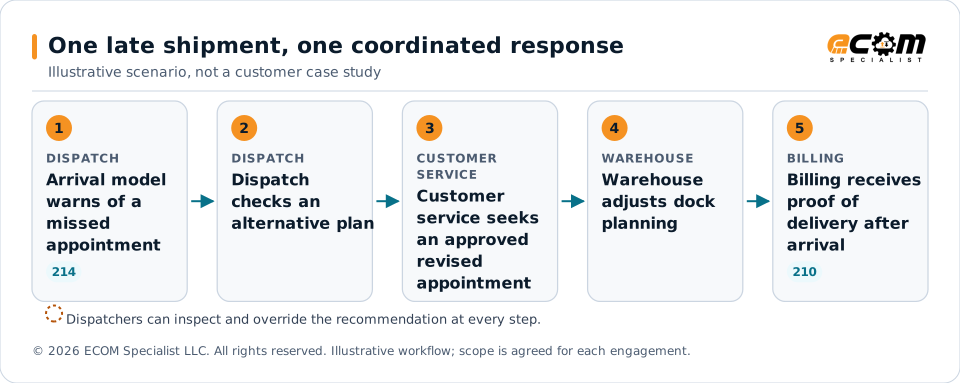
An arrival model raises a warning that a shipment will miss its delivery appointment. Dispatch checks an alternative plan, and customer service seeks an approved revised appointment. Warehouse staff adjust dock planning, and billing receives the completed proof of delivery after arrival. Without coordination, the same delay can generate detention, repeated calls and a late invoice.
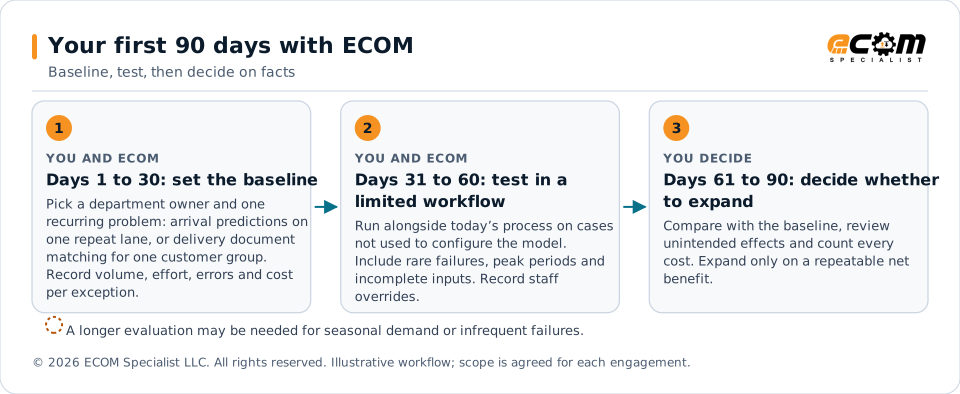
Days 1 to 30 set a baseline: a department owner, one recurring problem, current volume, effort, errors and cost per exception, confirmed data access and a definition of success. Days 31 to 60 test in a limited workflow, alongside the current process, on cases not used to configure the model, with staff overrides recorded. Days 61 to 90 compare the results with the baseline, count every cost and expand only if a repeatable net benefit is shown.
The cost of waiting
What companies miss by waiting
Static transit estimates
Manual check calls miss the window to recover a late load or combine compatible freight.
Delivered but not yet billed
Completed deliveries wait for paperwork, valid accessorials go unbilled and staff keep asking for documents.
Roadside failures
One breakdown disrupts several commitments and requires recovery or rental capacity.
Different versions of status
Service teams look at different portals and emails, and customers receive inconsistent answers.
Freight that grows revenue and shrinks profit
Without shipment-level cost, you can win lanes or customers with weak contribution after accessorials, claims and empty repositioning.
Department by department
Where AI helps, what waiting costs and how ECOM helps
The department list below comes from practical opportunities, not claims that every operator has implemented them. Start with one row.
| Department | Where AI can help | What waiting costs | How ECOM helps, and what to measure |
|---|---|---|---|
| Accounting and finance | Extract invoice and remittance details, suggest account coding, match transactions, prioritize exceptions and flag unusual payments. | Staff rekey documents and chase routine discrepancies. Cash and margin problems show up only after the reporting cycle closes. | Connects invoices, receipts, purchase orders and remittances from EDI, APIs and documents into one matched flow with exception queues. The controller keeps approval of payments, write-offs and material adjustments. Measure: cost per transaction, exception rate, days to close, overdue receivables. |
| Human resources | Answer questions from approved policies, guide onboarding, suggest role-specific training and forecast staffing demand. | Experienced employees repeat the same procedures, new hires take longer to become productive and staffing reacts only after overtime has risen. | Starts with policy search and training support built on approved content. Hiring, pay and disciplinary decisions stay under accountable human review. Measure: onboarding time, policy response time, training completion, overtime. |
| Dispatch and transportation planning | Predict arrival from shipment events, traffic, dwell history and appointment data, and recommend feasible routes and load combinations under vehicle capacity, driver availability and service constraints. | Planners use static transit estimates and manual check calls, and lose the window to recover a late load or combine compatible freight before vehicles leave. | Connects shipment status messages, appointments and tender responses into one view. Dispatchers can inspect and override every recommendation, and operating and safety constraints are enforced independently of model predictions. Measure: on-time pickup and delivery, empty mile share, cost per mile, arrival prediction error. |
| Warehouse operations and inventory | Use order patterns for slotting and labor planning, and apply vision and document tools to identify damaged freight or mismatched receipts. Recommendations respect storage compatibility, equipment availability and safe working practices. | Facilities add overtime after queues form while other areas sit idle. Inventory discrepancies cause repeated searches, failed picks and downstream shipment delays. | Connects warehouse orders, receipts, advance shipping notices and inventory records. Compare productivity by order complexity and never reward unsafe speed. Measure: dock-to-stock time, pick accuracy, throughput, inventory accuracy, overtime. |
| Fleet maintenance and asset management | Analyze diagnostic codes, mileage, operating conditions and repair history to prioritize inspections, and coordinate shop availability, parts and substitute vehicles before an asset leaves service. | A roadside failure disrupts several commitments and forces recovery or rental capacity. Fixed schedules alone miss differences in how each vehicle is used. | Builds the workflow around the warning so shop, parts and substitute vehicle are lined up. Required inspections and safety decisions stay with qualified personnel. Measure: roadside failures, vehicle availability, repair cost, false alarms. |
| Customer service and shipment visibility | Retrieve shipment status, summarize exceptions and draft updates from approved operational data. Rank shipments by risk and customer impact so teams contact affected customers first. | Service staff spend hours collecting information from portals and emails, and customers receive inconsistent answers from different versions of status. | Brings shipment events together so everyone sees one status. Display event timestamps and distinguish a predicted arrival from a confirmed appointment. Measure: response time, proactive notification rate, repeat inquiries, unresolved exceptions. |
| Sales and pricing | Estimate shipment cost, identify lanes or customers with weak contribution after accessorials, claims and empty repositioning, and draft bids from approved rate data. | Without shipment-level cost visibility you can win freight that raises revenue but lowers profit, and slow manual bids miss suitable opportunities. | Connects shipment, invoice and claim records so contribution is measured by lane and customer. Commercial approval of prices stays with you, and current capacity beats historical averages. Measure: quote turnaround, win rate, contribution by lane and customer. |
| Freight audit, billing and claims | Extract bills of lading, proof of delivery and invoices, then suggest matches and missing documents. Rules verify rates and contractual accessorials, and scoring prioritizes disputes before response windows close. | Completed deliveries wait to be billed, paperwork is requested again and again, valid accessorials go unbilled and customers dispute charges without evidence. | Links delivery events, documents and freight invoices through EDI and APIs, with exception queues for missing paperwork. Original documents are preserved and settlements require approval. Measure: delivery-to-invoice time, unbilled revenue, billing accuracy, claim resolution time. |
| Safety and compliance | Identify patterns in incidents, equipment defects and operating conditions to support coaching and investigation, and help retrieve procedures and organize evidence. | Recurring hazards are reviewed as isolated events and managers miss the chance to fix a process or equipment problem across the fleet or facility. | Consolidates the records behind each pattern. Qualified staff stay responsible for safety decisions and compliance, and data quality is reviewed before risk is attributed to any individual. Measure: preventable incidents, corrective action closure, alert precision. |
| IT and data management | Summarize incidents, help diagnose integration failures and identify unusual system behavior. | Departments keep conflicting spreadsheets and AI works from stale records, so one wrong inventory balance or customer identity spreads errors across the business. | Connects operational systems through managed EDI and API integrations with monitoring, a named owner, an audit trail and a way to reverse each action. Measure: data freshness, integration failures, duplicate records, recovery time. |
Capabilities
How ECOM’s AI automation specialists help logistics operators
Open any item for the detail.
Start with one lane or one customer groupArrival predictions on a repeat lane and delivery document matching.
- Start with arrival predictions on one repeat lane and delivery document matching for one customer group.
- Compare results with current arrival estimates and billing times while holding the service mix as constant as practical.
- Record current volume, labor effort, errors, service outcomes and the cost of each exception before you select a tool.
Connect the data your AI needsOrders, confirmations, shipments and invoices from the systems that already hold them.
- EDI and APIs can supply orders, order confirmations, shipment events and invoices from your trading partners and your ERP, warehouse and transportation systems.
- ECOM connects those feeds with shared identifiers, timestamps and validation rules, so every record stays traceable from the source to the decision.
- A fast recommendation built on a stale inventory balance or a duplicate customer record spreads errors. Clean, connected data comes first.
Automate the document-heavy stepsPDFs, emails and images become validated data in the same workflow.
- Document extraction brings information from PDFs, emails and images into the same workflow as your EDI and API data.
- Validation rules check the extracted data against the order, the shipment or the contract, and incomplete or unusual items go to an exception queue with an owner.
- Where a stable rule solves a clear requirement, ECOM recommends the rule. Not every workflow needs AI.
Keep people in controlApprovals, audit trails and a manual fallback.
- Connecting a model to a system does not by itself authorize it to change a financial or operational record. ECOM helps you define what each automated step may do, who approves it and how to reverse it.
- Every important action has an owner, an audit trail and a manual fallback. Staff can inspect and override a recommendation.
- The voluntary NIST AI Risk Management Framework gives a practical structure for approved uses, responsible owners, escalation thresholds and monitoring.
Prove it, then decide whether to expandA baseline, a limited pilot and a net-benefit decision.
- ECOM helps you record today’s volume, effort, errors and exception cost, run the new workflow alongside the current one and compare the results with a simple baseline.
- The business case includes software, integration, training, review time and monitoring, not only the savings. You expand only when a repeatable net benefit is shown.
- Seasonal demand or infrequent failures may need a longer evaluation. ECOM plans for that up front.
In practice
Logistics example: one late shipment, one coordinated response
A shipment is likely to miss its delivery appointmentIllustrative scenario, not a customer case study.
- An arrival model raises a warning. Dispatch checks an alternative plan and customer service seeks an approved revised appointment.
- Warehouse staff adjust dock planning, and billing receives the completed proof of delivery after arrival.
- Without a coordinated response, the same delay can generate detention, repeated calls and a late invoice.
What is it worth? A calculation you can reuseIllustrative arithmetic, not a promise.
- Illustrative calculation only. If a team handles 5,000 documents a month and reduces average handling time from 8 minutes to 3 minutes, it releases about 417 staff hours monthly. At an assumed loaded labor cost of $35 per hour, that is about $14,600 in monthly capacity value.
- That value becomes cash savings only if spending actually falls. Otherwise the benefit comes from useful redeployment, greater throughput or better service.
- Net annual benefit equals verified annual operating gains minus annual software, support, monitoring and other recurring costs. Simple payback equals the one-time implementation cost divided by the positive monthly net benefit.
- Keep released working capital separate from recurring profit, and avoid counting the same labor or error reduction twice. Bring your own volumes and ECOM will work through the arithmetic with you.
Business benefits
What this means for the business
Commitments protected
Late loads are seen while recovery is still possible.
Faster billing, fewer disputes
Documents are linked to the invoice, and accessorials have supporting evidence.
Less time on status requests
One status, with predicted and confirmed arrivals clearly distinguished.
Pricing based on contribution
Lanes and customers are judged after accessorials, claims and empty repositioning.
What public sources show
This is the company’s own published description. It is not an ECOM project, not a guaranteed savings level and not a capability available to every operator.
- UPS describes using AI, automation and advanced analytics to improve visibility, planning and network execution. Its published initiatives include predictive control tower capabilities that flag and prioritize disruptions across carrier networks.
- The NIST AI Risk Management Framework is a voluntary structure for governing, mapping, measuring and managing AI risk. It is a practical reference for approved uses, responsible owners, escalation thresholds and monitoring.
- U.S. EEOC guidance explains that employment discrimination protections also apply when AI is involved. Obtain HR and legal review for any tool that affects hiring, pay or discipline.
How to evaluate logistics AI
Pick the measures for the row you start with, record a baseline and keep the definitions fixed.
- On-time pickup and delivery, empty mile share and arrival prediction error
- Dock-to-stock time, pick accuracy and inventory accuracy
- Roadside failures and vehicle availability
- Response time, proactive notification rate and repeat inquiries
- Delivery-to-invoice time, unbilled revenue and claim resolution time
- Contribution by lane and customer
Getting started
Bring your costliest recurring logistics problem
Tell ECOM which recurring problem costs you the most: late arrivals on a repeat lane, delivery paperwork that delays invoices, repeated status calls or unbilled accessorials. Bring a rough monthly volume and the systems involved. ECOM’s AI automation specialists will help you define a baseline, the data you need and a limited first workflow, so you can decide on facts whether to expand. You do not need a model, a vendor or a budget line before the first conversation.
Frequently asked questions
How can AI help a U.S. carrier or 3PL?
AI can predict arrival from shipment events, recommend feasible routes and load combinations, prioritize fleet inspections, match delivery documents to invoices and rank shipments by risk. Benefits depend on data quality and adoption, so ECOM starts with one lane or one document queue.
Where should a logistics operator start with AI?
With arrival predictions on one repeat lane and delivery document matching for one customer group, compared with your current estimates and billing times.
What does ECOM do for a logistics AI project?
ECOM’s AI automation specialists help you choose the first workflow, connect shipment status, appointment, proof-of-delivery and invoice data from your partners and systems, automate document matching, set approvals and audit trails, and measure the result.
How do EDI and APIs connect to AI in logistics?
EDI and APIs supply orders, confirmations, shipment events and invoices. Document extraction brings bills of lading, delivery proofs and invoices from PDFs, emails and images into the same workflow, with shared identifiers and exception queues.
Can AI replace dispatchers?
No. Dispatchers must be able to inspect and override any recommendation, and operating and safety constraints are enforced independently of model predictions.
What does waiting cost a logistics operator?
Preventable miles, delayed invoices, unbilled accessorials and repeated exception handling. ECOM helps you put your own volumes into a net-benefit calculation rather than guess.
AI Automation by Industry
Other industries
-
Retailers
Demand, invoices, supplier delays, store tasks and fulfillment: AI on connected data, proven in 90 days.
View retailers -
Manufacturers
Scheduling, maintenance, quality, supply and order capture: AI on connected plant and partner data.
View manufacturers -
Automotive businesses
Quality and traceability, supplier releases, parts distribution, dealer leads and service readiness.
View automotive businesses
Talk to an AI Automation Specialist about AI for logistics and carriers
Tell us the recurring problem that costs you most and the systems involved. We will outline a baseline, the data you need and a limited first workflow you can judge on facts.