
EDI and B2B standards
TDCC: the transportation EDI formats that started it all
The Transportation Data Coordinating Committee (TDCC) wrote the first standard EDI formats for rail, motor, ocean and air freight. Their successors are today's X12 transportation documents, and some long-established carrier and shipper systems still use TDCC-era layouts. ECOM reads and writes them and maps them to current formats.
- Origin
- US transportation industry, late 1960s and 1970s
- Successor
- X12 transportation transaction sets
- Where it remains
- Older carrier and shipper systems
- Typical documents
- Bills of lading, freight bills, status
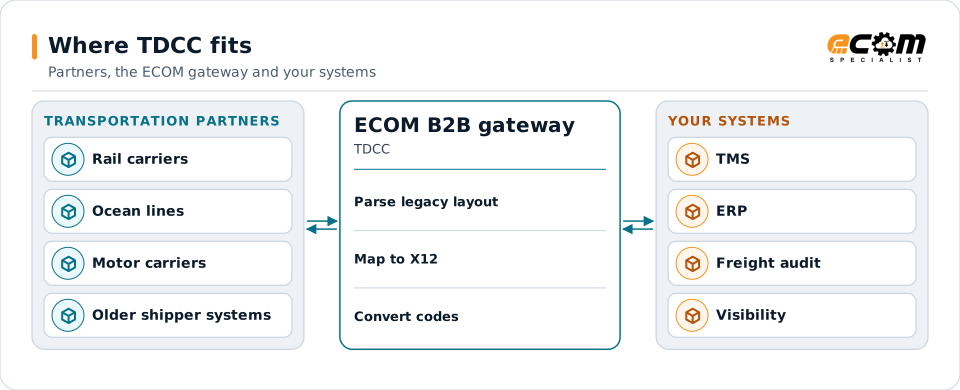
Older layouts come in from transportation partners; your systems receive current formats.
Overview
What TDCC is
In the late 1960s, US railroads, motor carriers, ocean lines and airlines formed the Transportation Data Coordinating Committee to agree on common electronic formats for freight documents. Its work is widely regarded as the beginning of standard EDI. The organization later became the Electronic Data Interchange Association, and its formats were carried into the X12 standard.
Today, most transportation partners use X12 sets such as the 204 load tender, 214 shipment status and 210 freight invoice. But some systems built long ago still exchange layouts based on TDCC conventions. When a partner uses one, the gateway treats it as a defined layout and maps it like any other format.
Where businesses use it
Older carrier systems
Rail, ocean and motor carriers whose systems were designed around TDCC-era formats.
Shipper legacy applications
Traffic and freight payment systems that still produce TDCC-style records.
Migration projects
Moving partners from older layouts to current X12 transportation sets without disrupting operations.
Structure
How TDCC-era documents are structured
TDCC formats introduced ideas X12 still uses: segments identified by a short code, data elements in a fixed order, and documents for each step of a shipment. Exact layouts vary by industry segment and by the version a partner implemented, so the partner's specification is the reference.
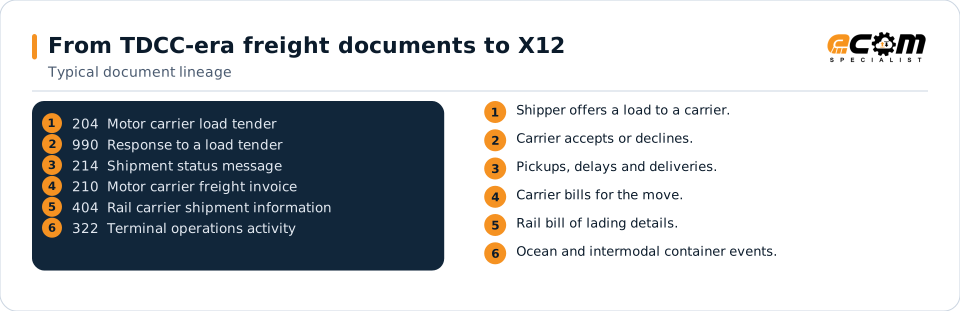
Because the lineage is shared, a TDCC-era bill of lading or freight bill usually maps cleanly to its X12 counterpart: a load tender to the 204, status to the 214, a freight bill to the 210.
Each line pairs a transportation document purpose with the X12 set that carries it today. A TDCC-era layout is mapped to the matching set.
In depth
What ECOM does with TDCC-based layouts
Read and write the layout
The partner's specification is set up as a defined format on the gateway, so records are parsed and validated like any other.
Map to current standards
Data is mapped to X12 transportation sets or to your TMS format, so one partner's old layout does not hold back the rest.
Plan the migration
Where a partner is ready to move, ECOM runs both formats in parallel and switches when testing is complete.
Keep codes consistent
Equipment, location and status codes are converted to the values current documents use.
Mapping
How a mapper reads and writes TDCC
TDCC as input
The map reads the partner's records using the layout in its specification, segment by segment, and checks required fields and codes.
TDCC as output
Data from your TMS is written in the partner's layout when it still requires it, or in X12 once it has moved.
What the mapping handles
Fields
Shipment, equipment, origin and destination fields are mapped to your TMS.
Loops
Stops and line items repeat as the layout defines.
Validation
Required fields and code values are checked against the specification.
Code conversions
Older status and equipment codes are converted to current ones.
Business rules
Reference numbers are matched to the original shipment.
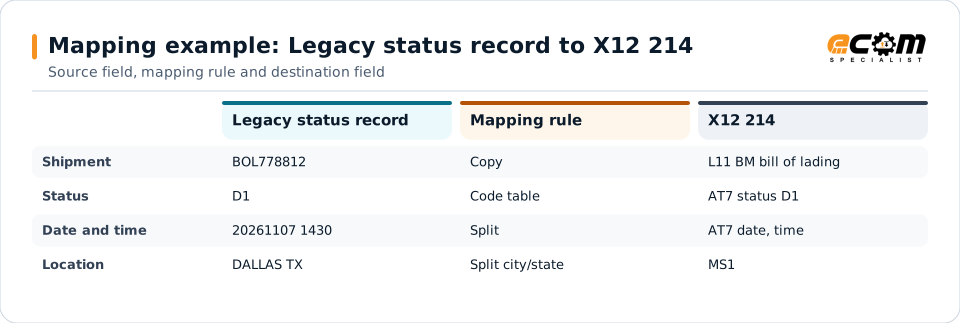
Example: source, mapping, destination
STATUS  BOL778812  D1  20261107 1430
DALLAS TXB10*PRO123*BOL778812*SCAC~
L11*BOL778812*BM~
AT7*D1*NS***20261107*1430~
MS1*DALLAS*TX~A status record in an older layout becomes a current X12 214. The meaning stays the same; the structure changes.
Connections
How TDCC connects your business
Carriers
Rail, ocean and motor carriers on older systems keep exchanging data without changing their side.
Transport management
Your TMS receives current-format data whatever the partner sends.
Freight audit and payment
Freight bills flow into audit and payment in a consistent format.
Visibility
Status events feed tracking and customer notifications.
ECOM
How ECOM supports TDCC
ECOM supports TDCC with dedicated implementation, mapping, communication and support teams, and with specialists who know the industries your partners work in.
Implementation team
Plans the TDCC setup with you, configures it on the gateway and runs the tests with your partners and systems.
Mapping team
Builds and maintains the maps, code conversions and validation rules between partner data and your applications.
Communication team
Sets up and monitors partner connections, certificates, keys and credentials, and coordinates changes with each partner.
Support team
Watches the flows, investigates failed or missing documents, and works the issue through with you and your partner.
For TDCC in particular
- Defined formats for a partner's TDCC-era specification, with validation.
- Maps to X12 transportation sets and to your TMS format.
- Parallel runs and cutover when a partner moves to X12.
Frequently asked questions
Is TDCC still a current standard?
No. TDCC's work was carried into X12, and current transportation EDI uses X12 sets such as the 204, 214 and 210. Some older systems still exchange TDCC-era layouts, and those are handled as defined formats.
Can ECOM convert a TDCC-era layout to X12?
Yes. The layout is mapped to the matching X12 transaction set, so your other systems and partners see current formats.
What do we need to start?
The partner's layout specification and a few sample files. ECOM sets up the format, maps it and tests with the partner.
Can both formats run during a migration?
Yes. The old layout and the new X12 documents can run in parallel until the partner confirms the switch.
Talk to an EDI/API Expert
Tell us which partners, systems and TDCC requirements you are working with. An ECOM specialist will review them with you and outline the setup, the maps and the tests.