

Executive summary
The situation and ECOM’s role
An energy services provider operates in an environment where business exchanges with counterparties follow energy-industry standards. ECOM is its integration services provider, covering specialized communications, translation and business processing for those exchanges.
Energy-sector integration differs from retail or manufacturing EDI: applicable industry standards, such as those from the North American Energy Standards Board (NAESB), apply alongside market, utility and counterparty implementation requirements.
In energy commerce, the applicable standard and the version each counterparty implements both matter.
Customer environment
- Industry
- Energy services, with exchanges governed by industry standards such as those from NAESB.
- ECOM scope
- Integration services: specialized communications, translation and business processing.
About this profile: the customer is not named and details are generalized. What is stated about the customer comes from ECOM; text marked “industry context” describes how this kind of business typically works. No volumes, timelines, figures, quotes or measured results are published.
The challenge
Standards-driven exchanges with their own rules
Industry context: retail and manufacturing EDI is organized around buyers and suppliers, with each buyer setting the rules for its trading relationships. Energy commerce also relies on industry standards. NAESB develops business practice standards for wholesale and retail natural gas and electricity markets, including standards for data formats and communications. Market, utility and counterparty implementation requirements apply alongside them.
Industry context: this changes the integration work in three ways. The standards are versioned and updated, so translation, validation and processing rules have to be kept current by someone, and the agreed scope should say who. Wholesale and retail markets have different requirements. And because the standards cover communications as well as data formats, secure transport and acknowledgment behavior are part of the requirement.
Why ECOM
One accountable team for communications, translation and processing
ECOM provides the integration services behind these exchanges. A specialist provider gives the company one accountable team for the integration work, so its own staff can focus on energy operations. Whether standards updates or counterparty changes are part of the service is set out in the agreed scope.
Industry context
Energy services provider
An energy services provider exchanges business data with counterparties in markets where industry standards, not each counterparty, set the rules. The standards are versioned, and they cover how data is sent and acknowledged as well as how it is formatted.
A standards body sets the requirements
Business practice standards for wholesale and retail energy markets come from industry bodies such as NAESB.
Versions change
Translation, validation and processing rules have to follow each version that a counterparty implements.
Communications are part of the requirement
Secure transport and acknowledgments are specified, not left to each trading pair.
Where it goes wrong
Typical problems in this kind of exchange
-
Standards move
A new version changes formats, validation or processing rules.
Maps and rules that were correct stop being correct for some counterparties.
-
Counterparties implement different versions
Not every counterparty moves at the same time.
The company has to support more than one version at once.
-
Secure communications need upkeep
Transport and security requirements are part of the standard.
Communications work competes with energy operations for the same staff.
What ECOM provides
The confirmed scope of services
-
EDI operations
ECOM runs the EDI exchange with the customer’s trading partners.
About EDI operations
What ECOM is responsible for
- ECOM provides specialized communications for standards-driven exchanges.
- ECOM provides translation between the company’s applications and the standard’s formats.
- ECOM provides business processing for the data that is received and sent.
Architecture
Where the integration sits
Company environment
- Internal applications
- Business processing
ECOM responsibilities
- Specialized communications
- Translation
- Business processing
Counterparties
- Energy-market counterparties
Educational diagram of this kind of environment, not the customer’s own architecture.
Running a similar exchange? Tell us your partners, systems and where the delays are, and a specialist will suggest where to start.
Talk to an EDI/API ExpertThe workflow
How the work flows
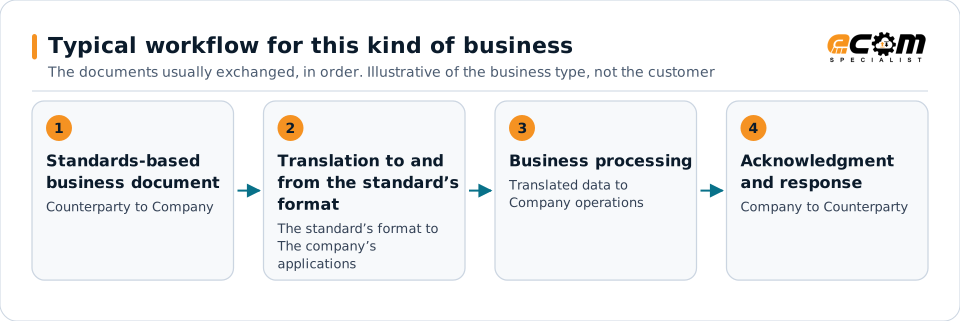
The documents typically exchanged in this kind of business, in the order they usually move. Partners vary, and some connect by API instead of EDI. The shaded line under a step shows where ECOM’s services act.
Steps are listed in the order the documents usually move, with who sends each one.
-
1. Receive
Standards-based business document
Counterparty Company
A document arrives over a secure connection in the format the standard specifies.
ECOM provides the specialized communications that receive and send these exchanges securely.
-
2. Translate
Translation to and from the standard’s format
The standard’s format The company’s applications
The document is converted into a form the company’s own applications can use, and back again for outbound data.
ECOM provides the translation between the company’s applications and the standard’s formats.
-
3. Process
Business processing
Translated data Company operations
The data is checked and processed according to the business rules for the exchange.
ECOM provides business processing for the data received and sent.
-
4. Acknowledge
Acknowledgment and response
Company Counterparty
Standards that specify acknowledgments expect a timely response.
ECOM’s role
Operational needs and ECOM’s role
What this kind of exchange needs, and what ECOM does about it within the agreed scope.
Exception handling
When something goes wrong
-
A document fails validation
A received document does not meet the standard’s rules.
The team that runs the exchange sees the failure and works it with the counterparty.
-
A version changes
A counterparty moves to a newer version of the standard.
Whether updates are included depends on the agreed scope.
Business value
Confirmed scope and intended benefits
Confirmed
- ECOM is the integration services provider for an energy services company.
- The services cover specialized communications, translation and business processing, in an environment that follows energy-industry standards.
Intended benefits
- One accountable team for communications, translation and processing.
- Company staff focused on energy operations.
Systems typically involved
- Counterparty systemsSend and receive standards-based business data.
- The company’s applicationsHold the business data that is sent and received.
Lessons for similar enterprises
What other organizations can take from this
Know which standards and versions apply
Plan around the applicable standards and their versions, alongside each counterparty’s implementation requirements.
Decide who handles version updates
Standards change, so agree up front who tracks and applies updates and whether that is in scope.
Include communications from the start
Secure transport and acknowledgments are part of the scope.