
X12 transaction guide · Government and regulatory

EDI 249 Animal Toxicological Data

The X12 document used to exchange animal toxicology data collected from studies on pesticides, drugs or other substances.

Sent by
Testing laboratory or study sponsor
Received by
Regulatory agency or sponsor
Standard
ANSI ASC X12

What is an EDI 249?

The EDI 249 Animal Toxicological Data is the ANSI X12 transaction set used to exchange animal toxicology data collected from studies on pesticides, drugs or other substances. It accommodates the lowest reportable level of individual data from the studies.

Regulators assess the safety of chemicals and medicines partly from animal studies submitted by sponsors. Submitting study data electronically, at the level of individual observations, lets reviewers analyze it directly. Regulators now generally prescribe their own study data standards, so current submission formats should be confirmed with each agency.

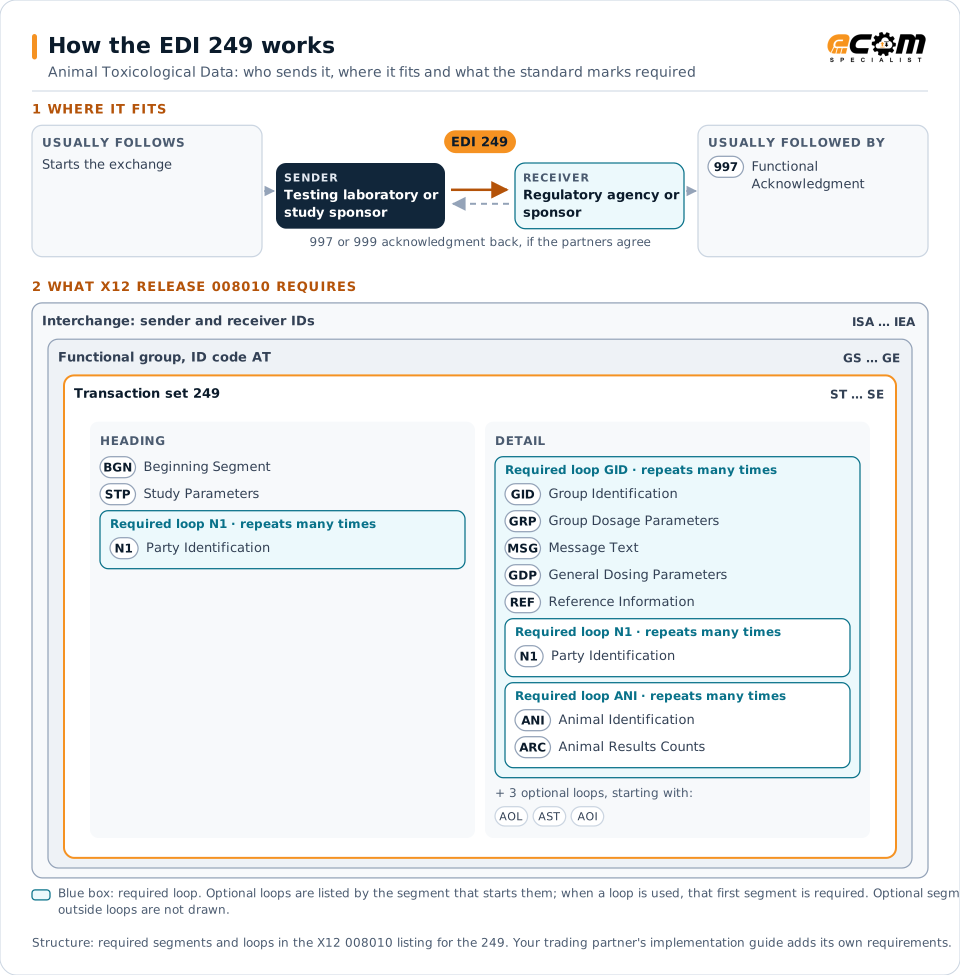
How the EDI 249 worksDiagram of the EDI 249 Animal Toxicological Data. Testing laboratory or study sponsor sends it to regulatory agency or sponsor. It usually starts the exchange. It is usually followed by 997. Inside the ISA, GS and ST envelopes, X12 release 008010 requires, in the heading: BGN (Beginning Segment), STP (Study Parameters) and the required N1 loop with N1 (Party Identification) and detail: the required GID loop with GID (Group Identification), GRP (Group Dosage Parameters), MSG (Message Text), GDP (General Dosing Parameters), REF (Reference Information), the required N1 loop with N1 (Party Identification) and the required ANI loop with ANI (Animal Identification) and ARC (Animal Results Counts). 3 optional loops are listed by their first segment.How the EDI 249 worksAnimal Toxicological Data: who sends it, where it fits and what the standard marks required1 WHERE IT FITSUSUALLY FOLLOWSStarts the exchangeEDI 249SENDERTesting laboratory orstudy sponsorRECEIVERRegulatory agency orsponsor997 or 999 acknowledgment back, if the partners agreeUSUALLY FOLLOWED BY997FunctionalAcknowledgment2 WHAT X12 RELEASE 008010 REQUIRESInterchange: sender and receiver IDsISA … IEAFunctional group, ID code ATGS … GETransaction set 249ST … SEHEADINGBGNBeginning SegmentSTPStudy ParametersRequired loop N1 · repeats many timesN1Party IdentificationDETAILRequired loop GID · repeats many timesGIDGroup IdentificationGRPGroup Dosage ParametersMSGMessage TextGDPGeneral Dosing ParametersREFReference InformationRequired loop N1 · repeats many timesN1Party IdentificationRequired loop ANI · repeats many timesANIAnimal IdentificationARCAnimal Results Counts+ 3 optional loops, starting with:AOLASTAOIBlue box: required loop. Optional loops are listed by the segment that starts them; when a loop is used, that first segment is required. Optional segmentsoutside loops are not drawn.Structure: required segments and loops in the X12 008010 listing for the 249. Your trading partner's implementation guide adds its own requirements.
How the EDI 249 worksDiagram of the EDI 249 Animal Toxicological Data. Testing laboratory or study sponsor sends it to regulatory agency or sponsor. It usually starts the exchange. It is usually followed by 997. Inside the ISA, GS and ST envelopes, X12 release 008010 requires, in the heading: BGN (Beginning Segment), STP (Study Parameters) and the required N1 loop with N1 (Party Identification) and detail: the required GID loop with GID (Group Identification), GRP (Group Dosage Parameters), MSG (Message Text), GDP (General Dosing Parameters), REF (Reference Information), the required N1 loop with N1 (Party Identification) and the required ANI loop with ANI (Animal Identification) and ARC (Animal Results Counts). 3 optional loops are listed by their first segment.How the EDI 249 worksAnimal Toxicological Data: who sends it, whereit fits and what the standard marks required1 WHERE IT FITSUSUALLY FOLLOWSStarts the exchangeEDI 249SENDERTestinglaboratory orstudy sponsorRECEIVERRegulatoryagency orsponsor997 or 999 acknowledgment back, if the partnersagreeUSUALLY FOLLOWED BY997Functional Acknowledgment2 WHAT X12 RELEASE 008010 REQUIRESInterchange: sender and receiver IDs (ISA… IEA)Functional group, ID code AT (GS … GE)Transaction set 249 (ST … SE)HEADINGBGNBeginning SegmentSTPStudy ParametersRequired loop N1 · repeats manytimesN1Party IdentificationDETAILRequired loop GID · repeatsmany timesGIDGroup IdentificationGRPGroup Dosage ParametersMSGMessage TextGDPGeneral DosingParametersREFReference InformationRequired loop N1 · repeatsmany timesN1Party IdentificationRequired loop ANI · repeatsmany timesANIAnimal IdentificationARCAnimal Results Counts+ 3 optional loops, starting with:AOLASTAOIBlue box: required loop. Optional loops are listedby the segment that starts them; when a loop isused, that first segment is required. Optionalsegments outside loops are not drawn.Structure: required segments and loops in the X12008010 listing for the 249. Your trading partner'simplementation guide adds its own requirements.

How to read this diagram: the top row shows who sends the 249, to whom, and which documents usually come before and after it. The lower part shows what X12 release 008010 itself requires: the envelopes around the 249 and the segments and loops the standard marks as required, area by area. Optional loops are listed by the segment that starts them rather than drawn in full. This is the standard's minimum, not a trading partner's requirement: each partner's implementation guide usually makes some optional loops mandatory, restricts the codes and may use a different release.
Expand diagram Download SVG

When it is used

  • Submitting toxicology study data to regulators
  • Exchanging study data between laboratories and sponsors
  • Supporting regulatory safety reviews

Where it fits in the document flow

This document 249 Animal Toxicological Data
Usually followed by 997 Functional Acknowledgment

Structure

Mandatory segments in the 249 (X12 release 008010)

The segments X12 release 008010 marks as mandatory at their level, in order. Segments inside optional loops are needed only when the loop is used. This is the standard's requirement, not your trading partner's: each partner's implementation guide names the release it uses, adds the optional segments it requires and restricts the values. The requirement status comes from one published X12 reference listing and has not been checked against a second source.

  • ST
  • BGN
  • STP
  • N1
  • GID
  • GRP
  • MSG
  • GDP
  • REF
  • ANI
  • ARC
  • AOL
  • AOR
  • NTE
  • AST
  • AOI
  • SE

Practical example

The 249 in practice

A contract laboratory completes a toxicity study on a new pesticide for a sponsor. It transfers the individual animal observations and measurements to the sponsor, which includes them in its regulatory submission. The agency's reviewers analyze the data as part of the safety assessment.

Implementation

Implementation considerations for the 249

  • Confirm the study data format each regulator requires.
  • Preserve data integrity and audit trails.
  • Follow good laboratory practice requirements.
  • Validate data against the approved study protocols.

Need help with the EDI 249?

ECOM maps, tests and monitors X12 documents for your trading partners and integrates them with your ERP.