
X12 transaction guide · Master data
EDI 536 Logistics Reassignment
The X12 document used to transfer management responsibility for items between an old and a new managing organization.
- Sent by
- Old or new managing organization
- Received by
- New or old managing organization
- Standard
- ANSI ASC X12
What is an EDI 536?
The EDI 536 Logistics Reassignment is the ANSI X12 transaction set used to provide the information needed to transfer management responsibility between an old and a new managing organization. It can convey item data, stock positions and other management information.
In large supply systems, responsibility for managing an item, its stock, procurement and records, may move between organizations. A structured transfer ensures nothing is lost: assets, open orders, contracts and history move together, so the new manager can continue without disruption.
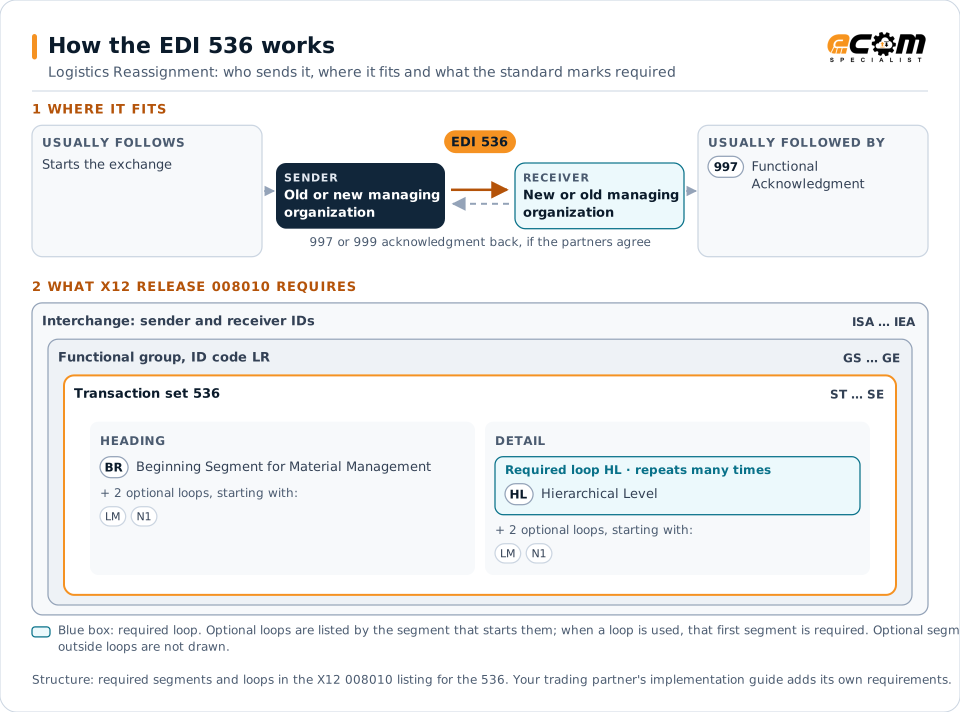
How to read this diagram: the top row shows who sends the 536, to whom, and which documents usually come before and after it. The lower part shows what X12 release 008010 itself requires: the envelopes around the 536 and the segments and loops the standard marks as required, area by area. Optional loops are listed by the segment that starts them rather than drawn in full. This is the standard's minimum, not a trading partner's requirement: each partner's implementation guide usually makes some optional loops mandatory, restricts the codes and may use a different release.
When it is used
- Transferring item management between organizations
- Passing stock and order positions to the new manager
- Coordinating the effective date of transfer
Where it fits in the document flow
Structure
Mandatory segments in the 536 (X12 release 008010)
The segments X12 release 008010 marks as mandatory at their level, in order. Segments inside optional loops are needed only when the loop is used. This is the standard's requirement, not your trading partner's: each partner's implementation guide names the release it uses, adds the optional segments it requires and restricts the values. The requirement status comes from one published X12 reference listing and has not been checked against a second source.
- ST
- BR
- LM
- LQ
- N1
- HL
- SE
Practical example
The 536 in practice
A supply agency transfers management of 1,000 spare parts from one inventory control point to another. The old manager sends 536 transactions with each item's data, stock on hand, open orders and contracts. The new manager loads the data and takes over on the agreed date.
Implementation
Implementation considerations for the 536
- Agree the effective date of each transfer.
- Transfer open orders and contracts with the items.
- Reconcile stock positions on both sides.
- Keep history needed for future management.
How ECOM helps
Automate the 536 with ECOM
Solution
Logistics Automation
Automate tenders, status updates, freight invoices and warehouse orders with logistics partners.
Solution
Supply Chain Visibility
Track orders, shipments and invoices across partners and catch exceptions early.
Solution
Enterprise Integration
Any-to-any integration across partners, systems, protocols, security requirements, formats and ERPs, in batch or real time.
More general questions about EDI are answered in the EDI FAQ.
Need help with the EDI 536?
ECOM maps, tests and monitors X12 documents for your trading partners and integrates them with your ERP.