
X12 transaction guide · Communications
EDI 620 Excavation Communication
The X12 document used to communicate about excavations, to obtain clearance or have affected parties locate and mark their assets.
- Sent by
- Excavator or one-call center
- Received by
- Utility operators and other affected parties
- Standard
- ANSI ASC X12
What is an EDI 620?
The EDI 620 Excavation Communication is the ANSI X12 transaction set used to communicate information about excavations, either to obtain clearance for the excavation or to have potentially affected parties locate their assets and supervise work near them.
Before digging, excavators must notify the owners of underground facilities, often through a one-call center, so pipes and cables can be marked. Structured notifications let utilities process locate requests automatically and dispatch locators. Responses confirm locates or clearances and close the request, and records of the exchange help establish responsibility if an underground facility is later damaged.
How to read this diagram: the top row shows who sends the 620, to whom, and which documents usually come before and after it. The lower part shows what X12 release 008010 itself requires: the envelopes around the 620 and the segments and loops the standard marks as required, area by area. Optional loops are listed by the segment that starts them rather than drawn in full. This is the standard's minimum, not a trading partner's requirement: each partner's implementation guide usually makes some optional loops mandatory, restricts the codes and may use a different release.
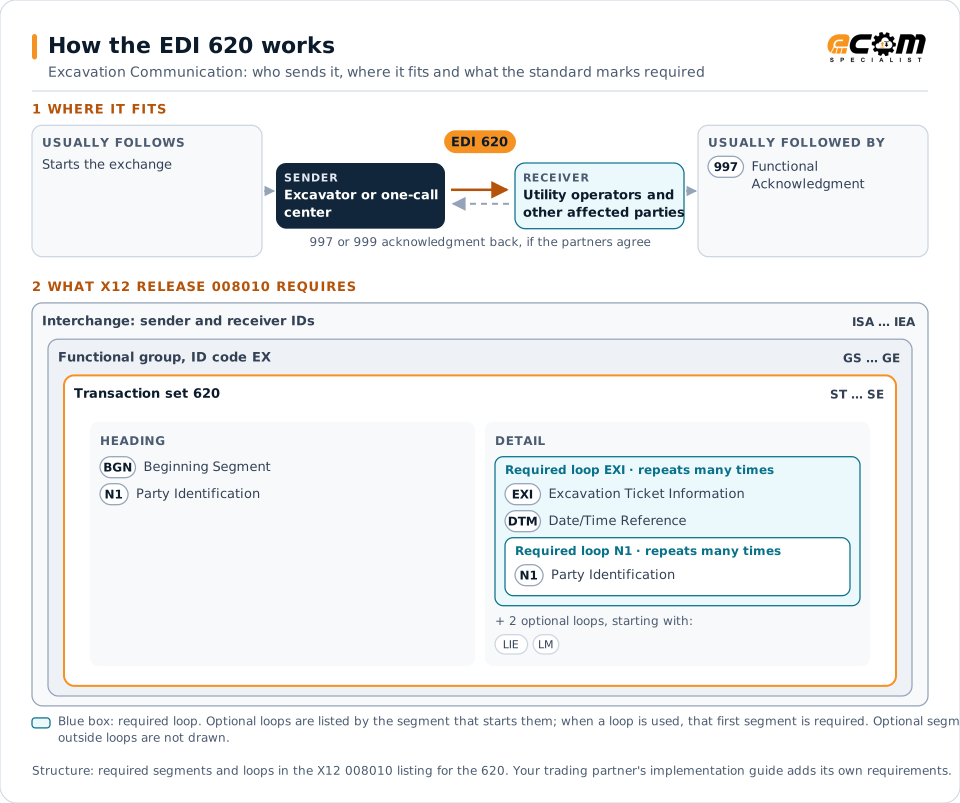
When it is used
- Notifying utilities of planned excavation
- Requesting location and marking of underground assets
- Responding with clearance or locate information
Where it fits in the document flow
Structure
Mandatory segments in the 620 (X12 release 008010)
The segments X12 release 008010 marks as mandatory at their level, in order. Segments inside optional loops are needed only when the loop is used. This is the standard's requirement, not your trading partner's: each partner's implementation guide names the release it uses, adds the optional segments it requires and restricts the values. The requirement status comes from one published X12 reference listing and has not been checked against a second source.
- ST
- BGN
- N1
- EXI
- DTM
- LIE
- PPA
- LM
- LQ
- SE
Practical example
The 620 in practice
A contractor plans to dig a trench for a new water line. The one-call center sends each utility in the area a 620 with the location, dates and type of work. The gas and telecom operators dispatch locators to mark their lines and respond that the area is marked.
Implementation
Implementation considerations for the 620
- Follow state or national one-call rules and timelines.
- Describe the excavation area precisely, with maps.
- Respond to every notification, including no-conflict responses.
- Keep records of notifications in case of damage claims.
How ECOM helps
Automate the 620 with ECOM
Industry
Telecom and Media
Equipment supply chains, service billing and partner data exchange for telecom and media companies.
Solution
B2B Integration
Connect every customer, supplier, carrier and bank across EDI, API, file and portal channels.
Solution
EDI Integration
Exchange X12 and EDIFACT documents with partners and integrate them directly with your ERP.
More general questions about EDI are answered in the EDI FAQ.
Related transactions
Related communications documents
Need help with the EDI 620?
ECOM maps, tests and monitors X12 documents for your trading partners and integrates them with your ERP.