
EDIFACT message guide · Transport
CALINF Vessel call information
The UN/EDIFACT message a liner agent sends a stevedore with the expected arrival of a vessel and the expected cargo operations.
- Sent by
- Liner agent
- Received by
- Stevedore or terminal operator
- Standard
- UN/EDIFACT · Batch message
- X12 equivalent
- No direct equivalent
What is the EDIFACT CALINF message?
CALINF is the UN/EDIFACT vessel call information message. The directory defines it as a notice from a liner agent to a stevedore providing information about the expected arrival of a vessel and the expected cargo operations. It is part of the family of container-related messages for intermodal handling.
The call information lets the terminal plan berth time, cranes and labor: it states the vessel, voyage, expected arrival and departure, and the expected numbers of containers to discharge and load. Detailed lists follow in COPRAR messages.
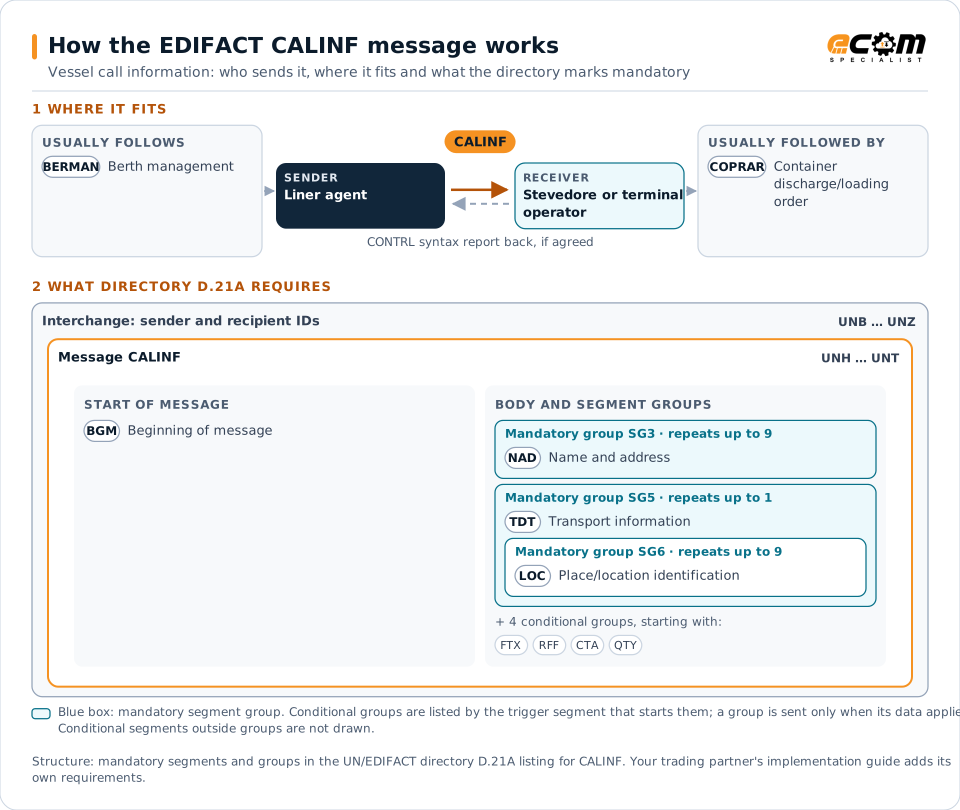
How to read this diagram: the top row shows who sends CALINF, to whom, and which messages usually come before and after it. The lower part shows what the directory D.21A itself requires: the envelopes around CALINF and the segments and segment groups it marks mandatory. Conditional groups are listed by their trigger segment rather than drawn in full. This is the directory's minimum, not a trading partner's requirement: a message implementation guide, such as an industry subset or a partner’s own guide, usually makes some conditional groups mandatory, restricts the codes and may use an older directory.
When it is used
- Announcing a vessel call to a terminal
- Giving expected discharge and load volumes
- Updating expected arrival times
Where it fits in the message flow
Structure
Mandatory segments in CALINF (directory D.21A)
In UN/EDIFACT directory D.21A, the CALINF message has 21 segment positions arranged in 7 segment groups. These are the segments and segment groups marked mandatory at message level, in order; a mandatory group is shown with the segment that starts it. Segments inside conditional groups are needed only when the group is used. This is the directory’s requirement, not your trading partner’s: each partner’s message implementation guide names the directory it uses, often an older one such as D.96A or D.01B where the structure can differ, makes some conditional segments mandatory and restricts the codes.
- UNH
- BGM
- SG3 (NAD)
- SG5 (TDT)
- UNT
Practical example
CALINF in practice
A liner agent sends the terminal a CALINF a week before a vessel's call with the expected arrival, the planned departure and the expected 650 discharge and 700 load moves. The terminal reserves the berth and gangs, and later receives detailed discharge and loading lists in COPRAR messages.
Implementation
Implementation considerations for CALINF
- Send call information early enough for resource planning.
- Update arrival times and volumes as they change.
- Keep the vessel call reference consistent with later messages.
- Follow the terminal's or port community's specification.
How ECOM helps
Automate CALINF with ECOM
Industry
Trucking and Transportation
Load tenders, responses, status and freight invoices for carriers, brokers and shippers, integrated with the TMS.
Solution
Logistics Automation
Automate tenders, status updates, freight invoices and warehouse orders with logistics partners.
Solution
EDI Integration
Exchange X12 and EDIFACT documents with partners and integrate them directly with your ERP.
Compare X12 and EDIFACT, or see answers to general questions in the EDI FAQ.
Related messages
Related transport messages
- BERMANBerth management
- COPRARContainer discharge/loading order
- VESDEPVessel departure
- BAPLIEBayplan/stowage plan occupied and empty locations
- BMISRMBulk marine inspection summary report
- COARRIContainer discharge/loading report
- CODECOContainer gate
- COEDORTransport equipment stock and profile report
- COHAORContainer special handling order
- COPARNContainer announcement
- COPINOContainer pre-notification
- COREORContainer release order
Need help with CALINF?
ECOM maps, tests and monitors EDIFACT messages for your trading partners and integrates them with your ERP.