
EDIFACT message guide · Transport
IFTSTQ International multimodal status request
The UN/EDIFACT message used to request a transport status report (IFTSTA) for a consignment.
- Sent by
- Shipper, consignee or forwarder
- Received by
- Carrier or forwarder
- Standard
- UN/EDIFACT · Batch message
- X12 equivalent
- 313 Shipment Status Inquiry (Ocean)
What is the EDIFACT IFTSTQ message?
IFTSTQ is the UN/EDIFACT international multimodal status request message. The directory defines it as a message to request an international multimodal status report (IFTSTA) giving details of the transport status, or a change in transport status, between agreed parties.
It identifies the consignments or equipment to report on, by references such as booking, bill of lading or container numbers. Many parties subscribe to status events instead, but a request is useful when an expected event is missing. The carrier answers with one or more status reports.
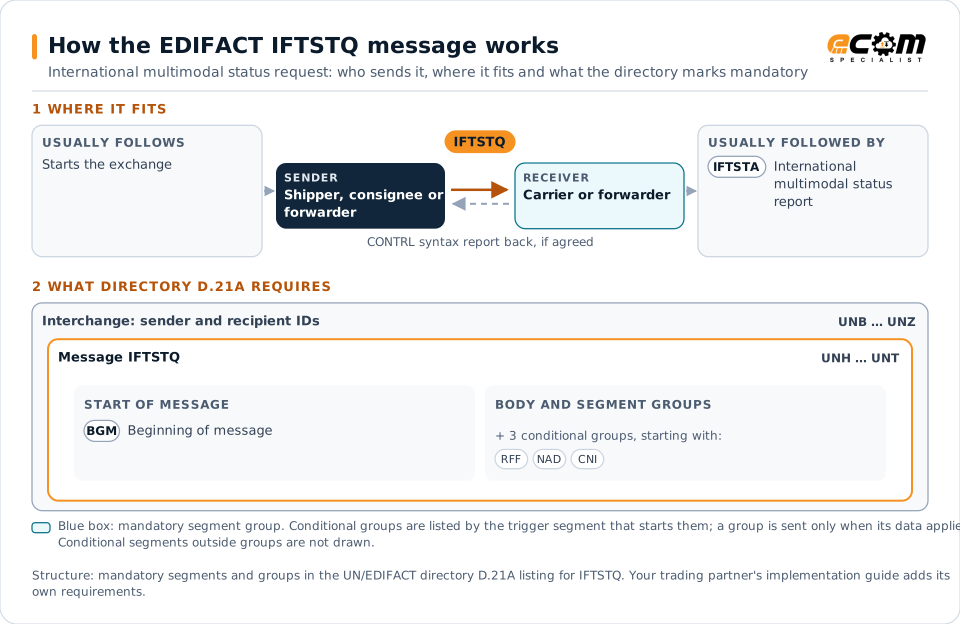
How to read this diagram: the top row shows who sends IFTSTQ, to whom, and which messages usually come before and after it. The lower part shows what the directory D.21A itself requires: the envelopes around IFTSTQ and the segments and segment groups it marks mandatory. Conditional groups are listed by their trigger segment rather than drawn in full. This is the directory's minimum, not a trading partner's requirement: a message implementation guide, such as an industry subset or a partner’s own guide, usually makes some conditional groups mandatory, restricts the codes and may use an older directory.
When it is used
- Asking for the current status of a consignment
- Checking shipments with missing events
- Requesting status for specific containers
Where it fits in the message flow
Structure
Mandatory segments in IFTSTQ (directory D.21A)
In UN/EDIFACT directory D.21A, the IFTSTQ message has 25 segment positions arranged in 8 segment groups. These are the segments and segment groups marked mandatory at message level, in order; a mandatory group is shown with the segment that starts it. Segments inside conditional groups are needed only when the group is used. This is the directory’s requirement, not your trading partner’s: each partner’s message implementation guide names the directory it uses, often an older one such as D.96A or D.01B where the structure can differ, makes some conditional segments mandatory and restricts the codes.
- UNH
- BGM
- UNT
Practical example
IFTSTQ in practice
A consignee notices that no discharge event has arrived for a container whose vessel arrived two days ago. Its visibility platform sends the carrier an IFTSTQ for the container number. The carrier answers with an IFTSTA showing the container is discharged and held for inspection, and the consignee alerts its broker.
Implementation
Implementation considerations for IFTSTQ
- Use the references the carrier indexes, such as container or bill of lading numbers.
- Use requests for exceptions rather than polling every shipment.
- Match each IFTSTA response to the request.
- Check which parties the carrier authorizes to request status.
How ECOM helps
Automate IFTSTQ with ECOM
Solution
Supply Chain Visibility
Track orders, shipments and invoices across partners and catch exceptions early.
Industry
Trucking and Transportation
Load tenders, responses, status and freight invoices for carriers, brokers and shippers, integrated with the TMS.
Industry
3PL and Warehousing
Warehouse orders, shipping advice, receipts and inventory reporting between brands, 3PLs, carriers and retailers.
Compare X12 and EDIFACT, or see answers to general questions in the EDI FAQ.
Related messages
Related transport messages
- IFTSTAInternational multimodal status report
- COPARNContainer announcement
- COPINOContainer pre-notification
- COREORContainer release order
- COSTCOContainer stuffing/stripping confirmation
- COSTORContainer stuffing/stripping order
- IFCSUMForwarding and consolidation summary
- IFTMBCBooking confirmation
- IFTMBFFirm booking
- IFTMBPProvisional booking
- IFTMCAConsignment advice
- IFTMINInstruction
Need help with IFTSTQ?
ECOM maps, tests and monitors EDIFACT messages for your trading partners and integrates them with your ERP.