
EDIFACT message guide · Shipping and logistics
RETANN Announcement for returns
The UN/EDIFACT message a party uses to announce goods it wants to return and the reasons, such as repair, end of lease or damage.
- Sent by
- Customer or holder of the goods
- Received by
- Supplier, lessor or manufacturer
- Standard
- UN/EDIFACT · Batch message
- X12 equivalent
- No direct equivalent
What is the EDIFACT RETANN message?
RETANN is the UN/EDIFACT announcement for returns message. The directory defines it as a message by which a party announces to another party details of goods for return for specified reasons, such as returns for repair, returns at the end of a leasing period or returns because of damage.
The announcement lets the supplier decide whether and how the goods should come back before anything ships. The supplier answers with an instruction for returns (RETINS), and the return itself is then announced with a despatch advice.
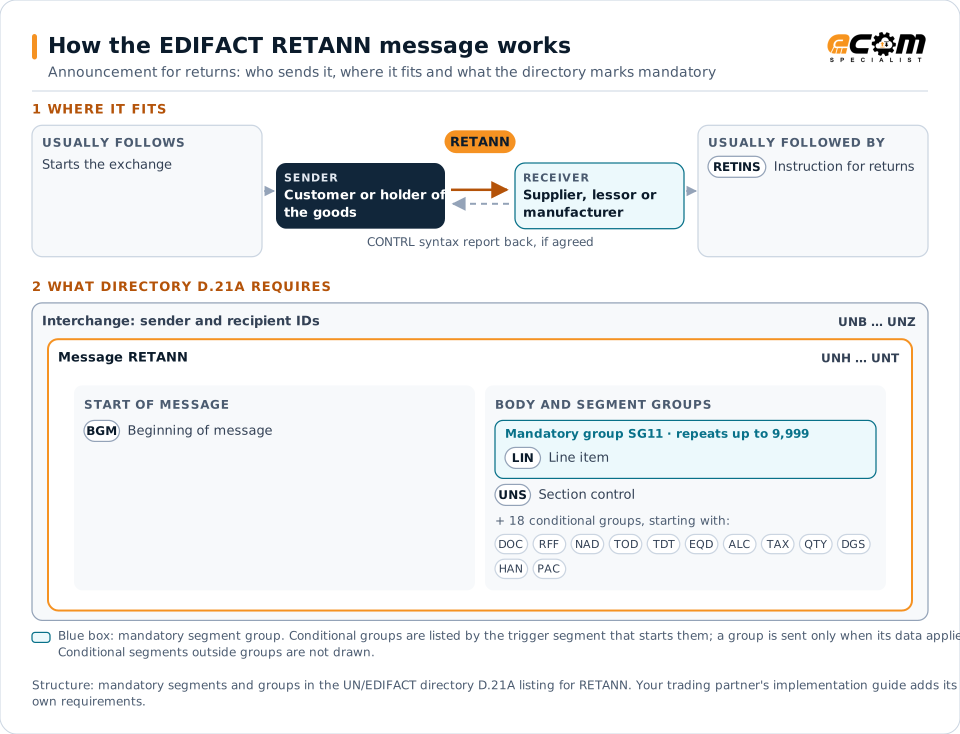
How to read this diagram: the top row shows who sends RETANN, to whom, and which messages usually come before and after it. The lower part shows what the directory D.21A itself requires: the envelopes around RETANN and the segments and segment groups it marks mandatory. Conditional groups are listed by their trigger segment rather than drawn in full. This is the directory's minimum, not a trading partner's requirement: a message implementation guide, such as an industry subset or a partner’s own guide, usually makes some conditional groups mandatory, restricts the codes and may use an older directory.
When it is used
- Announcing damaged or defective goods for return
- Announcing returns at the end of a lease
- Requesting return of unsold or overstocked goods
Where it fits in the message flow
Structure
Mandatory segments in RETANN (directory D.21A)
In UN/EDIFACT directory D.21A, the RETANN message has 74 segment positions arranged in 24 segment groups. These are the segments and segment groups marked mandatory at message level, in order; a mandatory group is shown with the segment that starts it. Segments inside conditional groups are needed only when the group is used. This is the directory’s requirement, not your trading partner’s: each partner’s message implementation guide names the directory it uses, often an older one such as D.96A or D.01B where the structure can differ, makes some conditional segments mandatory and restricts the codes.
- UNH
- BGM
- SG11 (LIN)
- UNS
- UNT
Practical example
RETANN in practice
An electronics retailer has 40 faulty units of a router model returned by customers. It sends the manufacturer a RETANN listing the product, serial numbers, quantities and fault reasons. The manufacturer replies with a RETINS authorizing the return to its repair center, and the retailer ships the units with a DESADV.
Implementation
Implementation considerations for RETANN
- Use return reason codes agreed with the supplier.
- Include serial or batch numbers where the supplier tracks them.
- Wait for return instructions before shipping.
- Link the return to credit notes or repairs that follow.
How ECOM helps
Automate RETANN with ECOM
Industry
Retail
Retail and eCommerce EDI for suppliers and retailers, from purchase order to payment, with compliance built in.
Industry
Consumer Goods
Retail, distributor, marketplace and direct-channel integration for consumer brands.
Solution
Logistics Automation
Automate tenders, status updates, freight invoices and warehouse orders with logistics partners.
Compare X12 and EDIFACT, or see answers to general questions in the EDI FAQ.
Related messages
Related shipping and logistics messages
Need help with RETANN?
ECOM maps, tests and monitors EDIFACT messages for your trading partners and integrates them with your ERP.