Executive summary
The situation and ECOM’s role
A pharmaceutical manufacturer sells to distributors, wholesalers and other trading partners, and exchanges supply transactions such as orders, shipment notices and invoices. Wholesalers and distributors typically require EDI in their own formats, while some smaller partners cannot run an EDI system at all.
ECOM operates the EDI exchange, provides the API Gateway for internal and external integrations, provides WebEDI for partners without EDI, and provides Reconcile360 to match remittance, deposits and invoices.
In pharmaceutical supply, the order, the shipment and the payment all have to agree, and each arrives separately.
Customer environment
- Industry
- Pharmaceutical manufacturing.
- Partners
- Distributors, wholesalers and other trading partners, some without EDI.
- ECOM scope
- EDI operations, API Gateway, WebEDI and Reconcile360.
About this profile: the customer is not named and details are generalized. What is stated about the customer comes from ECOM; text marked “industry context” describes how this kind of business typically works. No volumes, timelines, figures, quotes or measured results are published.
The challenge
The money moves separately from the documents
Industry context: a manufacturer selling through wholesalers and distributors exchanges the standard order flow of 850 purchase orders, 855 acknowledgments, 856 ship notices and 810 invoices. It also exchanges documents specific to the channel, such as inventory and sales reporting (852 and 867) and, in many pharmaceutical arrangements, chargeback and contract-pricing transactions such as the 844 and 849 that relate pricing agreed with a manufacturer to what a wholesaler actually charged.
These flows create exceptions that are hard to see from any one system. A wholesaler may claim a price difference after the sale. A payment may arrive as a lump sum covering many invoices, net of deductions. A shipment may be received short. Each of these is resolved by comparing documents that came from different systems at different times.
Systems that handle orders, inventory and finance have to exchange data accurately and traceably, because supply transactions in this industry are expected to be accountable. Meanwhile some partners are too small for EDI and would otherwise send orders by phone, fax or email, which means manual handling and more errors.
Why ECOM
EDI, browser access and reconciliation under one operating model
ECOM operates the EDI exchange with distributors and wholesalers, so distributor requirements are handled by a team that does this every day. Which activities, such as mapping changes or onboarding, are included follows the agreed scope. One integration pattern connects order, inventory and finance systems with outside parties.
A browser route through WebEDI keeps small partners inside the same controlled process, and Reconcile360 means finance reviews flagged differences rather than matching every payment by hand. Its recorded scope is matching remittance, deposits and invoices; chargeback and claims handling is explained below as industry practice, not as a confirmed capability.
Industry context
Pharmaceutical manufacturer
A pharmaceutical manufacturer sells to distributors, wholesalers and other trading partners. The business is regulated and the transactions that flow through it must be accurate and traceable. Large distributors expect EDI in their own formats; smaller partners may not be able to run EDI at all.
Accuracy matters
Orders, shipment notices and invoices feed inventory, finance and, in a regulated product, traceability.
Distributors have their own formats
Each distributor or wholesaler specifies how documents must be sent.
Claims and payments arrive separately
Payments and chargeback-style claims arrive apart from the invoices they relate to.
Where it goes wrong
Typical problems in this kind of exchange
-
Distributor requirements vary
Each distributor specifies formats and timing.
Internal staff maintain many partner variations.
-
Smaller partners cannot do EDI
Some partners lack EDI systems.
Manual orders mean re-keying and a higher chance of errors.
-
Payments and claims are separated from invoices
Remittance and claims arrive on their own schedule.
Finance matches by hand and can miss claims that need review.
-
Systems must stay accurate
Order, inventory and finance systems exchange data.
A mismatch can be hard to trace.
What ECOM provides
The confirmed scope of services
-
EDI operations
ECOM runs the EDI exchange with the customer’s trading partners.
About EDI operations -
API Gateway
PRISM-API Gateway carries the integrations between the customer’s own applications and with outside parties, so internal and external connections follow one pattern.
About API Gateway -
WebEDI
PRISM-WebEDI lets trading partners without an EDI system exchange transactions through a browser.
About WebEDI -
Reconcile360
PRISM Reconcile360 matches remittance advice, bank deposits and open invoices, and flags differences for review.
About Reconcile360
What ECOM is responsible for
- ECOM operates the EDI exchange with distributors, wholesalers and other trading partners.
- The API Gateway carries integrations between the manufacturer’s applications and with outside parties.
- WebEDI lets partners without EDI exchange transactions through a browser.
- Reconcile360 matches remittance, deposits and invoices and flags differences for review.
Technical and operational detail
Chargebacks, claims and accountability (industry practice)
In practice, many pharmaceutical supply arrangements involve a price agreed between the manufacturer and an end customer, while the sale itself passes through a wholesaler. The wholesaler sells at the contract price and then claims the difference from the manufacturer. That claim has to be validated against the contract, the sale and the product, which is why chargeback and contract-pricing transactions (X12 844, 849 and related documents) are common in this industry, alongside the standard order, ship notice and invoice cycle.
These claims arrive on their own schedule, separately from the invoices they relate to, and payments may be net of deductions. In a reliable process each claim is matched to its contract and each payment to the invoices it covers, with anything that does not fit routed to a person with the authority to resolve it. The recorded Reconcile360 scope for this customer is matching remittance, deposits and invoices; claims and contract-pricing handling is described here as industry practice, not as a confirmed capability.
Because pharmaceutical supply is closely scrutinized, accuracy and traceability matter: it should be possible to show how a document moved from request to resolution.
Architecture
Where the integration sits
Manufacturer environment
- Order, inventory and finance systems
ECOM responsibilities
- EDI operations
- API Gateway
- WebEDI
- Reconcile360
Partners
- Distributors
- Wholesalers
- Smaller partners using a browser
Educational diagram of this kind of environment, not the customer’s own architecture.
Running a similar exchange? Tell us your partners, systems and where the delays are, and a specialist will suggest where to start.
Talk to an EDI/API ExpertThe workflow
How the work flows
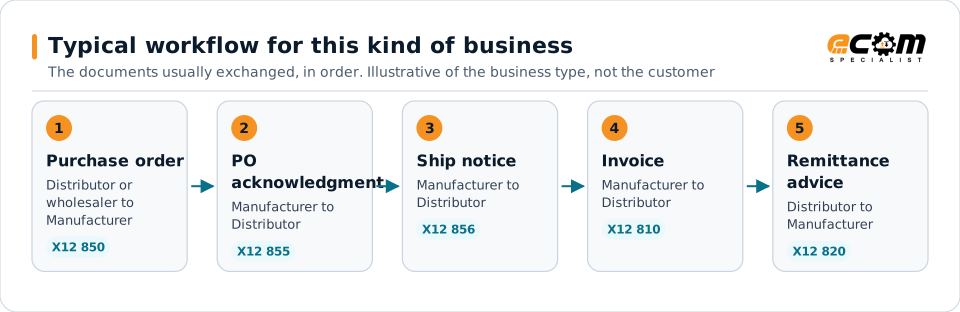
The documents typically exchanged in this kind of business, in the order they usually move. Partners vary, and some connect by API instead of EDI. The shaded line under a step shows where ECOM’s services act.
Steps are listed in the order the documents usually move, with who sends each one. Running alongside every step: Browser exchange.
-
1. Order
Purchase orderX12 850
Distributor or wholesaler Manufacturer
The distributor orders product.
ECOM operates the EDI exchange with the customer’s trading partners.
-
2. Confirm
Order acknowledgmentX12 855
Manufacturer Distributor
Confirms the order.
-
3. Ship
Advance ship noticeX12 856
Manufacturer Distributor
Announces the shipment.
Where a partner or internal system sends or receives this document by API instead of EDI, PRISM-API Gateway carries the same data.
-
4. Invoice
InvoiceX12 810
Manufacturer Distributor
Bills the shipment.
-
5. Get paid
Remittance adviceX12 820
Distributor Manufacturer
Payment arrives with remittance detail that is matched to open invoices. Claims, where a distributor raises them, are handled separately.
PRISM Reconcile360 matches this remittance advice with the bank deposit and the open invoices, and flags differences for review.
Running alongside every step
These support the exchange throughout. They are alternative routes and controls, not steps that happen after payment.
-
Smaller partners
Browser exchange
Partners without EDI Manufacturer
Partners that cannot run EDI exchange transactions by browser.
PRISM-WebEDI lets trading partners without an EDI system exchange transactions through a browser.
ECOM’s role
Operational needs and ECOM’s role
What this kind of exchange needs, and what ECOM does about it within the agreed scope.
Exception handling
When something goes wrong
-
A document is rejected
A distributor’s system rejects a document.
The team that operates the exchange works it with the distributor’s requirements.
-
A claim does not match an invoice
A payment or claim does not tie to an invoice.
It is flagged for finance review.
Business value
Confirmed scope and intended benefits
Confirmed
- ECOM operates EDI, and provides the API Gateway, WebEDI and Reconcile360.
- The customer is a pharmaceutical manufacturer exchanging supply transactions with distributors and wholesalers.
Intended benefits
- Distributor requirements handled by a team that works with them daily.
- Smaller partners taking part through a browser route.
- Finance reviewing flagged differences instead of matching every payment manually.
Systems typically involved
- Distributor and wholesaler systemsSend orders and receive notices and invoices.
- Order, inventory and finance systemsSource and destination of transaction data.
- BrowsersUsed by partners without an EDI system.
Lessons for similar enterprises
What other organizations can take from this
Treat claims as a workflow
Price differences and short shipments are routine. Give them a defined review path.
Include smaller partners
A browser route avoids phone and email orders that need re-keying.
Reconcile from matched records
Cash application is faster when remittance is compared with invoices automatically.