Executive summary
The situation and ECOM’s role
A pharmaceutical and healthcare products distributor buys from manufacturers and supplies pharmacies, hospitals and other providers. Orders, shipment notices and invoices flow in both directions, with suppliers on one side and customers on the other, and many customers pay in volume with remittance that has to be applied to open invoices.
ECOM assessed the customer’s EDI processing and consolidated it. ECOM operates the EDI exchange, provides the API Gateway for internal and external integrations, provides WebEDI for partners without EDI, and provides Reconcile360 to match remittance, deposits and invoices.
A distributor is a trading partner twice over: a customer to its suppliers and a supplier to its customers.
Customer environment
- Industry
- Pharmaceutical and healthcare products distribution.
- Customer environment
- Several business units, with EDI handled in more than one way before consolidation.
- Partners
- Manufacturers upstream; pharmacies, hospitals and other providers downstream.
- ECOM scope
- EDI operations, API Gateway, WebEDI and Reconcile360.
About this profile: the customer is not named and details are generalized. What is stated about the customer comes from ECOM; text marked “industry context” describes how this kind of business typically works. No volumes, timelines, figures, quotes or measured results are published.
The challenge
High-volume exchange in two directions
Industry context: toward suppliers, a distributor sends 850 purchase orders and receives 855 acknowledgments, 856 ship notices and 810 invoices, and often exchanges inventory and sales data (846, 852, 867) and pricing or chargeback information. Toward customers, it receives orders, sends acknowledgments and ship notices, and invoices. The same company sits at both ends, so a late supplier shipment turns into a late customer shipment.
Volume makes small errors expensive. Many customers pay in bulk, with a single remittance covering numerous invoices and net of deductions. Applying that payment correctly is slow when done by hand, and unapplied cash distorts what customers actually owe.
Supply transactions and the systems behind them also need to be accurate and traceable. Healthcare customers expect accuracy, and a distributor that cannot show how an order moved from request to delivery loses time every time a question arises. Customers differ widely in size, so some are ready for EDI and others need a simpler way to transact.
The customer’s own situation, as supplied by ECOM: it runs several business units, and its EDI had grown across more than one approach rather than one managed process.
Why ECOM
A managed exchange that handles both directions
ECOM assessed the customer’s EDI processing and consolidated it, so that exchanges handled in several places are run as one process.
ECOM operates the EDI exchange with suppliers and customers, so it is run by a team that handles these exchanges daily; mapping changes and onboarding follow the agreed scope. One integration pattern connects the distributor’s applications with outside parties.
A browser route lets partners of different sizes take part, and matched records give cash application a starting point.
Industry context
Pharmaceutical and healthcare products distributor
A healthcare products distributor stands in the middle: it buys from manufacturers and supplies pharmacies, hospitals and other providers. Documents flow in both directions, in high volume, and the supply chain behind them has to stay accurate and traceable.
Two sides of the exchange
Orders, shipment notices and invoices flow with suppliers on one side and customers on the other.
Customers pay in volume
Many customers pay many invoices at once, with remittance to apply.
Traceability matters
Supply transactions and the systems behind them must stay accurate.
Where it goes wrong
Typical problems in this kind of exchange
-
Volume in both directions
Orders, notices and invoices flow with many suppliers and customers.
Any error in the exchange is multiplied across many transactions.
-
Not every customer runs EDI
Smaller pharmacies and providers may order by browser or phone.
Manual orders add re-keying.
-
Payment application
Customers pay in volume with remittance.
Matching is slow, and open items age.
What ECOM provides
The confirmed scope of services
-
EDI operations
ECOM runs the EDI exchange with the customer’s trading partners.
About EDI operations -
API Gateway
PRISM-API Gateway carries the integrations between the customer’s own applications and with outside parties, so internal and external connections follow one pattern.
About API Gateway -
WebEDI
PRISM-WebEDI lets trading partners without an EDI system exchange transactions through a browser.
About WebEDI -
Reconcile360
PRISM Reconcile360 matches remittance advice, bank deposits and open invoices, and flags differences for review.
About Reconcile360
What ECOM is responsible for
- ECOM operates the EDI exchange with manufacturers and customers.
- The API Gateway carries integrations between the distributor’s applications and with outside parties.
- WebEDI serves partners without an EDI system.
- Reconcile360 matches remittance, deposits and invoices and flags differences for review.
Technical and operational detail
Two directions, one chain of accountability (industry practice)
In practice, a healthcare distributor’s exchange has two halves that depend on each other. Upstream, it orders from manufacturers, receives acknowledgments, shipment notices and invoices, and checks them against what actually arrived. Downstream, it receives orders from pharmacies and providers, confirms availability, ships and invoices. A short shipment from a supplier shows up as a short shipment to a customer.
Volume is the other pressure. Large customers may pay many invoices at once, so correct cash application depends on reading remittance advice and matching each line to an open invoice. Deductions and short payments need a place to go. Supplier credits and returns have to be tracked on the other side.
Architecture
Where the integration sits
Distributor environment
- Order and inventory systems
- Finance
ECOM responsibilities
- EDI operations
- API Gateway
- WebEDI
- Reconcile360
Partners
- Manufacturers
- Pharmacies and hospitals
- Other providers
Educational diagram of this kind of environment, not the customer’s own architecture.
Running a similar exchange? Tell us your partners, systems and where the delays are, and a specialist will suggest where to start.
Talk to an EDI/API ExpertThe workflow
How the work flows
The documents typically exchanged in this kind of business, in the order they usually move. Partners vary, and some connect by API instead of EDI. The shaded line under a step shows where ECOM’s services act.
Steps are listed in the order the documents usually move, with who sends each one.
Steps are listed in the order the documents usually move, with who sends each one.
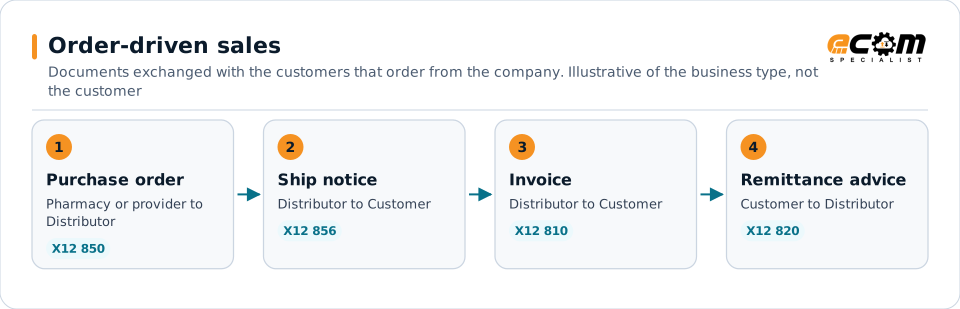
Order-driven sales
Documents exchanged with the customers that order from the company.
-
1. Order
Customer purchase orderX12 850
Pharmacy or provider Distributor
Customers order by EDI or in a browser.
A partner without an EDI system can send or receive this document through PRISM-WebEDI in a browser.
-
2. Ship
Advance ship noticeX12 856
Distributor Customer
Announces what is on its way.
Where a partner or internal system sends or receives this document by API instead of EDI, PRISM-API Gateway carries the same data.
-
3. Invoice
InvoiceX12 810
Distributor Customer
Bills the shipped order.
-
4. Get paid
Remittance adviceX12 820
Customer Distributor
Volume payments are applied to open invoices.
PRISM Reconcile360 matches this remittance advice with the bank deposit and the open invoices, and flags differences for review.
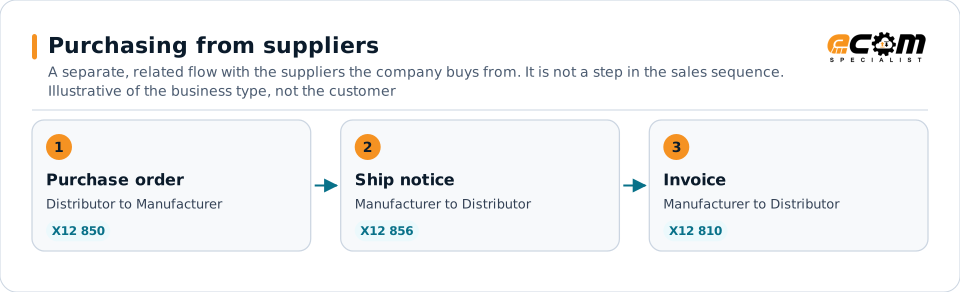
Purchasing from suppliers
A separate, related flow with the suppliers the company buys from. It is not a step in the sales sequence.
-
1. Buy
Purchase order to supplierX12 850
Distributor Manufacturer
Replenishment orders go to manufacturers and suppliers.
ECOM operates the EDI exchange with the customer’s trading partners.
-
2. Ship notice
Advance ship noticeX12 856
Manufacturer Distributor
Suppliers announce inbound shipments so receiving can plan.
-
3. Invoice
Supplier invoiceX12 810
Manufacturer Distributor
Supplier invoices are matched to orders and receipts.
ECOM’s role
Operational needs and ECOM’s role
What this kind of exchange needs, and what ECOM does about it within the agreed scope.
Exception handling
When something goes wrong
-
An order cannot be processed
A customer’s order fails validation.
The team that operates the exchange works it with the customer.
-
A payment is unmatched
Remittance does not tie to open invoices.
It is flagged for review.
Business value
Confirmed scope and intended benefits
Confirmed
- ECOM operates EDI and provides the API Gateway, WebEDI and Reconcile360.
- ECOM assessed the customer’s EDI processing and consolidated it.
- The customer runs several business units, and its EDI had been spread across more than one approach.
- The customer buys from manufacturers and supplies pharmacies, hospitals and other providers.
Intended benefits
- Supplier and customer exchanges run by a team that handles them daily.
- Cash application starting from matched records.
- Partners of different sizes able to take part.
Systems typically involved
- Manufacturer systemsReceive orders and send confirmations, notices and invoices.
- Customer systems and browsersSend orders and receive notices and invoices.
- Order, warehouse and finance systemsSource of order, shipment and invoice data.
Lessons for similar enterprises
What other organizations can take from this
Run both directions as one process
Supplier delays become customer delays. Visibility on both sides shortens that chain.
Apply cash from matched records
Bulk remittance needs automatic matching, with exceptions reviewed by people.
Let partners join at their level
EDI where possible, browser where necessary, one process either way.