
EDI fundamentals

EDI vs API: differences, strengths and when to use each

How EDI and APIs differ, where each fits, and why most organizations need both.

2 min read · Updated October 19, 2026

The short answer

EDI exchanges standardized business documents, often in batches, using established formats like X12 that most large trading partners require. APIs exchange data on request in real time, usually as JSON, with formats defined by each provider. EDI is best for high-volume standardized documents; APIs are best for real-time lookups and modern platforms. Most companies need both.

EDI and APIs compared

CriteriaEDIAPI
Data formatStandards such as X12 and EDIFACTProvider-defined, usually JSON or XML
TimingBatch or near-real-time document exchangeReal-time request and response
StandardizationSame document types across thousands of partnersEach API is different
Typical usesOrders, ship notices, invoices, schedulesTracking, inventory lookups, marketplaces, pricing
Partner adoptionRequired by most large retailers, manufacturers and carriersCommon with marketplaces, SaaS platforms and modern carriers
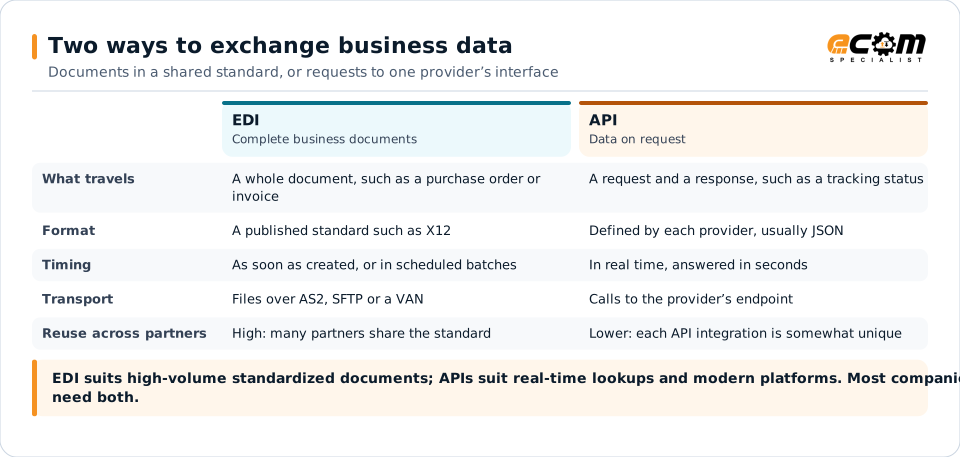
Two ways to exchange business dataComparison of EDI and APIs. EDI sends whole documents in a published standard such as X12, as soon as created or in batches, as files over AS2, SFTP or a VAN, and is highly reusable across partners. APIs send a request and get a response, in a format each provider defines, usually JSON, in real time, with each integration somewhat unique. EDI suits high-volume standardized documents; APIs suit real-time lookups.Two ways to exchange business dataDocuments in a shared standard, or requests to one provider’s interfaceEDIComplete business documentsAPIData on requestWhat travelsA whole document, such as a purchase order orinvoiceA request and a response, such as a tracking statusFormatA published standard such as X12Defined by each provider, usually JSONTimingAs soon as created, or in scheduled batchesIn real time, answered in secondsTransportFiles over AS2, SFTP or a VANCalls to the provider’s endpointReuse across partnersHigh: many partners share the standardLower: each API integration is somewhat uniqueEDI suits high-volume standardized documents; APIs suit real-time lookups and modern platforms. Most companiesneed both.
Two ways to exchange business dataComparison of EDI and APIs. EDI sends whole documents in a published standard such as X12, as soon as created or in batches, as files over AS2, SFTP or a VAN, and is highly reusable across partners. APIs send a request and get a response, in a format each provider defines, usually JSON, in real time, with each integration somewhat unique. EDI suits high-volume standardized documents; APIs suit real-time lookups.Two ways to exchange businessdataDocuments in a shared standard, or requests toone provider’s interfaceEDIComplete businessdocumentsAPIData on requestWhat travelsA whole document,such as a purchaseorder or invoiceA request and aresponse, such as atracking statusFormatA published standardsuch as X12Defined by eachprovider, usuallyJSONTimingAs soon as created,or in scheduledbatchesIn real time,answered in secondsTransportFiles over AS2,SFTP or a VANCalls to theprovider’s endpointReuse across partnersHigh: many partnersshare the standardLower: each APIintegration issomewhat uniqueEDI suits high-volume standardizeddocuments; APIs suit real-timelookups and modern platforms. Mostcompanies need both.

Each row contrasts one aspect of the two approaches, using the examples in this article: a purchase order for EDI and a package tracking lookup for an API.
Expand diagram Download SVG

Two ways to exchange business data

Both EDI and APIs let systems exchange data without people re-keying it. They differ in how data is structured, when it moves, and how widely each format is shared.

How EDI works

EDI exchanges complete business documents, such as a purchase order or an invoice, in a standard format. Because thousands of companies use the same standards, a supplier can reuse much of its work across many customers. Documents are usually sent as files over AS2, SFTP or a VAN, either as soon as they are created or in scheduled batches. See how EDI works.

How APIs work

An API lets one system request or send data to another in real time. A shipper’s system can ask a carrier’s tracking API for the current status of a package and get an answer in seconds. APIs are flexible and fast, but each provider designs its own, so every API integration is somewhat unique.

Where each fits best

Use EDI when:

  • The partner requires it, as most large retailers, manufacturers and carriers do.
  • You exchange high volumes of standardized documents.
  • You need consistent processes across many partners.

Use APIs when:

  • You need real-time answers, such as inventory availability or shipment status.
  • The partner is a marketplace, SaaS platform or modern carrier that offers APIs.
  • You are building new digital channels or customer-facing services.

Running both

The practical answer for most organizations is not EDI or APIs but EDI and APIs on one platform. A purchase order can arrive as an EDI 850 from one customer and as a JSON order from a marketplace API, then follow the same validation, ERP posting and monitoring. Status updates can combine EDI 214 messages with carrier tracking APIs.

Keeping business rules in one integration layer, rather than separately for each channel, means adding a new partner or channel is a configuration task rather than a new project.

Frequently asked questions

Will APIs replace EDI?

Not in the foreseeable future for most supply chains. Large trading partners continue to require EDI, while APIs grow for real-time and platform-specific needs.

Can EDI and APIs feed the same process?

Yes. An integration platform can convert API payloads to and from EDI so orders from either channel follow the same validation and ERP workflow.

Is API integration cheaper than EDI?

It depends. APIs avoid some network costs but each API requires its own integration and maintenance, while EDI maps can be reused across partners using the same standard.

Have an EDI question we did not answer?

ECOM's integration specialists can review your partners, documents and systems and recommend next steps.