
X12 transaction guide · Transportation
EDI 121 Vehicle Service
The X12 document a carrier uses to tell a vehicle manufacturer that a requested movement or service has been performed, or that a vehicle's status changed.
- Sent by
- Rail or truck carrier
- Received by
- Vehicle manufacturer
- Standard
- ANSI ASC X12
What is an EDI 121?
The EDI 121 Vehicle Service is the ANSI X12 transaction set a carrier uses to notify a vehicle manufacturer that a requested movement or service has been performed on motor vehicles, or that a change in status has occurred.
Manufacturers track every finished vehicle from the plant to the dealer. Carriers report events such as receipt at the ramp, departure, arrival and delivery, and services performed. The events update the vehicle's status in the manufacturer's systems and support payment of the carrier.
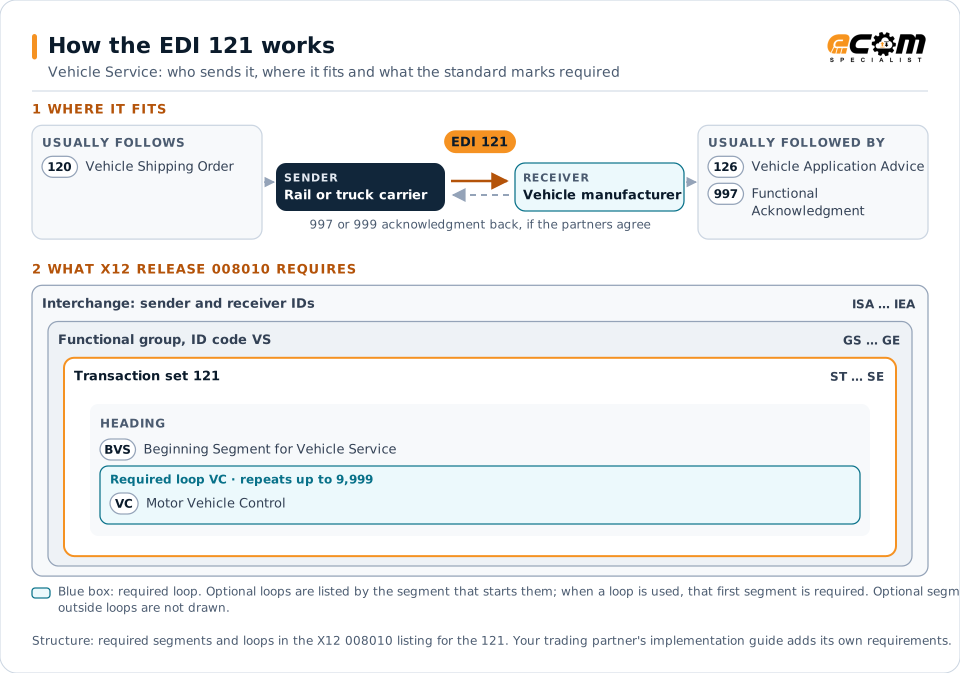
How to read this diagram: the top row shows who sends the 121, to whom, and which documents usually come before and after it. The lower part shows what X12 release 008010 itself requires: the envelopes around the 121 and the segments and loops the standard marks as required, area by area. Optional loops are listed by the segment that starts them rather than drawn in full. This is the standard's minimum, not a trading partner's requirement: each partner's implementation guide usually makes some optional loops mandatory, restricts the codes and may use a different release.
When it is used
- Reporting vehicle departures and arrivals
- Reporting delivery to dealers
- Reporting services performed on vehicles
Where it fits in the document flow
Structure
Mandatory segments in the 121 (X12 release 008010)
The segments X12 release 008010 marks as mandatory at their level, in order. Segments inside optional loops are needed only when the loop is used. This is the standard's requirement, not your trading partner's: each partner's implementation guide names the release it uses, adds the optional segments it requires and restricts the values. The requirement status comes from one published X12 reference listing and has not been checked against a second source.
- ST
- BVS
- VC
- SE
Practical example
The 121 in practice
A truck carrier delivers eight vehicles to a dealer. Its system sends the manufacturer a 121 for each vehicle with the delivery time and any exceptions noted at handover. The manufacturer updates the vehicles to delivered and includes them in the carrier's next payment cycle.
Implementation
Implementation considerations for the 121
- Report events promptly; they drive dealer and customer information.
- Use the event codes the manufacturer defines.
- Identify vehicles by their vehicle identification numbers.
- Reconcile reported services with carrier invoices.
How ECOM helps
Automate the 121 with ECOM
Industry
Automotive
Schedules, ship notices, labels, self-billing and multi-plant routing for automotive suppliers.
Solution
Supply Chain Visibility
Track orders, shipments and invoices across partners and catch exceptions early.
Industry
Trucking and Transportation
Load tenders, responses, status and freight invoices for carriers, brokers and shippers, integrated with the TMS.
More general questions about EDI are answered in the EDI FAQ.
Related transactions
Related transportation documents
- 120Vehicle Shipping Order
- 127Vehicle Baying Order
- 453Railroad Service Commitment Advice
- 924Loss or Damage Claim - Motor Vehicle
- 125Multilevel Railcar Load Details
- 421Estimated Time of Arrival and Car Scheduling
- 928Automotive Inspection Detail
- 219Logistics Service Request
- 220Logistics Service Response
- 104Air Shipment Information
- 106Motor Carrier Rate Proposal
- 107Request for Motor Carrier Rate Proposal
Need help with the EDI 121?
ECOM maps, tests and monitors X12 documents for your trading partners and integrates them with your ERP.