
X12 transaction guide · Healthcare and insurance
EDI 256 Periodic Compensation
The X12 document used to report compensation data, including amounts earned, paid, adjustments and balances.
- Sent by
- Insurance company
- Received by
- Distributor, agency or producer
- Standard
- ANSI ASC X12
What is an EDI 256?
The EDI 256 Periodic Compensation is the ANSI X12 transaction set used to report compensation data, including compensation amounts, compensation earned, compensation paid, adjustments and balances.
Insurers pay commissions to agencies and producers on new business and renewals, with chargebacks when policies lapse early. Commission statements as data let agencies reconcile what they were paid against the policies sold and split commissions among their producers automatically. Statements can cover several producers and policies for one period, showing first-year and renewal commissions separately, along with chargebacks for policies that lapsed and the resulting net balance.
How to read this diagram: the top row shows who sends the 256, to whom, and which documents usually come before and after it. The lower part shows what X12 release 008010 itself requires: the envelopes around the 256 and the segments and loops the standard marks as required, area by area. Optional loops are listed by the segment that starts them rather than drawn in full. This is the standard's minimum, not a trading partner's requirement: each partner's implementation guide usually makes some optional loops mandatory, restricts the codes and may use a different release.
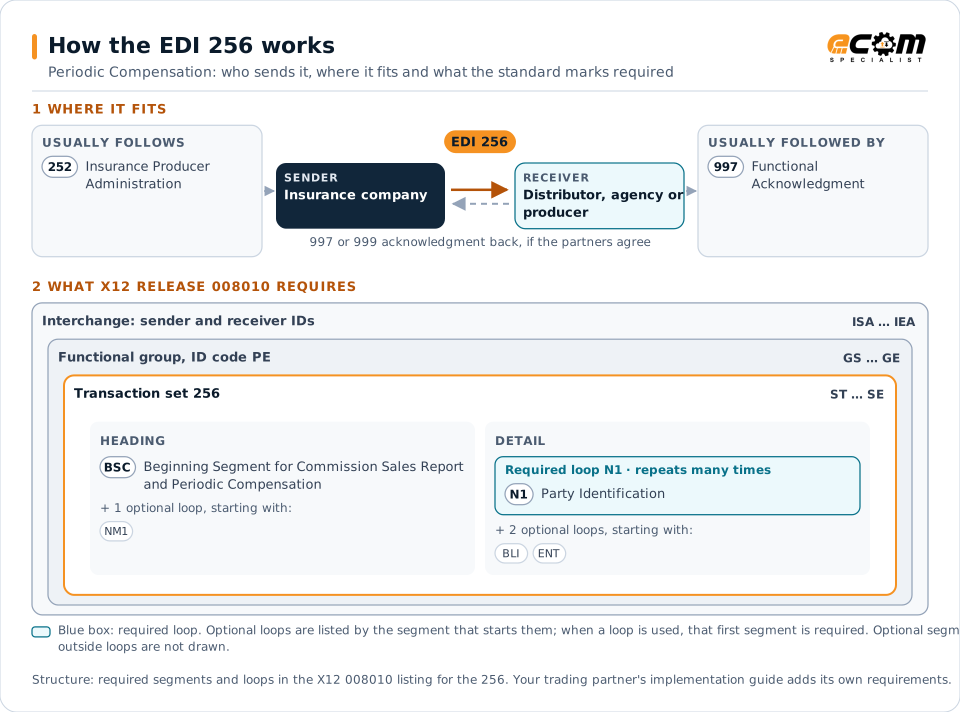
When it is used
- Reporting commissions earned and paid
- Reporting chargebacks and adjustments
- Supporting commission reconciliation
Where it fits in the document flow
Structure
Mandatory segments in the 256 (X12 release 008010)
The segments X12 release 008010 marks as mandatory at their level, in order. Segments inside optional loops are needed only when the loop is used. This is the standard's requirement, not your trading partner's: each partner's implementation guide names the release it uses, adds the optional segments it requires and restricts the values. The requirement status comes from one published X12 reference listing and has not been checked against a second source.
- ST
- BSC
- NM1
- N1
- BLI
- AM1
- AMT
- RPA
- ENT
- SE
Practical example
The 256 in practice
An agency receives commissions from ten insurers. Each month the insurers send 256 statements listing the commission for each policy, chargebacks for lapsed policies and the net payment. The agency's management system reconciles the payments and calculates each producer's share.
Implementation
Implementation considerations for the 256
- Report commissions at policy level for reconciliation.
- Show chargebacks and adjustments separately.
- Reconcile statements with payments received.
- Identify producers consistently with appointment records.
How ECOM helps
Automate the 256 with ECOM
Industry
Financial Services
Secure file transfer and B2B integration for banks and financial institutions.
Solution
Financial Document Automation
Automate invoices, remittances, payment files and bank statements from capture to posting.
Solution
EDI Integration
Exchange X12 and EDIFACT documents with partners and integrate them directly with your ERP.
More general questions about EDI are answered in the EDI FAQ.
Related transactions
Related healthcare and insurance documents
- 252Insurance Producer Administration
- 100Insurance Plan Description
- 186Insurance Underwriting Requirements Reporting
- 273Insurance/Annuity Application Status
- 111Individual Insurance Policy and Client Information
- 112Property Damage Report
- 124Vehicle Damage
- 148Report of Injury, Illness or Incident
- 187Premium Audit Request and Return
- 255Underwriting Information Services
- 259Residential Mortgage Insurance Explanation of Benefits
- 260Application for Mortgage Insurance Benefits
Need help with the EDI 256?
ECOM maps, tests and monitors X12 documents for your trading partners and integrates them with your ERP.