
X12 transaction guide · Transportation
EDI 304 Shipping Instructions
The X12 document a shipper or forwarder sends to an ocean carrier with the information needed to prepare the bill of lading or sea waybill.
- Sent by
- Shipper or freight forwarder
- Received by
- Ocean carrier
- Standard
- ANSI ASC X12
- EDIFACT equivalent
- IFTMIN
What is an EDI 304?
The EDI 304 Shipping Instructions is the ANSI X12 transaction set that gives an ocean carrier all the information needed to prepare and distribute a contract of carriage, such as an ocean bill of lading or sea waybill. It covers the parties, the cargo and container details, references and how the documents should be issued.
Shipping instructions must be accurate and on time: they become the bill of lading, which customs authorities, banks and consignees rely on. Corrections after the bill of lading is issued can delay cargo and incur fees.
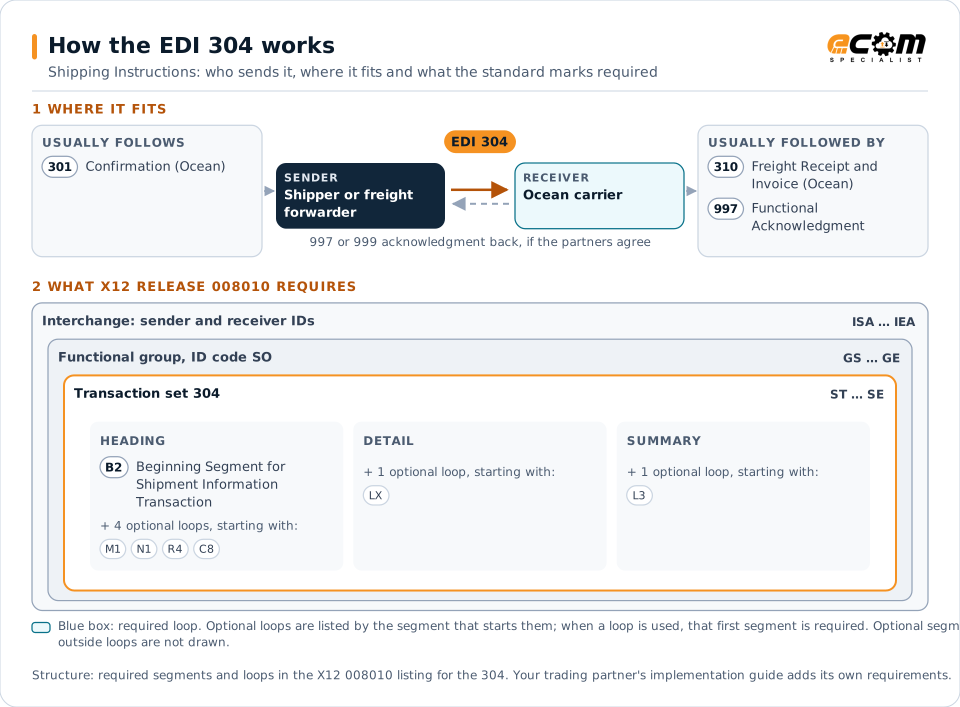
How to read this diagram: the top row shows who sends the 304, to whom, and which documents usually come before and after it. The lower part shows what X12 release 008010 itself requires: the envelopes around the 304 and the segments and loops the standard marks as required, area by area. Optional loops are listed by the segment that starts them rather than drawn in full. This is the standard's minimum, not a trading partner's requirement: each partner's implementation guide usually makes some optional loops mandatory, restricts the codes and may use a different release.
When it is used
- Giving a carrier the data for the bill of lading
- Providing container, seal and cargo details after loading
- Specifying consignee and notify parties
Where it fits in the document flow
Structure
Mandatory segments in the 304 (X12 release 008010)
The segments X12 release 008010 marks as mandatory at their level, in order. Segments inside optional loops are needed only when the loop is used. This is the standard's requirement, not your trading partner's: each partner's implementation guide names the release it uses, adds the optional segments it requires and restricts the values. The requirement status comes from one published X12 reference listing and has not been checked against a second source.
- ST
- B2
- M1
- N1
- R4
- C8
- LX
- N7
- L1
- H1
- LH1
- PO4
- L0
- PAL
- CTP
- SAC
- L9
- L3
- TDS
- SE
Practical example
The 304 in practice
Once its four containers are loaded and sealed, the exporter's forwarder sends the carrier a 304 with each container and seal number, the cargo description, weights, the shipper, consignee and notify parties. The carrier prepares the bill of lading from it and sends a 310 for the forwarder to check before the original is released.
Implementation
Implementation considerations for the 304
- Submit instructions before the carrier's documentation cut-off.
- Validate container numbers, seals and weights against loading records.
- Review the draft bill of lading (310) against the instructions before it is finalized.
Trading partners
Integration guides that include the 304


How ECOM helps
Automate the 304 with ECOM
Industry
Transportation and Logistics
Load tenders, responses, status and freight invoices for carriers, brokers and shippers, integrated with the TMS.
Industry
3PL and Warehousing
Warehouse orders, shipping advice, receipts and inventory reporting between brands, 3PLs, carriers and retailers.
Solution
EDI Integration
Exchange X12 and EDIFACT documents with partners and integrate them directly with your ERP.
Solution
Ocean Freight EDI and API Integration
Ocean carrier, terminal and customs integration for booking, shipping instructions, VGM, container tracking and freight invoices.
More general questions about EDI are answered in the EDI FAQ.
Related transactions
Related transportation documents
- 301Confirmation (Ocean)
- 310Freight Receipt and Invoice (Ocean)
- 300Reservation (Booking Request) (Ocean)
- 303Booking Cancellation (Ocean)
- 313Shipment Status Inquiry (Ocean)
- 323Vessel Schedule and Itinerary (Ocean)
- 361Carrier Interchange Agreement (Ocean)
- 215Motor Carrier Pickup Manifest
- 219Logistics Service Request
- 220Logistics Service Response
- 222Cartage Work Assignment
- 225Response to a Cartage Work Assignment
From the guide to go-live
Put this into practice with ECOM
Reading about EDI is the first step. When you are ready to meet a trading partner's requirements, an ECOM specialist can help.
-
EDI compliance help
Check documents against the partner's rules before they are sent, and find out why labels, ship notices or invoices are rejected or short-paid for EDI 304.
-
EDI implementation
Map, test and certify the documents for EDI 304, and connect them to your ERP, warehouse or order system.
-
Managed EDI
Have ECOM run the day-to-day EDI: monitoring, error handling and new trading partner setup.
Need help with the EDI 304?
ECOM maps, tests and monitors X12 documents for your trading partners and integrates them with your ERP.