
X12 transaction guide · Transportation
EDI 323 Vessel Schedule and Itinerary (Ocean)
The X12 document an ocean carrier uses to communicate the schedule and itinerary of a vessel to interested parties.
- Sent by
- Ocean carrier
- Received by
- Shippers, forwarders, terminals and other parties
- Standard
- ANSI ASC X12
- EDIFACT equivalent
- IFTSAI
What is an EDI 323?
The EDI 323 Vessel Schedule and Itinerary (Ocean) is the ANSI X12 transaction set an ocean carrier uses to communicate the schedule and itinerary of a vessel. It lists the vessel, voyage, ports of call and the scheduled arrival and departure dates at each.
Shippers and forwarders use schedules to choose sailings and plan bookings; terminals use them to plan berths and labor. Schedules change often, so recipients need to process updates and not rely on a one-time load. It is often sent weekly.
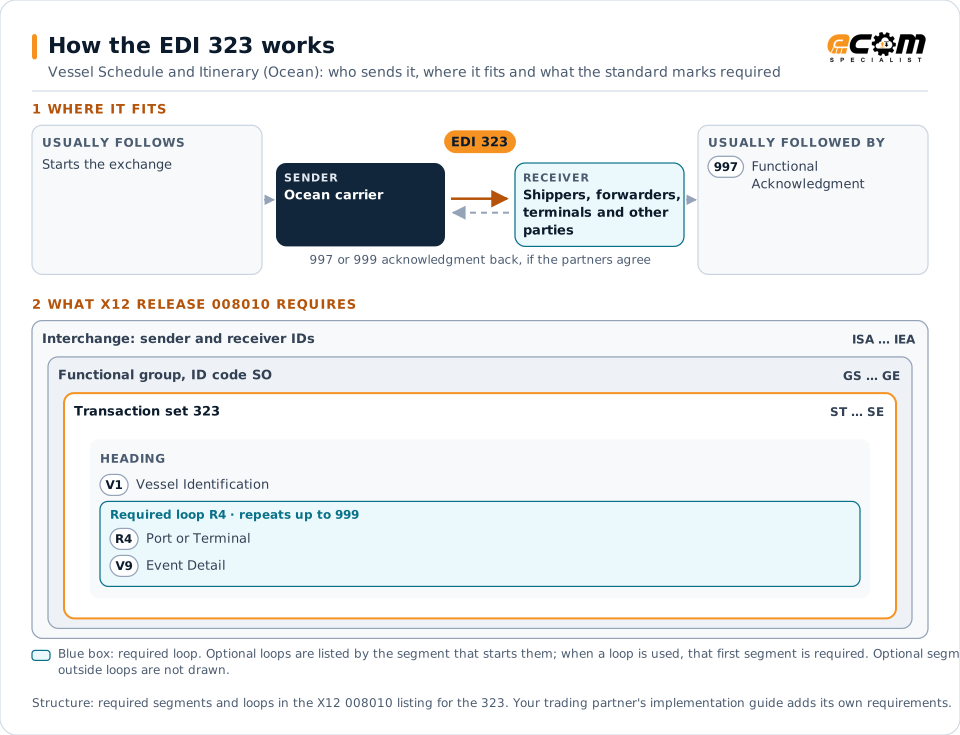
How to read this diagram: the top row shows who sends the 323, to whom, and which documents usually come before and after it. The lower part shows what X12 release 008010 itself requires: the envelopes around the 323 and the segments and loops the standard marks as required, area by area. Optional loops are listed by the segment that starts them rather than drawn in full. This is the standard's minimum, not a trading partner's requirement: each partner's implementation guide usually makes some optional loops mandatory, restricts the codes and may use a different release.
When it is used
- Publishing sailing schedules
- Updating port call dates after delays
- Feeding booking and planning systems with voyage data
Where it fits in the document flow
Structure
Mandatory segments in the 323 (X12 release 008010)
The segments X12 release 008010 marks as mandatory at their level, in order. Segments inside optional loops are needed only when the loop is used. This is the standard's requirement, not your trading partner's: each partner's implementation guide names the release it uses, adds the optional segments it requires and restricts the values. The requirement status comes from one published X12 reference listing and has not been checked against a second source.
- ST
- V1
- R4
- V9
- SE
Practical example
The 323 in practice
An ocean carrier publishes its transpacific schedule weekly with a 323 to large shippers and forwarders. When a vessel is delayed by weather, the carrier sends an updated 323 with revised arrival dates at each remaining port. A forwarder's booking system updates its sailing options and warns customers whose cargo is on the delayed voyage.
Implementation
Implementation considerations for the 323
- Process schedule updates, not just the initial schedule.
- Use standard port codes, such as UN/LOCODEs, mapped to your locations.
- Identify vessels and voyages consistently with bookings and bills of lading.
- Alert affected shipments when schedules change.
How ECOM helps
Automate the 323 with ECOM
Industry
Trucking and Transportation
Load tenders, responses, status and freight invoices for carriers, brokers and shippers, integrated with the TMS.
Solution
Supply Chain Visibility
Track orders, shipments and invoices across partners and catch exceptions early.
Industry
3PL and Warehousing
Warehouse orders, shipping advice, receipts and inventory reporting between brands, 3PLs, carriers and retailers.
More general questions about EDI are answered in the EDI FAQ.
Related transactions
Related transportation documents
- 300Reservation (Booking Request) (Ocean)
- 301Confirmation (Ocean)
- 303Booking Cancellation (Ocean)
- 313Shipment Status Inquiry (Ocean)
- 361Carrier Interchange Agreement (Ocean)
- 304Shipping Instructions
- 310Freight Receipt and Invoice (Ocean)
- 324Vessel Stow Plan (Ocean)
- 215Motor Carrier Pickup Manifest
- 219Logistics Service Request
- 220Logistics Service Response
- 222Cartage Work Assignment
Need help with the EDI 323?
ECOM maps, tests and monitors X12 documents for your trading partners and integrates them with your ERP.