
X12 transaction guide · Transportation
EDI 317 Delivery/Pickup Order
The X12 document importers or their agents use to give marine terminal operators orders for the delivery or pickup of goods.
- Sent by
- Importer, customs broker or forwarder
- Received by
- Marine terminal operator
- Standard
- ANSI ASC X12
What is an EDI 317?
The EDI 317 Delivery/Pickup Order is the ANSI X12 transaction set importers or their agents use to give marine terminal operators orders for the delivery or pickup of goods. It tells the terminal which cargo to release, to which trucker or carrier, and when.
The delivery order is one of the release conditions at a terminal, alongside customs clearance and payment of carrier charges. Sending it electronically speeds up container pickup and reduces the risk of release to the wrong party.
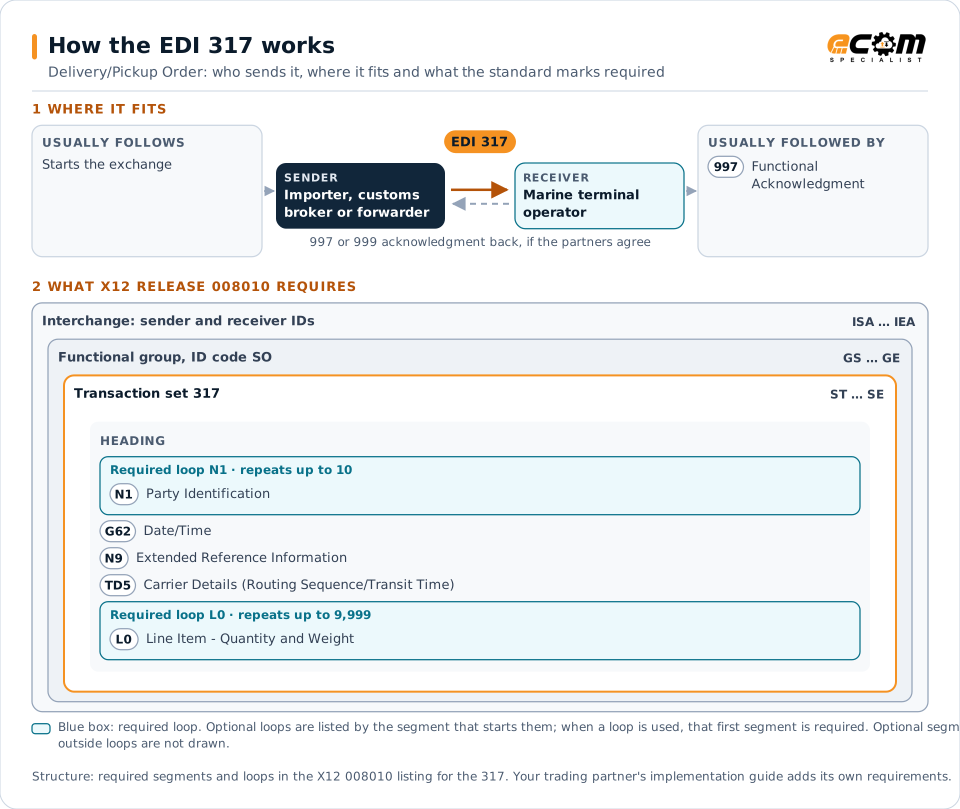
How to read this diagram: the top row shows who sends the 317, to whom, and which documents usually come before and after it. The lower part shows what X12 release 008010 itself requires: the envelopes around the 317 and the segments and loops the standard marks as required, area by area. Optional loops are listed by the segment that starts them rather than drawn in full. This is the standard's minimum, not a trading partner's requirement: each partner's implementation guide usually makes some optional loops mandatory, restricts the codes and may use a different release.
When it is used
- Authorizing a trucker to pick up an import container
- Ordering delivery of cargo from a terminal
- Updating pickup arrangements at a terminal
Where it fits in the document flow
Structure
Mandatory segments in the 317 (X12 release 008010)
The segments X12 release 008010 marks as mandatory at their level, in order. Segments inside optional loops are needed only when the loop is used. This is the standard's requirement, not your trading partner's: each partner's implementation guide names the release it uses, adds the optional segments it requires and restricts the values. The requirement status comes from one published X12 reference listing and has not been checked against a second source.
- ST
- N1
- G62
- N9
- TD5
- L0
- SE
Practical example
The 317 in practice
After customs releases an import shipment, the importer's broker sends the terminal a 317 naming the trucking company that will collect two containers, with the bill of lading and container numbers and the planned pickup date. The terminal's gate system matches the trucker on arrival and releases the containers.
Implementation
Implementation considerations for the 317
- Identify the authorized trucker exactly, to avoid gate rejections.
- Send the order before the trucker arrives at the terminal.
- Check customs and carrier holds, which can still block release.
- Track free time, as delayed pickup leads to storage charges.
How ECOM helps
Automate the 317 with ECOM
Industry
Transportation and Logistics
Load tenders, responses, status and freight invoices for carriers, brokers and shippers, integrated with the TMS.
Industry
3PL and Warehousing
Warehouse orders, shipping advice, receipts and inventory reporting between brands, 3PLs, carriers and retailers.
Solution
Logistics Automation
Automate tenders, status updates, freight invoices and warehouse orders with logistics partners.
Solution
Ocean Freight EDI and API Integration
Ocean carrier, terminal and customs integration for booking, shipping instructions, VGM, container tracking and freight invoices.
More general questions about EDI are answered in the EDI FAQ.
Related transactions
Related transportation documents
- 215Motor Carrier Pickup Manifest
- 361Carrier Interchange Agreement (Ocean)
- 219Logistics Service Request
- 220Logistics Service Response
- 222Cartage Work Assignment
- 225Response to a Cartage Work Assignment
- 300Reservation (Booking Request) (Ocean)
- 301Confirmation (Ocean)
- 303Booking Cancellation (Ocean)
- 304Shipping Instructions
- 313Shipment Status Inquiry (Ocean)
- 319Terminal Information
From the guide to go-live
Put this into practice with ECOM
Reading about EDI is the first step. When you are ready to meet a trading partner's requirements, an ECOM specialist can help.
-
EDI compliance help
Check documents against the partner's rules before they are sent, and find out why labels, ship notices or invoices are rejected or short-paid for EDI 317.
-
EDI implementation
Map, test and certify the documents for EDI 317, and connect them to your ERP, warehouse or order system.
-
Managed EDI
Have ECOM run the day-to-day EDI: monitoring, error handling and new trading partner setup.
Need help with the EDI 317?
ECOM maps, tests and monitors X12 documents for your trading partners and integrates them with your ERP.