
X12 transaction guide · Catalogs and pricing
EDI 486 Rate Docket Expiration
The X12 document used to transmit the expiration date of a rate docket.
- Sent by
- Railroad or rate publisher
- Received by
- Shippers, railroads and other rate users
- Standard
- ANSI ASC X12
What is an EDI 486?
The EDI 486 Rate Docket Expiration is the ANSI X12 transaction set used to transmit the expiration date of a docket.
Rates in a docket apply until they expire. Communicating expirations electronically lets shippers' rating and audit systems stop using expired rates on time and alerts them to negotiate replacements before shipments move without an agreed rate. Expired rates must no longer be applied to shipments, so rating and audit systems need the expiration dates as soon as they are set. Expiration notices also prompt shippers and railroads to negotiate replacement rates in good time.
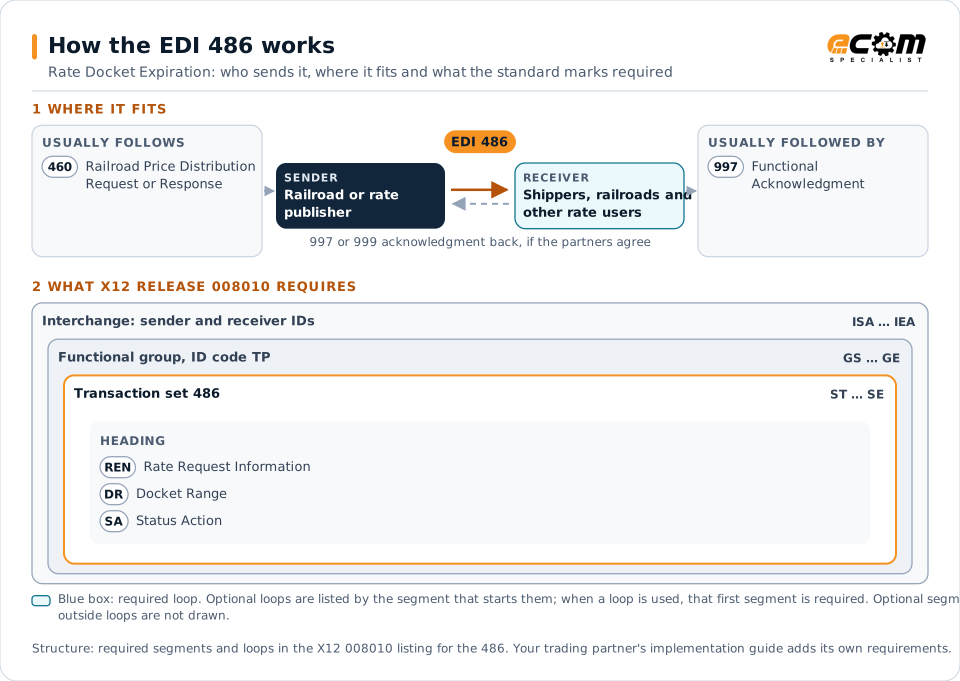
How to read this diagram: the top row shows who sends the 486, to whom, and which documents usually come before and after it. The lower part shows what X12 release 008010 itself requires: the envelopes around the 486 and the segments and loops the standard marks as required, area by area. Optional loops are listed by the segment that starts them rather than drawn in full. This is the standard's minimum, not a trading partner's requirement: each partner's implementation guide usually makes some optional loops mandatory, restricts the codes and may use a different release.
When it is used
- Announcing the expiration of a rate docket
- Changing a docket's expiration date
- Alerting users to renegotiate rates
Where it fits in the document flow
Structure
Mandatory segments in the 486 (X12 release 008010)
The segments X12 release 008010 marks as mandatory at their level, in order. Segments inside optional loops are needed only when the loop is used. This is the standard's requirement, not your trading partner's: each partner's implementation guide names the release it uses, adds the optional segments it requires and restricts the values. The requirement status comes from one published X12 reference listing and has not been checked against a second source.
- ST
- REN
- DR
- SA
- SE
Practical example
The 486 in practice
A railroad's contract rates with a customer are due to end at the close of the year. It sends a 486 with the docket's expiration date. The customer's freight audit system flags the expiring rates, and its logistics team starts renewal talks.
Implementation
Implementation considerations for the 486
- Load expiration dates into rating and audit systems.
- Alert commercial teams ahead of expirations.
- Make sure replacement rates are loaded in time.
- Reference the rate docket exactly as published.
How ECOM helps
Automate the 486 with ECOM
Industry
Trucking and Transportation
Load tenders, responses, status and freight invoices for carriers, brokers and shippers, integrated with the TMS.
Solution
Financial Document Automation
Automate invoices, remittances, payment files and bank statements from capture to posting.
Solution
EDI Integration
Exchange X12 and EDIFACT documents with partners and integrate them directly with your ERP.
More general questions about EDI are answered in the EDI FAQ.
Related transactions
Related catalogs and pricing documents
Need help with the EDI 486?
ECOM maps, tests and monitors X12 documents for your trading partners and integrates them with your ERP.