
EDIFACT message guide · Communications
INFCON Infrastructure condition
The UN/EDIFACT message a responsible party uses to inform others about the condition of a component in a services or utilities infrastructure.
- Sent by
- Infrastructure operator or responsible party
- Received by
- Other interested parties, such as service providers
- Standard
- UN/EDIFACT · Batch message
- X12 equivalent
- No direct equivalent
What is the EDIFACT INFCON message?
INFCON is the UN/EDIFACT infrastructure condition message. The directory defines it as a message sent by a responsible party to other interested parties about the condition of a component in a commercial services or utilities infrastructure.
Conditions include planned outages, faults, restrictions and restorations. Parties that depend on the infrastructure, such as energy suppliers relying on a grid operator's network, use the information to inform customers and plan their own operations. Messages can describe planned work as well as unplanned faults, with start and expected end times for each.
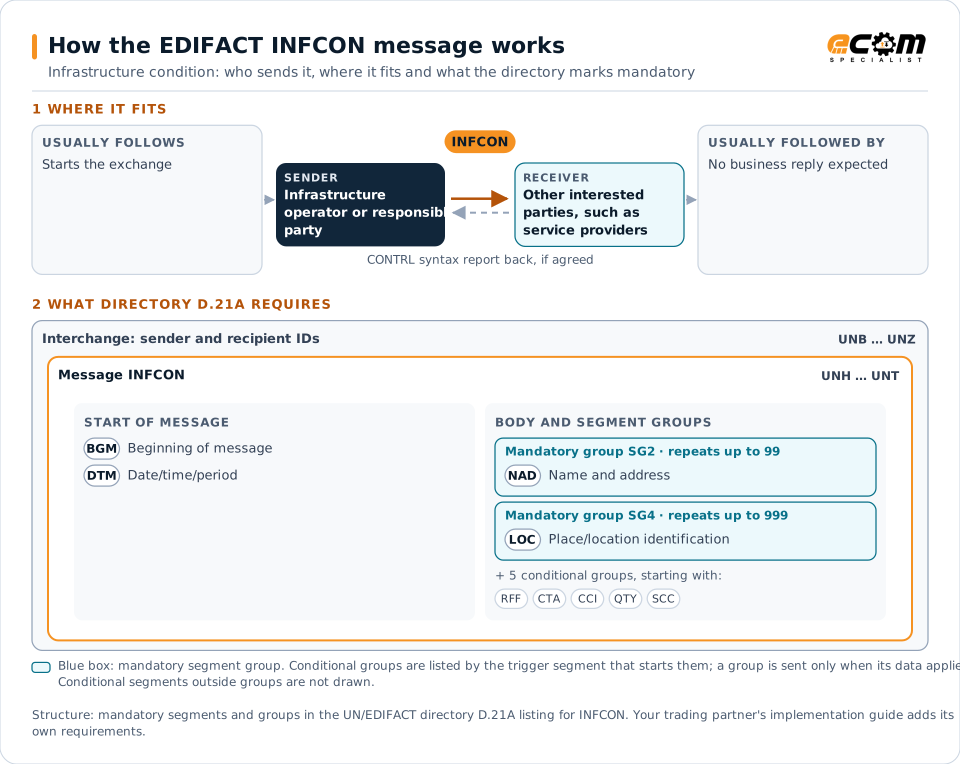
How to read this diagram: the top row shows who sends INFCON, to whom, and which messages usually come before and after it. The lower part shows what the directory D.21A itself requires: the envelopes around INFCON and the segments and segment groups it marks mandatory. Conditional groups are listed by their trigger segment rather than drawn in full. This is the directory's minimum, not a trading partner's requirement: a message implementation guide, such as an industry subset or a partner’s own guide, usually makes some conditional groups mandatory, restricts the codes and may use an older directory.
When it is used
- Announcing planned maintenance outages
- Reporting faults on infrastructure components
- Reporting restoration of service
Where it fits in the message flow
No other message routinely comes directly before or after INFCON; it is exchanged when the business event occurs. If the partners agree, the receiver confirms each interchange with a CONTRL syntax and service report.
Structure
Mandatory segments in INFCON (directory D.21A)
In UN/EDIFACT directory D.21A, the INFCON message has 20 segment positions arranged in 7 segment groups. These are the segments and segment groups marked mandatory at message level, in order; a mandatory group is shown with the segment that starts it. Segments inside conditional groups are needed only when the group is used. This is the directory’s requirement, not your trading partner’s: each partner’s message implementation guide names the directory it uses, often an older one such as D.96A or D.01B where the structure can differ, makes some conditional segments mandatory and restricts the codes.
- UNH
- BGM
- DTM
- SG2 (NAD)
- SG4 (LOC)
- UNT
Practical example
INFCON in practice
A grid operator plans maintenance on a substation that will interrupt supply to several streets. It sends the energy suppliers serving those customers an INFCON with the affected component, the area and the outage window. The suppliers notify their customers, and a second INFCON reports when supply is restored.
Implementation
Implementation considerations for INFCON
- Identify components and affected areas with agreed codes.
- Announce planned outages within regulatory notice periods.
- Report restorations of service as well as outages.
- Follow national market rules where they define the exchange.
How ECOM helps
Automate INFCON with ECOM
Industry
Telecom and Media
Equipment supply chains, service billing and partner data exchange for telecom and media companies.
Solution
B2B Integration
Connect every customer, supplier, carrier and bank across EDI, API, file and portal channels.
Solution
EDI Integration
Exchange X12 and EDIFACT documents with partners and integrate them directly with your ERP.
Compare X12 and EDIFACT, or see answers to general questions in the EDI FAQ.
Need help with INFCON?
ECOM maps, tests and monitors EDIFACT messages for your trading partners and integrates them with your ERP.