
EDIFACT message guide · Catalogs and pricing
PRIHIS Pricing history
The UN/EDIFACT message that provides the pricing history of goods previously ordered under conditions agreed between seller and buyer.
- Sent by
- Seller
- Received by
- Buyer
- Standard
- UN/EDIFACT · Batch message
- X12 equivalent
- No direct equivalent
What is the EDIFACT PRIHIS message?
PRIHIS is the UN/EDIFACT pricing history message. The directory defines it as a message furnishing the pricing history, and related information, of goods previously ordered under conditions agreed between a seller and a buyer.
Pricing history supports contract renewals, audits and price-escalation calculations. Buyers, including public bodies that must justify prices, use it to see what was paid for items over time, under which contracts and at which quantities, and to compare a supplier's new offer against the past. It complements current catalogue and contract data, such as PRICAT and CNTCND.
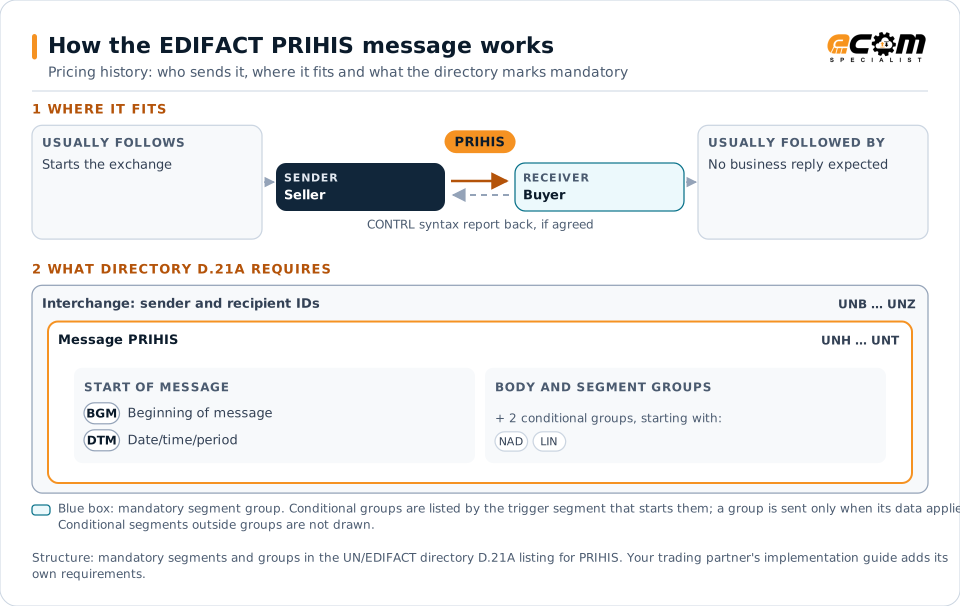
How to read this diagram: the top row shows who sends PRIHIS, to whom, and which messages usually come before and after it. The lower part shows what the directory D.21A itself requires: the envelopes around PRIHIS and the segments and segment groups it marks mandatory. Conditional groups are listed by their trigger segment rather than drawn in full. This is the directory's minimum, not a trading partner's requirement: a message implementation guide, such as an industry subset or a partner’s own guide, usually makes some conditional groups mandatory, restricts the codes and may use an older directory.
When it is used
- Supporting contract renewals and negotiations
- Auditing prices paid over a period
- Supporting price-escalation calculations
Where it fits in the message flow
No other message routinely comes directly before or after PRIHIS; it is exchanged when the business event occurs. If the partners agree, the receiver confirms each interchange with a CONTRL syntax and service report.
Structure
Mandatory segments in PRIHIS (directory D.21A)
In UN/EDIFACT directory D.21A, the PRIHIS message has 56 segment positions arranged in 17 segment groups. These are the segments and segment groups marked mandatory at message level, in order; a mandatory group is shown with the segment that starts it. Segments inside conditional groups are needed only when the group is used. This is the directory’s requirement, not your trading partner’s: each partner’s message implementation guide names the directory it uses, often an older one such as D.96A or D.01B where the structure can differ, makes some conditional segments mandatory and restricts the codes.
- UNH
- BGM
- DTM
- UNT
Practical example
PRIHIS in practice
A defense agency prepares to renew a spare parts contract and asks the supplier for three years of pricing history. The supplier sends a PRIHIS listing each part, the prices charged under each order, the quantities and dates. The agency's analysts compare the trend with the supplier's proposed new prices.
Implementation
Implementation considerations for PRIHIS
- Define the period and items the history should cover.
- Reference the orders or contracts behind each price.
- Keep currency and unit of measure consistent across the history.
- Reconcile the history with invoices where audits require it.
How ECOM helps
Automate PRIHIS with ECOM
Solution
Procure-to-Pay Automation
Automate purchasing, receiving and supplier invoicing across EDI, portals and documents.
Industry
Industrial Manufacturing
Distributor, OEM customer and supplier integration for industrial manufacturers.
Solution
Financial Document Automation
Automate invoices, remittances, payment files and bank statements from capture to posting.
Compare X12 and EDIFACT, or see answers to general questions in the EDI FAQ.
Need help with PRIHIS?
ECOM maps, tests and monitors EDIFACT messages for your trading partners and integrates them with your ERP.