
EDIFACT message guide · Customs and regulatory
REGENT Registration of enterprise
The UN/EDIFACT message used to send legal, administrative and statutory information on the creation, change or cessation of a business activity.
- Sent by
- Enterprise or its representative
- Received by
- Registration authority or other administration
- Standard
- UN/EDIFACT · Batch message
- X12 equivalent
- No direct equivalent
What is the EDIFACT REGENT message?
REGENT is the UN/EDIFACT registration of enterprise message. The directory defines it as a message designed to transmit legal, administrative and statutory information about the creation, change or cessation of a business activity within an enterprise. It can be exchanged between an enterprise and an authority responsible for registration, and between authorities.
Registration data, such as legal form, address, activity codes and officers, is needed by trade registers, tax and social security administrations. Exchanging it electronically lets one registration reach several administrations.
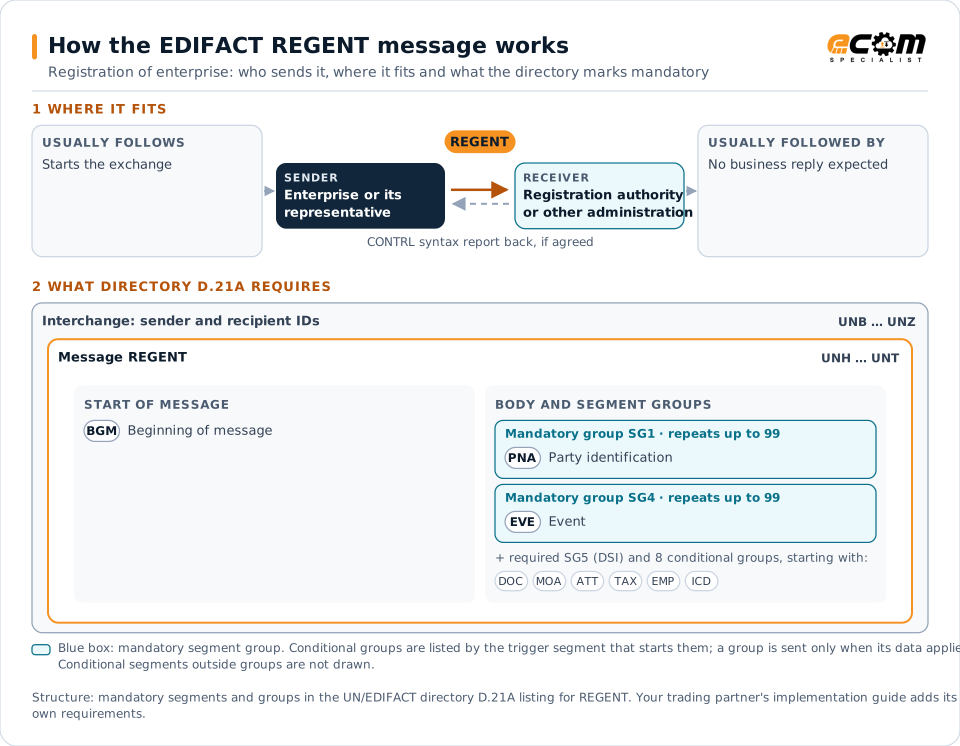
How to read this diagram: the top row shows who sends REGENT, to whom, and which messages usually come before and after it. The lower part shows what the directory D.21A itself requires: the envelopes around REGENT and the segments and segment groups it marks mandatory. Conditional groups are listed by their trigger segment rather than drawn in full. This is the directory's minimum, not a trading partner's requirement: a message implementation guide, such as an industry subset or a partner’s own guide, usually makes some conditional groups mandatory, restricts the codes and may use an older directory.
When it is used
- Registering a new business activity
- Reporting changes such as address or legal form
- Notifying cessation of an activity
Where it fits in the message flow
No other message routinely comes directly before or after REGENT; it is exchanged when the business event occurs. If the partners agree, the receiver confirms each interchange with a CONTRL syntax and service report.
Structure
Mandatory segments in REGENT (directory D.21A)
In UN/EDIFACT directory D.21A, the REGENT message has 71 segment positions arranged in 14 segment groups. These are the segments and segment groups marked mandatory at message level, in order; a mandatory group is shown with the segment that starts it. Segments inside conditional groups are needed only when the group is used. This is the directory’s requirement, not your trading partner’s: each partner’s message implementation guide names the directory it uses, often an older one such as D.96A or D.01B where the structure can differ, makes some conditional segments mandatory and restricts the codes.
- UNH
- BGM
- SG1 (PNA)
- SG4 (EVE)
- SG5 (DSI)
- UNT
Practical example
REGENT in practice
A company opens a new branch. Its formalities agent sends the registration authority a REGENT with the branch address, activity code, start date and manager. The authority records the branch and passes the information to the tax and social security administrations.
Implementation
Implementation considerations for REGENT
- Check which administrations accept REGENT and which require portals.
- Use official activity classification codes.
- Report changes within statutory deadlines.
- Keep confirmations as proof of registration.
How ECOM helps
Automate REGENT with ECOM
Solution
EDI Integration
Exchange X12 and EDIFACT documents with partners and integrate them directly with your ERP.
Solution
Enterprise Integration
Any-to-any integration across partners, systems, protocols, security requirements, formats and ERPs, in batch or real time.
Industry
Financial Services
Secure file transfer and B2B integration for banks and financial institutions.
Compare X12 and EDIFACT, or see answers to general questions in the EDI FAQ.
Related messages
Related customs and regulatory messages
Need help with REGENT?
ECOM maps, tests and monitors EDIFACT messages for your trading partners and integrates them with your ERP.