Executive summary
The situation and ECOM’s role
A diversified freight and logistics provider had run its EDI on the same platform for decades. It had worked well, and that was the difficulty: the technology was approaching the end of vendor support, while the platform held a long history of business rules for a wide range of services.
The provider moves freight across several services and modes, including international shipments and customs-related processes. Each service needs different documents, routing decisions, acknowledgments and exception handling.
ECOM provides managed EDI operations, the API Gateway, Reconcile360 and PRISM-SCV. Modernizing a reliable platform is a business-process question first and a technology question second.
A legacy EDI platform can be reliable and still be a major enterprise risk when vendor support ends.
Customer environment
- Industry
- Freight and logistics services across several transportation modes.
- Platform history
- An EDI environment with many years of history, running effectively but nearing the end of vendor support.
- Services
- Several service lines across multiple transportation modes, including international shipments.
- Partners
- Shippers, carriers, agents and other parties connected through different document exchanges.
About this profile: the customer is not named and details are generalized. What is stated about the customer comes from ECOM; text marked “industry context” describes how this kind of business typically works. No volumes, timelines, figures, quotes or measured results are published.
The challenge
Nothing was failing. That was the problem.
It is easier to justify replacing a system that is failing. A platform that has run for decades without drama tends to be left alone until the vendor announces the end of support. By then, the choice is no longer whether to move but how fast, and the risk is concentrated in a short window.
The older the system, the more of the company’s operating logic it contains. Routing rules for one service line, acknowledgment handling for another, a particular way of reporting an international shipment, a partner-specific exception: much of it was written years ago and is not recorded anywhere else.
A replacement that only reproduces the translation layer will miss that logic. A replacement that has to be fully designed from interviews will take longer than the support window allows. The practical task is business-rule discovery: reading the existing mappings and processing to learn what the business actually does, and carrying it forward with each trading partner’s relationship intact.
Why ECOM
Preserving the process while replacing the technology
Technology replacement and business-process preservation are different jobs. The first picks a platform. The second makes sure that what the old platform did for tenders, status, customs documents and invoices is still done afterward, and that partners notice nothing but continuity.
ECOM’s role is to take operational responsibility for the exchange as a managed service. The activities, such as mapping analysis and partner continuity work, are defined in the agreed scope, so they are not squeezed into the provider’s own project calendar.
The scope also covers connections by API, shipment visibility and payment matching (listed below).
Industry context
Freight and logistics services company
A freight and logistics services company sells several services to many shippers: moving freight, managing shipments and providing visibility. Customers expect the same reliability whichever service they buy, but the systems behind each service differ, and so do the ways customers want to connect.
Many customers, different connections
Some customers send EDI, some use APIs, and each service line may have its own set of documents.
Customer service needs answers fast
When a shipper asks where a load is, the answer should come from one place, not from a search across systems.
Money comes back in batches
Customers pay many invoices at once, with remittance that must be traced to the right accounts.
Where it goes wrong
Typical problems in this kind of exchange
-
Integration work is scattered
Each service line connects customers its own way.
Work is spread across teams and tools, so each new customer takes longer than it should.
-
Status is hard to find
Shipment information sits in several operating systems.
Customer-facing staff spend calls searching, and customers wait for answers they expect at once.
-
Missing responses go unnoticed
A tender response or delivery update that does not arrive leaves no obvious trace.
The customer notices before the provider does.
-
Payments are hard to trace
One payment covers many invoices, with remittance that may arrive separately.
Receivables staff match by hand, and unmatched items can sit unapplied.
What ECOM provides
The confirmed scope of services
-
EDI operations
ECOM runs the EDI exchange with the customer’s trading partners.
About EDI operations -
API Gateway
PRISM-API Gateway carries the integrations between the customer’s own applications and with outside parties, so internal and external connections follow one pattern.
About API Gateway -
Reconcile360
PRISM Reconcile360 matches remittance advice, bank deposits and open invoices, and flags differences for review.
About Reconcile360 -
PRISM-SCV
PRISM-SCV links an order’s documents into one timeline, monitors expected responses and routes exceptions to the right team.
About PRISM-SCV
What ECOM is responsible for
- ECOM operates the provider’s EDI exchange as a managed service, taking responsibility for maps, partner connections and monitoring.
- Understanding the existing mappings and business rules comes first, so they can be carried forward.
- The API Gateway handles connections between the provider’s systems and with outside parties that connect by API.
- PRISM-SCV follows each shipment’s documents across the different services and flags expected responses that have not arrived.
- Reconcile360 matches remittance, deposits and open invoices and flags differences for review.
Technical and operational detail
Why replacing a long-running platform is more than translating documents
Industry context: a platform that has run for decades has absorbed requirements from every service line and every partner it ever connected. Replacing it raises risks that have little to do with the new technology. Business rules embedded in old mappings may be known only to the platform itself. Partner connections have their own credentials, schedules and test requirements. Documents that are rare, such as a quarter-end report or a once-a-year customs filing, will not appear in any short test window. And a freight business cannot pause: loads keep moving, and invoices keep being issued, while the cutover happens.
The usual approach to this problem is to inventory what the platform actually does, group partners by connection method and complexity, run the new path in parallel where partners allow it, and move partners in planned waves with a way back. ECOM’s confirmed role is to take responsibility for the managed EDI operation as a service. The specific sequence and timing of any migration for this customer are not published.
Vendor end of support matters because it ends security patches and the ability to get answers when something breaks. A platform in that state can be operated for a while, but each month the cost of an unexpected failure goes up and the number of people who can fix it goes down.
A document landscape that differs by service (industry context)
Truckload and less-than-truckload shipments typically use load tenders and responses (204, 990), shipment status (214) and freight invoices (210). Multi-stop moves add stop-level status. International and ocean shipments use booking and bill-of-lading style documents (such as 300 series and 304 in X12, or IFTMIN and IFTSTA in EDIFACT), vessel and container status messages (315), and customs-related messages. Third-party transportation providers add their own tender and status conventions.
No single pattern serves all of that. The practical goal is a managed exchange where each service keeps the documents it needs, partners are monitored against their own expected responses, and exceptions reach the team that can resolve them. PRISM-SCV follows each shipment’s documents across the services and routes exceptions, the API Gateway handles partners that connect by API, and Reconcile360 supports cash application.
Architecture
Where the integration sits
Provider environment
- Transportation and logistics operating systems
- International and customs processes
- Accounting and receivables
ECOM responsibilities
- Managed EDI operations
- Business-rule and mapping analysis
- API Gateway
- PRISM-SCV timeline and exceptions
- Reconcile360
Partners
- Shippers and customers
- Carriers and third-party transportation providers
- Customs-related parties
- The bank
Educational diagram of this kind of environment, not the customer’s own architecture.
Running a similar exchange? Tell us your partners, systems and where the delays are, and a specialist will suggest where to start.
Talk to an EDI/API ExpertThe workflow
How the work flows
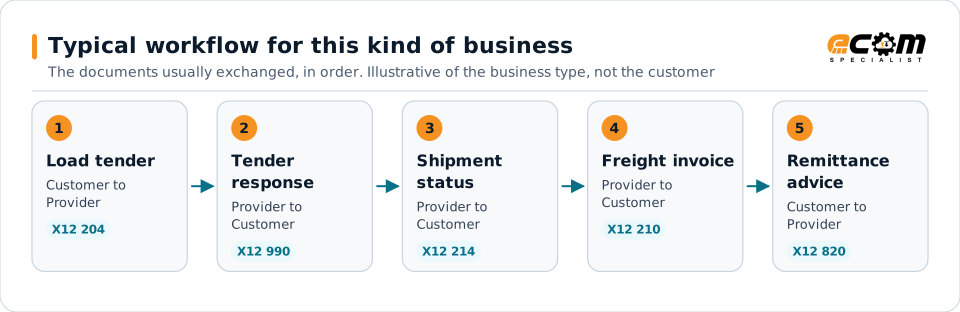
The documents typically exchanged in this kind of business, in the order they usually move. Partners vary, and some connect by API instead of EDI. The shaded line under a step shows where ECOM’s services act.
Steps are listed in the order the documents usually move, with who sends each one.
Shown for a truckload movement. Other modes, such as parcel, ocean, air or rail, use different documents.
-
1. Request
Load tenderX12 204
Customer Provider
A customer asks the provider to move a shipment, by EDI or API.
ECOM operates the EDI exchange with the customer’s trading partners.
-
2. Respond
Tender responseX12 990
Provider Customer
The provider accepts or declines within the window the customer sets.
PRISM-SCV watches for the response and routes a tender that gets no answer to the team that owns it.
-
3. Track
Shipment statusX12 214
Provider Customer
Pickup, transit and delivery events keep the customer informed.
PRISM-SCV links status events into one timeline and flags an expected update that has not arrived.
-
4. Bill
Freight invoiceX12 210
Provider Customer
Charges are billed with the references the customer needs to pay.
-
5. Get paid
Remittance adviceX12 820
Customer Provider
Payments arrive for many invoices at once, often with remittance separate from the deposit.
PRISM Reconcile360 matches this remittance advice with the bank deposit and the open invoices, and flags differences for review.
ECOM’s role
Operational needs and ECOM’s role
What this kind of exchange needs, and what ECOM does about it within the agreed scope.
Exception handling
When something goes wrong
-
A response or update is overdue
An expected tender response or status message has not arrived.
It is flagged and routed to the team that owns that step.
-
A connection fails
A customer’s EDI or API connection stops.
The team that operates the exchange sees it and works it with the customer’s requirements.
-
A payment does not tie out
The remittance, deposit and open invoices disagree.
The item goes to review with the records side by side.
Business value
Confirmed scope and intended benefits
Confirmed
- ECOM is responsible for managed EDI operations for the provider.
- ECOM provides the API Gateway, Reconcile360 and PRISM-SCV.
Intended benefits
- Business rules identified and carried forward rather than rediscovered after go-live.
- Trading-partner relationships maintained through the transition.
- Visibility across services with different document flows.
- Reconciliation that follows the business rather than a single platform’s format.
Systems typically involved
- Customer systemsSend requests and receive responses, status and invoices.
- Operating and dispatch systemsSource of shipments, events and delivery evidence.
- Accounting system and bankHold open invoices and deposits to be matched.
Lessons for similar enterprises
What other organizations can take from this
Reliable is not the same as supported
Plan for the end of vendor support while the platform is still stable, not after the date is announced.
Discover rules before choosing the replacement
Mappings and processing show what the business does. Read them first, and let that shape the move.
Protect partner relationships
A partner remembers whether the transition was invisible. Continuity is part of the project goal.
Different services need different flows
Truckload, LTL, multi-stop and international shipments should not be forced into one pattern.