Executive summary
The situation and ECOM’s role
A large North American truckload carrier ran its transportation business on a long-established midrange platform and several transportation management applications, and exchanged documents with many trading partners through a large inventory of EDI maps. Those maps, and the partner-specific logic built into them, were maintained by a small team of experienced EDI developers.
That team was shrinking as developers approached retirement, and some of what they knew had never been written down. The exposure was not old technology. It was a business-critical function that depended on a handful of people about to leave.
ECOM took on operational responsibility for the carrier’s EDI, with managed EDI operations, the API Gateway, Reconcile360 and PRISM-SCV.
The greatest risk in a legacy EDI environment may not be outdated technology. It may be the departure of the last people who understand how the business operates.
Customer environment
- Industry
- Truckload transportation, shipping for many shippers and brokers.
- Size
- A large carrier (size band only).
- Platform
- A long-established midrange platform and multiple transportation management applications.
- Trading partners
- Many trading partners, supported by a large inventory of EDI maps.
- External platforms
- Integration with external transportation bidding platforms and other third-party systems.
- Staffing
- A small group of experienced EDI developers approaching retirement.
About this profile: the customer is not named and details are generalized. What is stated about the customer comes from ECOM; text marked “industry context” describes how this kind of business typically works. No volumes, timelines, figures, quotes or measured results are published.
The challenge
A business-continuity risk hidden inside an integration team
Every EDI environment accumulates history. Years of partner requests, special cases and temporary fixes become permanent logic inside the maps. After a decade or two, the maps are less a set of translations than a record of how the business actually works, and the best documentation is often a person.
When the people who hold that record retire, the cost is not simply an open job requisition. A replacement developer must learn the trading partners, the legacy platform, the TMS applications, the bidding-platform connections and the exceptions that only appear at month end or when a particular shipper changes a rule. Until they do, every change to a map carries risk.
The carrier’s situation made this concrete: a small team, retirements approaching and a large map inventory. The question was not whether to modernize. It was how to keep tenders answered, status sent and invoices flowing while responsibility changed hands.
Why ECOM
Moving responsibility to a team, not to a person
A managed-services model replaces dependence on individuals with a team that does this work for many customers and can absorb absences. Knowledge is held in documented maps, monitoring and procedures rather than in a single developer’s experience.
A responsible takeover starts with understanding what exists: the trading partners, the maps, the dependencies on legacy systems and the exceptions that matter, and documenting them. That inventory is the foundation for continuity and for any later modernization.
EDI is only part of the continuity picture, which is why the scope also covers integration, shipment visibility and cash matching (listed below).
Industry context
North American truckload carrier
A truckload carrier sells capacity: a tractor, a trailer and a driver at the right place and time. Revenue depends on accepting the loads that shippers and brokers offer, moving them on schedule, and then being paid the right amount. Every handoff produces a document or message, and most shippers and brokers define their own format, timing and rules for it.
Many customers, many rulebooks
Each shipper or broker publishes its own connection requirements: which documents it sends, which it expects back, how fast, and over which channel (EDI, an API or a portal).
Time-sensitive responses
A load offer usually carries a response deadline, and shippers commonly watch how quickly and reliably a carrier answers.
Money arrives in a different shape than it was billed
Freight is invoiced load by load, but customers often pay in batches, with remittance detail that arrives separately from the bank deposit and with deductions taken for accessorial charges, service issues or missing paperwork.
Where it goes wrong
Typical problems in this kind of exchange
-
Shipper-by-shipper requirements
Each customer has its own formats, timing and testing before a connection goes live.
Changes and new connections compete for a small internal team’s time, and a connection that is not ready means loads from that customer cannot be handled electronically.
-
Unanswered or late tender responses
The load offer and the carrier’s answer travel through different systems and people.
A shipper that does not get an answer in its window may offer the load elsewhere, and the carrier finds out afterwards.
-
Missing or late status
Status depends on events recorded in operations systems being sent on time in the shipper’s format.
Customer service spends time chasing and answering “where is it?” calls that a timeline would answer.
-
Invoices held up by detail
A freight invoice that lacks a reference, or whose accessorial charge lacks support, is queried before it is paid.
Cash is delayed while the query is traced back through the load’s documents.
-
Batched payments and deductions
One payment can cover many invoices, with deductions taken and remittance sent separately.
Receivables staff match by hand, items stay unapplied longer, and short payments can be missed or questioned too late to recover.
What ECOM provides
The confirmed scope of services
-
EDI operations
ECOM runs the EDI exchange with the customer’s trading partners.
About EDI operations -
API Gateway
PRISM-API Gateway carries the integrations between the customer’s own applications and with outside parties, so internal and external connections follow one pattern.
About API Gateway -
Reconcile360
PRISM Reconcile360 matches remittance advice, bank deposits and open invoices, and flags differences for review.
About Reconcile360 -
PRISM-SCV
PRISM-SCV links an order’s documents into one timeline, monitors expected responses and routes exceptions to the right team.
About PRISM-SCV
What ECOM is responsible for
- ECOM runs the carrier’s EDI operations, taking responsibility for the maps, the trading-partner connections and the monitoring of the exchange.
- The API Gateway carries the integrations between the carrier’s own applications and with outside parties such as bidding platforms.
- PRISM-SCV links each shipment’s documents into one timeline, monitors expected responses and routes exceptions to the team that owns them.
- Reconcile360 matches remittance, bank deposits and open freight invoices and sends short payments and unmatched items for review. This is receivables reconciliation, separate from auditing carrier invoices.
Technical and operational detail
What undocumented EDI looks like (industry context)
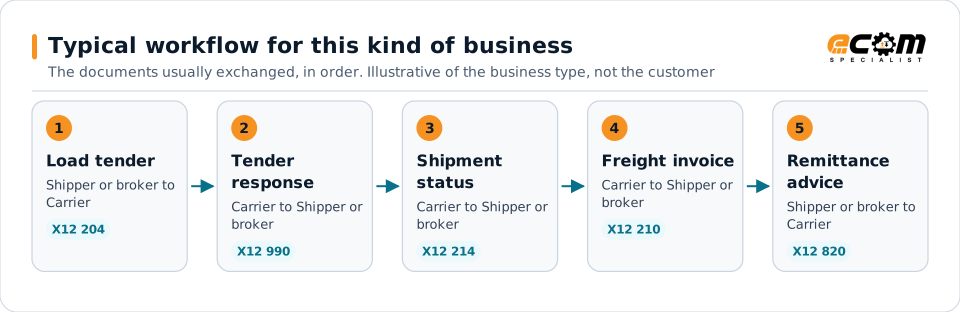
A truckload carrier’s EDI centers on a small set of documents exchanged on a clock. The shipper sends a load tender (X12 204). The carrier answers with a tender response (990) that accepts or declines. During the move, the carrier sends shipment status messages (214), and after delivery it sends the freight invoice (210). Each is acknowledged at the transmission level (997). Shippers and brokers each define how quickly each message must arrive, what codes are acceptable and what happens when one is missing.
On a long-established midrange platform, that logic often lives in programs written decades ago, in flat files shaped for a particular application, and in partner-specific conditions added one request at a time. A map is rarely just a format conversion. It may calculate a charge, pick a shipper’s reference number from one of several fields, suppress a message for one customer, or wait for a dispatch event before sending. When the person who wrote that condition retires, the condition keeps running and nobody can explain why.
External bidding and freight-procurement platforms add a different set of connections. Their data does not always follow a published standard, and they change on their own schedule, so their integrations are another place where undocumented knowledge accumulates.
Taking over operational responsibility without interrupting freight
In practice, a responsible takeover of an EDI operation starts with an inventory: which trading partners exist, which maps serve them, which maps are actually in use, how each connects, what each depends on in the carrier’s own systems, and which exceptions occur regularly. Documentation is produced from what the maps and the processing actually do, and the people who built them are interviewed while they are still available. That record becomes the shared basis for monitoring, change control and any later modernization.
ECOM’s confirmed role is managed EDI operations for the carrier, together with the API Gateway, Reconcile360 and PRISM-SCV. Operationally, the scope covers monitoring the exchange and responding when a tender response or status message does not go out; partner changes follow the agreed scope.
The extra applications address what surrounds the EDI. The API Gateway connects the carrier’s applications and outside platforms. PRISM-SCV watches for expected responses that never arrive, which is how a missed tender response or a missing delivery status becomes an exception with an owner. Reconcile360 starts cash application from matched remittance and invoices.
Architecture
Where the integration sits
Carrier environment
- Midrange platform
- Transportation management applications
- Accounting and receivables
ECOM responsibilities
- Managed EDI operations
- API Gateway
- PRISM-SCV shipment timeline and exceptions
- Reconcile360 cash matching
Partners and platforms
- Shippers and brokers (EDI)
- External transportation bidding platforms
- The bank (deposit data)
Educational diagram of this kind of environment, not the customer’s own architecture.
Running a similar exchange? Tell us your partners, systems and where the delays are, and a specialist will suggest where to start.
Talk to an EDI/API ExpertThe workflow
How the work flows
The documents typically exchanged in this kind of business, in the order they usually move. Partners vary, and some connect by API instead of EDI. The shaded line under a step shows where ECOM’s services act.
Steps are listed in the order the documents usually move, with who sends each one.
Shown for a truckload movement. Other modes, such as parcel, ocean, air or rail, use different documents.
-
1. Offer
Load tenderX12 204
Shipper or broker Carrier
Offers a load: pickup and delivery stops, equipment, dates and reference numbers.
ECOM operates the EDI exchange with the customer’s trading partners.
-
2. Respond
Tender responseX12 990
Carrier Shipper or broker
Accepts or declines the load, normally within the window the shipper sets.
PRISM-SCV watches for the response and routes a tender that gets no answer to the team that owns it.
-
3. Track
Shipment statusX12 214
Carrier Shipper or broker
Reports pickup, in-transit and delivery events so the shipper can follow the load.
PRISM-SCV links status events into one timeline and flags an expected update that has not arrived.
-
4. Bill
Freight invoiceX12 210
Carrier Shipper or broker
Bills linehaul and accessorial charges with the references the shipper needs to approve it.
Where a partner or internal system sends or receives this document by API instead of EDI, PRISM-API Gateway carries the same data.
-
5. Get paid
Remittance adviceX12 820
Shipper or broker Carrier
Payment, often batched, with remittance detail that may arrive apart from the bank deposit.
PRISM Reconcile360 matches this remittance advice with the bank deposit and the open invoices, and flags differences for review.
ECOM’s role
Operational needs and ECOM’s role
What this kind of exchange needs, and what ECOM does about it within the agreed scope.
Exception handling
When something goes wrong
-
An expected response does not arrive
A tender response or status message is due and has not been seen.
It is flagged and routed to the team that owns that step.
-
A document or connection fails
A document is rejected or a connection stops working.
It is watched by the ECOM team that operates the exchange rather than discovered by the carrier’s staff.
-
A payment is short or cannot be matched
The deposit, the remittance and the open invoices do not agree.
The item goes to review with the records side by side.
Business value
Confirmed scope and intended benefits
Confirmed
- ECOM is responsible for managed EDI operations for the carrier.
- ECOM provides the API Gateway, Reconcile360 and PRISM-SCV.
Intended benefits
- Operational continuity that does not depend on one or two individuals.
- Documented maps and partner knowledge held by a team.
- Missing tender responses and status messages seen as exceptions with an owner.
- Cash application that starts from matched records.
Systems typically involved
- Shipper and broker systemsSend load offers and receive responses, status and invoices over EDI or API.
- The carrier’s operations and dispatch systemsSource of loads, equipment, status events and delivery evidence.
- The carrier’s accounting systemHolds open freight invoices and receives applied cash.
- The bankSource of deposit information that is matched with remittance.
Lessons for similar enterprises
What other organizations can take from this
Count the people, not just the maps
A large map inventory is manageable with a deep team. It is a risk when a few people close to retirement hold the knowledge.
Document before the knowledge leaves
Partner-specific rules, exceptions and legacy dependencies should be captured while the people who know them are still available.
Treat continuity as a project in its own right
Waiting for a vacancy to open is not a plan. Define who will own operations, and how, before the last expert leaves.
Connect EDI to visibility and cash
Tenders, status and invoices sit on one chain. Monitoring and reconciliation keep that chain honest.