
X12 transaction guide · Master data
EDI 603 Transportation Equipment Registration
The X12 document equipment owners or controllers use to register transportation equipment, such as containers and chassis, with service providers.
- Sent by
- Equipment owner or controller
- Received by
- Transportation service provider or registry
- Standard
- ANSI ASC X12
What is an EDI 603?
The EDI 603 Transportation Equipment Registration is the ANSI X12 transaction set transportation equipment owners or controllers use with transportation service providers and other interested parties to register equipment and maintain its details. Registered details include the equipment identification, type, dimensions and characteristics.
Terminals, railroads and other providers rely on accurate equipment data to plan handling, check compatibility and bill correctly. Registration keeps that data in step with the owner's fleet as equipment is added, modified or retired. It is often used by leasing companies and railroads.
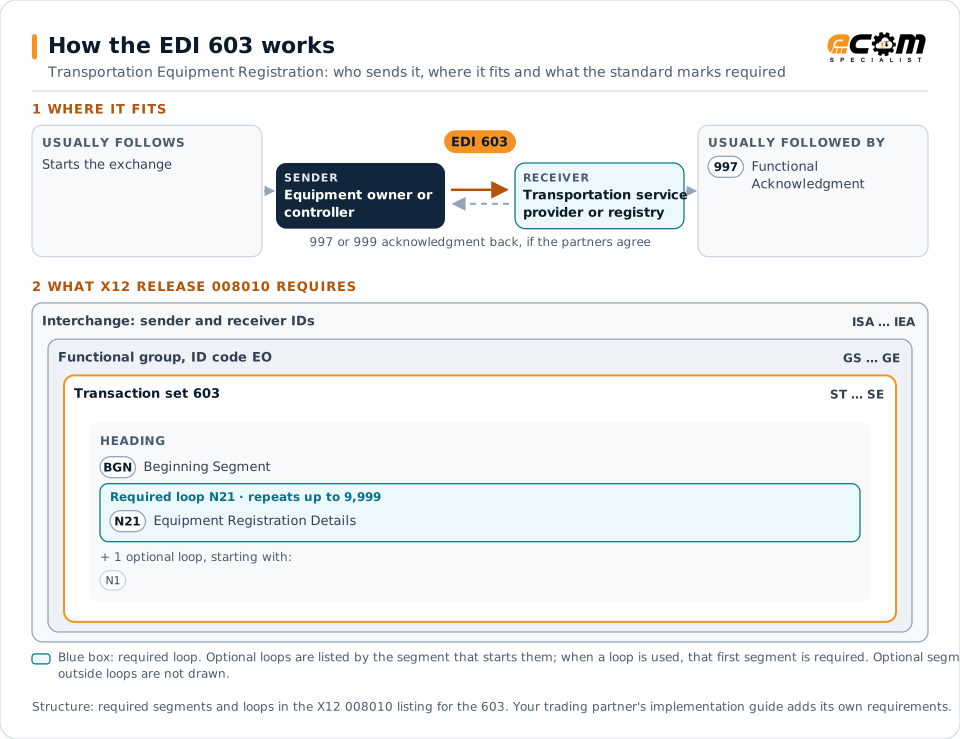
How to read this diagram: the top row shows who sends the 603, to whom, and which documents usually come before and after it. The lower part shows what X12 release 008010 itself requires: the envelopes around the 603 and the segments and loops the standard marks as required, area by area. Optional loops are listed by the segment that starts them rather than drawn in full. This is the standard's minimum, not a trading partner's requirement: each partner's implementation guide usually makes some optional loops mandatory, restricts the codes and may use a different release.
When it is used
- Registering new containers, trailers or chassis
- Updating equipment characteristics
- Retiring equipment from service
Where it fits in the document flow
Structure
Mandatory segments in the 603 (X12 release 008010)
The segments X12 release 008010 marks as mandatory at their level, in order. Segments inside optional loops are needed only when the loop is used. This is the standard's requirement, not your trading partner's: each partner's implementation guide names the release it uses, adds the optional segments it requires and restricts the values. The requirement status comes from one published X12 reference listing and has not been checked against a second source.
- ST
- BGN
- N1
- N21
- SE
Practical example
The 603 in practice
A leasing company adds 500 new refrigerated containers to its fleet. It sends the registry and the railroads it works with a 603 for each container, with the identification, size and type code, tare weight and refrigeration characteristics. When the containers enter service, the railroads already have the data needed to plan and bill moves.
Implementation
Implementation considerations for the 603
- Register equipment before it enters service.
- Use standard equipment identification and type codes.
- Send updates when equipment is modified or retired.
- Reconcile registry data with operational records periodically.
How ECOM helps
Automate the 603 with ECOM
Industry
Trucking and Transportation
Load tenders, responses, status and freight invoices for carriers, brokers and shippers, integrated with the TMS.
Solution
Logistics Automation
Automate tenders, status updates, freight invoices and warehouse orders with logistics partners.
Solution
EDI Integration
Exchange X12 and EDIFACT documents with partners and integrate them directly with your ERP.
More general questions about EDI are answered in the EDI FAQ.
Related transactions
Related master data documents
- 435Standard Transportation Commodity Code Master
- 128Dealer Information
- 217Motor Carrier Loading and Route Guide
- 431Railroad Station Master File
- 433Railroad Reciprocal Switch File
- 434Railroad Mark Register Update Activity
- 437Railroad Junctions and Interchanges Activity
- 475Rail Route File Maintenance
- 140Product Registration
Need help with the EDI 603?
ECOM maps, tests and monitors X12 documents for your trading partners and integrates them with your ERP.