
X12 transaction guide · Finance
EDI 823 Lockbox
The X12 document a bank or lockbox provider sends to give a company the detail and totals of the payments it received.
- Sent by
- Bank or lockbox service provider
- Received by
- Company receiving the payments
- Standard
- ANSI ASC X12
What is an EDI 823?
The EDI 823 Lockbox is the ANSI X12 transaction set used to transmit lockbox information, the incoming payments a bank or other lockbox service provider has received for a company, together with their totals. It lists each deposit and the payments within it, with details such as amounts, check numbers and remitter information.
Companies load 823 data into accounts receivable to apply cash. Combined with remittance detail, for example from an 820, it lets payments be matched to open invoices without keying them from paper.
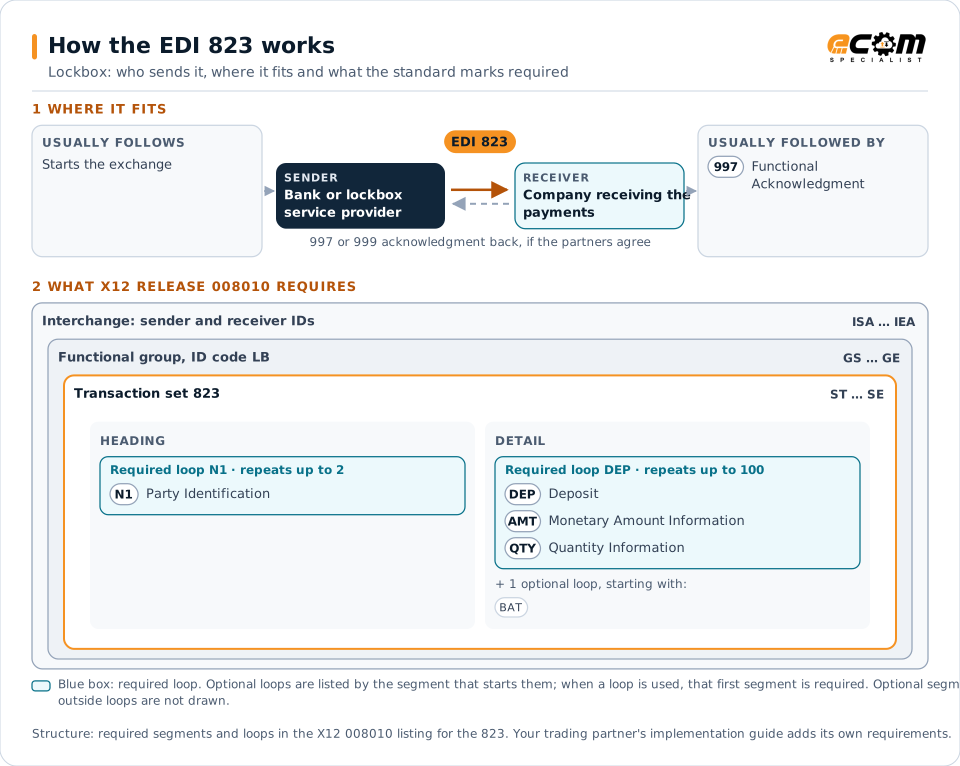
How to read this diagram: the top row shows who sends the 823, to whom, and which documents usually come before and after it. The lower part shows what X12 release 008010 itself requires: the envelopes around the 823 and the segments and loops the standard marks as required, area by area. Optional loops are listed by the segment that starts them rather than drawn in full. This is the standard's minimum, not a trading partner's requirement: each partner's implementation guide usually makes some optional loops mandatory, restricts the codes and may use a different release.
When it is used
- Daily reporting of lockbox deposits by a bank
- Automating cash application in accounts receivable
- Reconciling deposits with bank statements
Where it fits in the document flow
Structure
Mandatory segments in the 823 (X12 release 008010)
The segments X12 release 008010 marks as mandatory at their level, in order. Segments inside optional loops are needed only when the loop is used. This is the standard's requirement, not your trading partner's: each partner's implementation guide names the release it uses, adds the optional segments it requires and restricts the values. The requirement status comes from one published X12 reference listing and has not been checked against a second source.
- ST
- N1
- DEP
- AMT
- QTY
- BAT
- BPR
- ADX
- REF
- IT1
- SAC
- SLN
- RMR
- TXP
- DED
- LX
- NM1
- AIN
- PEN
- INV
- SE
Practical example
The 823 in practice
A manufacturer's customers mail checks to a bank lockbox. Each morning, the bank sends an 823 listing the previous day's deposit, every check and the invoice numbers written on the remittance stubs. The manufacturer's ERP applies most payments to open invoices automatically, and the team reviews only the exceptions.
Implementation
Implementation considerations for the 823
- Agree with the bank on file timing and the remittance detail captured from each payment.
- Reconcile 823 totals with the bank deposit before applying cash.
- Handle payments without a clear invoice reference in an exception queue.
How ECOM helps
Automate the 823 with ECOM
Solution
Financial Document Automation
Automate invoices, remittances, payment files and bank statements from capture to posting.
Industry
Financial Services
Secure file transfer and B2B integration for banks and financial institutions.
Solution
Order-to-Cash Automation
Automate the flow from purchase order to payment across every customer channel.
More general questions about EDI are answered in the EDI FAQ.
Related transactions
Related finance documents
- 820Payment Order/Remittance Advice
- 135Student Aid Origination Record
- 139Student Loan Guarantee Result
- 144Student Loan Transfer and Status Verification
- 155Business Credit Report
- 191Student Loan Pre-Claims and Claims
- 197Real Estate Title Evidence
- 198Loan Verification Information
- 199Real Estate Settlement Information
- 200Mortgage Credit Report
- 201Residential Loan Application
- 202Secondary Mortgage Market Loan Delivery
Need help with the EDI 823?
ECOM maps, tests and monitors X12 documents for your trading partners and integrates them with your ERP.