
EDIFACT message guide · Customs and regulatory
CUSRES Customs response
The UN/EDIFACT message a customs administration uses to acknowledge declarations and reports, report errors and communicate decisions.
- Sent by
- Customs administration
- Received by
- Declarant, carrier or agent
- Standard
- UN/EDIFACT · Batch message
- X12 equivalent
- 355 Customs Acceptance/Rejection
What is the EDIFACT CUSRES message?
CUSRES is the UN/EDIFACT customs response. The directory defines it as a message that transfers data from a customs administration to acknowledge receipt of a message, to indicate whether the information received is correct or contains errors, and to communicate customs decisions about it.
Declarants and carriers depend on CUSRES to know whether a declaration was accepted, whether goods are released or held for inspection, and what duties are due. Because release decisions control when goods can move, responses need to be processed and acted on quickly.
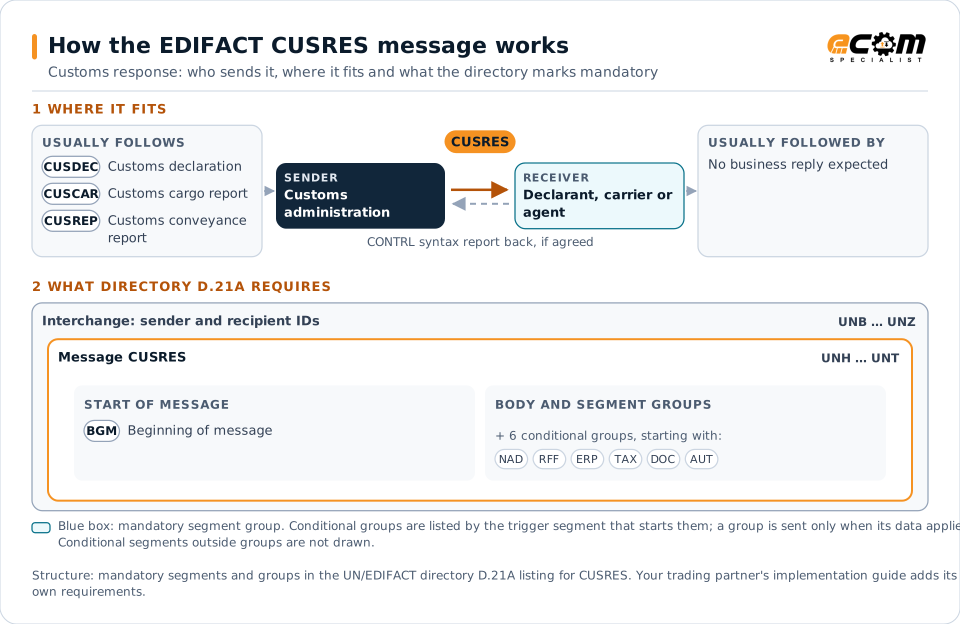
How to read this diagram: the top row shows who sends CUSRES, to whom, and which messages usually come before and after it. The lower part shows what the directory D.21A itself requires: the envelopes around CUSRES and the segments and segment groups it marks mandatory. Conditional groups are listed by their trigger segment rather than drawn in full. This is the directory's minimum, not a trading partner's requirement: a message implementation guide, such as an industry subset or a partner’s own guide, usually makes some conditional groups mandatory, restricts the codes and may use an older directory.
When it is used
- Acknowledging receipt of a declaration or report
- Reporting errors in a submission
- Communicating release, hold or inspection decisions
Where it fits in the message flow
Structure
Mandatory segments in CUSRES (directory D.21A)
In UN/EDIFACT directory D.21A, the CUSRES message has 56 segment positions arranged in 15 segment groups. These are the segments and segment groups marked mandatory at message level, in order; a mandatory group is shown with the segment that starts it. Segments inside conditional groups are needed only when the group is used. This is the directory’s requirement, not your trading partner’s: each partner’s message implementation guide names the directory it uses, often an older one such as D.96A or D.01B where the structure can differ, makes some conditional segments mandatory and restricts the codes.
- UNH
- BGM
- UNT
Practical example
CUSRES in practice
A customs broker submits a CUSDEC import declaration. Customs replies first with a CUSRES acknowledging receipt, then with another CUSRES selecting the goods for documentary control. After the broker provides the documents, a final CUSRES releases the goods, and the broker notifies the haulier.
Implementation
Implementation considerations for CUSRES
- Route each response type to the people who must act on it.
- Match responses to submissions by reference.
- Treat release responses as the trigger for collection.
- Follow the national specification for response codes.
How ECOM helps
Automate CUSRES with ECOM
Industry
Trucking and Transportation
Load tenders, responses, status and freight invoices for carriers, brokers and shippers, integrated with the TMS.
Solution
Supply Chain Visibility
Track orders, shipments and invoices across partners and catch exceptions early.
Solution
EDI Integration
Exchange X12 and EDIFACT documents with partners and integrate them directly with your ERP.
Compare X12 and EDIFACT, or see answers to general questions in the EDI FAQ.
Related messages
Related customs and regulatory messages
- CUSCARCustoms cargo report
- CUSDECCustoms declaration
- CUSEXPCustoms express consignment declaration
- CUSPEDPeriodic customs declaration
- CUSREPCustoms conveyance report
- GOVCBRGovernment Cross Border Regulatory
- PAXLSTPassenger list
- CODENOPermit expiration/clearance ready notice
- DGRECADangerous goods recapitulation
- SANCRTInternational movement of goods governmental regulatory
- WASDISWaste disposal information
Need help with CUSRES?
ECOM maps, tests and monitors EDIFACT messages for your trading partners and integrates them with your ERP.