
EDIFACT message guide · Communications
INSRPT Inspection report
The UN/EDIFACT message a customer's inspection service uses to report inspection results on items due for despatch.
- Sent by
- Customer's inspection service or agent
- Received by
- Supplier and other interested parties
- Standard
- UN/EDIFACT · Batch message
- X12 equivalent
- No direct equivalent
What is the EDIFACT INSRPT message?
INSRPT is the UN/EDIFACT inspection report. The directory defines it as a message sent by a customer's inspection service, or its agent, informing a supplier and other interested parties of the results of the inspection of items due for despatch to the customer.
The report states whether the goods passed or failed, the defects found and any instructions, such as rework before re-inspection. Buyers often make shipment, or payment under letters of credit, conditional on a passed inspection. It is the answer to an INSREQ.
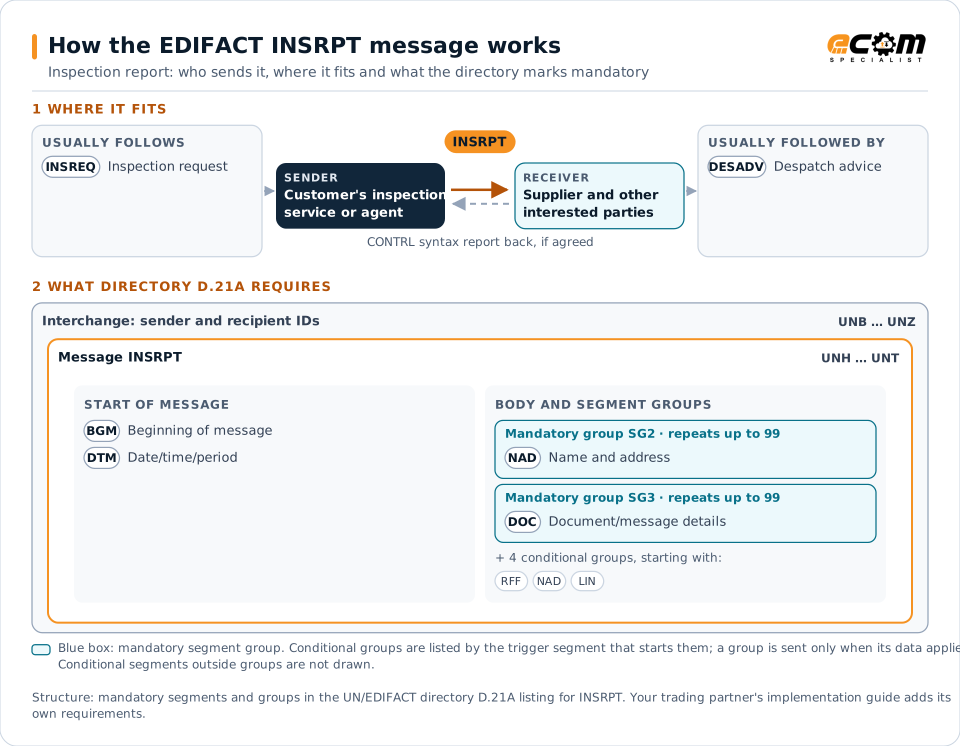
How to read this diagram: the top row shows who sends INSRPT, to whom, and which messages usually come before and after it. The lower part shows what the directory D.21A itself requires: the envelopes around INSRPT and the segments and segment groups it marks mandatory. Conditional groups are listed by their trigger segment rather than drawn in full. This is the directory's minimum, not a trading partner's requirement: a message implementation guide, such as an industry subset or a partner’s own guide, usually makes some conditional groups mandatory, restricts the codes and may use an older directory.
When it is used
- Reporting pre-shipment inspection results
- Approving goods for despatch
- Reporting defects requiring rework
Where it fits in the message flow
Structure
Mandatory segments in INSRPT (directory D.21A)
In UN/EDIFACT directory D.21A, the INSRPT message has 35 segment positions arranged in 9 segment groups. These are the segments and segment groups marked mandatory at message level, in order; a mandatory group is shown with the segment that starts it. Segments inside conditional groups are needed only when the group is used. This is the directory’s requirement, not your trading partner’s: each partner’s message implementation guide names the directory it uses, often an older one such as D.96A or D.01B where the structure can differ, makes some conditional segments mandatory and restricts the codes.
- UNH
- BGM
- DTM
- SG2 (NAD)
- SG3 (DOC)
- UNT
Practical example
INSRPT in practice
An inspector checks a sample of a garment order and finds stitching defects above the allowed level in one style. The agency sends the factory and the retailer an INSRPT passing four styles and failing one with the defect details. The factory reworks the failed style and requests re-inspection.
Implementation
Implementation considerations for INSRPT
- Use agreed defect classifications and acceptance levels.
- Report results per item or lot, not only overall.
- Distribute results to everyone who controls shipment and payment.
- Link re-inspections to the original report.
How ECOM helps
Automate INSRPT with ECOM
Industry
Retail
Retail and eCommerce EDI for suppliers and retailers, from purchase order to payment, with compliance built in.
Industry
Consumer Goods
Retail, distributor, marketplace and direct-channel integration for consumer brands.
Solution
Supply Chain Visibility
Track orders, shipments and invoices across partners and catch exceptions early.
Compare X12 and EDIFACT, or see answers to general questions in the EDI FAQ.
Related messages
Related communications messages
Need help with INSRPT?
ECOM maps, tests and monitors EDIFACT messages for your trading partners and integrates them with your ERP.