
EDIFACT message guide · Communications
RPCALL Repair call
The UN/EDIFACT message a manufacturer or call center uses to send service and repair centers details of appliances needing repair.
- Sent by
- Manufacturer or call center
- Received by
- Servicing or repair center
- Standard
- UN/EDIFACT · Batch message
- X12 equivalent
- No direct equivalent
What is the EDIFACT RPCALL message?
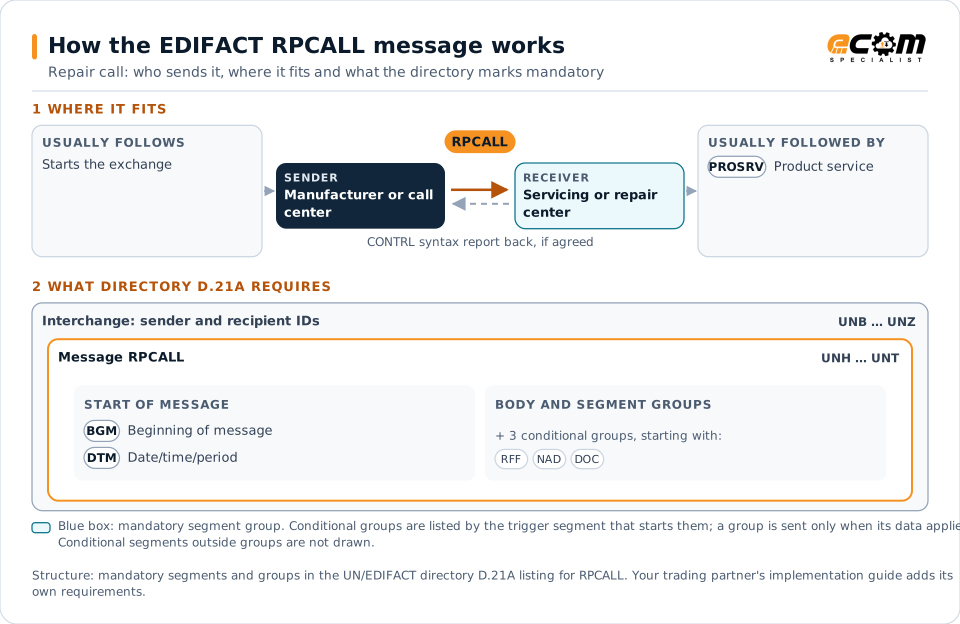
RPCALL is the UN/EDIFACT repair call message. The directory defines it as a message sent by a manufacturer or call center to servicing and repair centers with details of appliances requiring repair or service, including the appliance, symptoms and faults and the service history.
A repair call lets a manufacturer dispatch jobs to its network of service partners without phone calls. The service center schedules the visit, prepares parts from the fault description and later reports the work with a PROSRV.
How to read this diagram: the top row shows who sends RPCALL, to whom, and which messages usually come before and after it. The lower part shows what the directory D.21A itself requires: the envelopes around RPCALL and the segments and segment groups it marks mandatory. Conditional groups are listed by their trigger segment rather than drawn in full. This is the directory's minimum, not a trading partner's requirement: a message implementation guide, such as an industry subset or a partner’s own guide, usually makes some conditional groups mandatory, restricts the codes and may use an older directory.
When it is used
- Dispatching a consumer repair job to a service center
- Sending fault and history details before a visit
- Assigning warranty work to service partners
Where it fits in the message flow
Structure
Mandatory segments in RPCALL (directory D.21A)
In UN/EDIFACT directory D.21A, the RPCALL message has 28 segment positions arranged in 10 segment groups. These are the segments and segment groups marked mandatory at message level, in order; a mandatory group is shown with the segment that starts it. Segments inside conditional groups are needed only when the group is used. This is the directory’s requirement, not your trading partner’s: each partner’s message implementation guide names the directory it uses, often an older one such as D.96A or D.01B where the structure can differ, makes some conditional segments mandatory and restricts the codes.
- UNH
- BGM
- DTM
- UNT
Practical example
RPCALL in practice
A consumer calls an appliance maker's helpline about a dishwasher that will not drain. The call center sends the nearest service partner an RPCALL with the customer's address, the model and serial number, the reported symptom and previous repairs. The partner books a visit, brings a likely replacement pump and later reports the repair with a PROSRV.
Implementation
Implementation considerations for RPCALL
- Protect customer personal data in transit and at rest.
- Use product and fault codes consistent with the manufacturer's.
- Confirm acceptance of each job by the service center.
- Link calls to the service reports that close them.
How ECOM helps
Automate RPCALL with ECOM
Industry
Consumer Goods
Retail, distributor, marketplace and direct-channel integration for consumer brands.
Industry
Manufacturing
Customer schedules, supplier connectivity and shipping integrated with the ERP for manufacturers.
Solution
B2B Integration
Connect every customer, supplier, carrier and bank across EDI, API, file and portal channels.
Compare X12 and EDIFACT, or see answers to general questions in the EDI FAQ.
Related messages
Related communications messages
Need help with RPCALL?
ECOM maps, tests and monitors EDIFACT messages for your trading partners and integrates them with your ERP.