
EDIFACT message guide · Insurance
REBORD Reinsurance bordereau
The UN/EDIFACT message that reports individual policy data and its effect on a reinsurance contract, such as how premiums or claims are built up.
- Sent by
- Insurer (cedent) or intermediary
- Received by
- Reinsurer
- Standard
- UN/EDIFACT · Batch message
- X12 equivalent
- No direct equivalent
What is the EDIFACT REBORD message?
REBORD is the UN/EDIFACT reinsurance bordereau. The directory defines it as a message made up of individual policy data and their impact on a reinsurance contract. It can report how reinsurance premium or claims figures are built up, or report the risks covered.
Bordereaux give reinsurers the detail behind the totals in technical accounts: which policies were ceded, their sums insured and premiums, or which claims arose. Reinsurers use them to check accounts and analyze the business they assume. Bordereaux are usually sent each period.
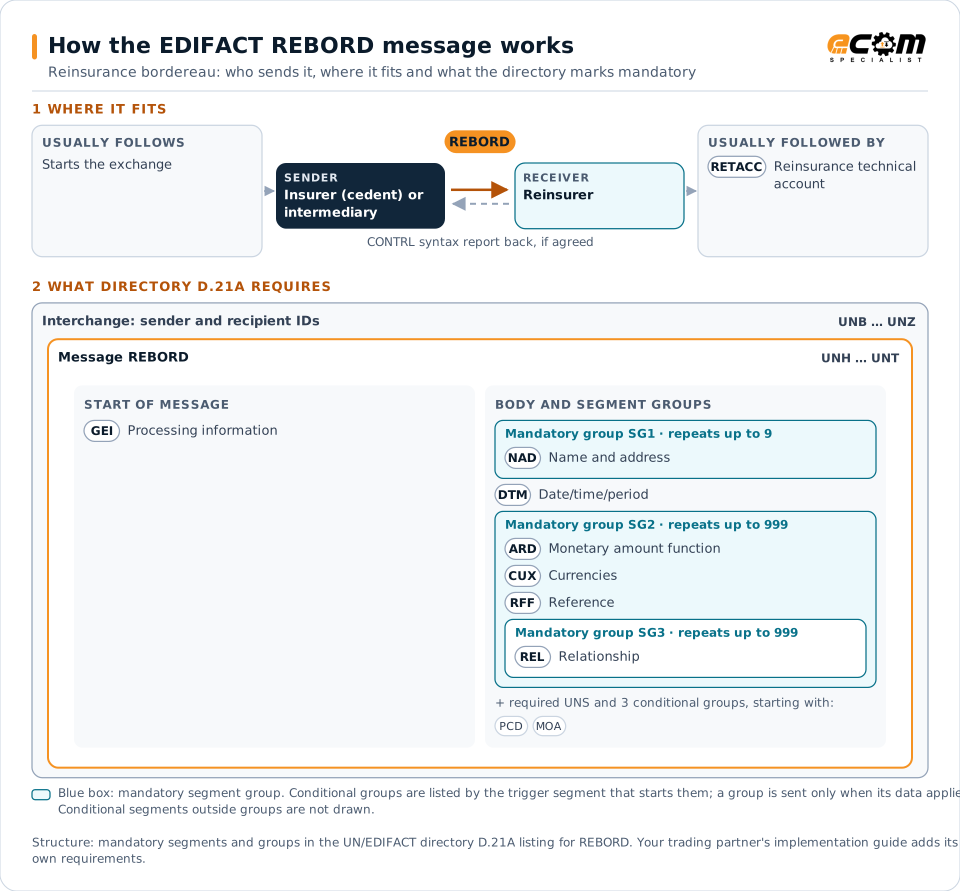
How to read this diagram: the top row shows who sends REBORD, to whom, and which messages usually come before and after it. The lower part shows what the directory D.21A itself requires: the envelopes around REBORD and the segments and segment groups it marks mandatory. Conditional groups are listed by their trigger segment rather than drawn in full. This is the directory's minimum, not a trading partner's requirement: a message implementation guide, such as an industry subset or a partner’s own guide, usually makes some conditional groups mandatory, restricts the codes and may use an older directory.
When it is used
- Reporting ceded policies under a treaty
- Showing how ceded premiums are calculated
- Reporting the claims behind recoveries
Where it fits in the message flow
Structure
Mandatory segments in REBORD (directory D.21A)
In UN/EDIFACT directory D.21A, the REBORD message has 39 segment positions arranged in 8 segment groups. These are the segments and segment groups marked mandatory at message level, in order; a mandatory group is shown with the segment that starts it. Segments inside conditional groups are needed only when the group is used. This is the directory’s requirement, not your trading partner’s: each partner’s message implementation guide names the directory it uses, often an older one such as D.96A or D.01B where the structure can differ, makes some conditional segments mandatory and restricts the codes.
- UNH
- GEI
- SG1 (NAD)
- DTM
- SG2 (ARD)
- UNS
- UNT
Practical example
REBORD in practice
Each quarter, a life insurer sends its reinsurer a REBORD listing every policy ceded under a surplus treaty, with the insured amount, the retained and ceded shares and the ceded premium. The reinsurer reconciles the bordereau totals with the technical account.
Implementation
Implementation considerations for REBORD
- Make bordereau totals agree with technical accounts.
- Protect personal data on individual policies.
- Agree the fields and frequency with the reinsurer.
- Use consistent policy and contract identifiers.
How ECOM helps
Automate REBORD with ECOM
Industry
Financial Services
Secure file transfer and B2B integration for banks and financial institutions.
Solution
Financial Document Automation
Automate invoices, remittances, payment files and bank statements from capture to posting.
Solution
B2B Integration
Connect every customer, supplier, carrier and bank across EDI, API, file and portal channels.
Compare X12 and EDIFACT, or see answers to general questions in the EDI FAQ.
Related messages
Related insurance messages
- RETACCReinsurance technical account
- LREACTLife reinsurance activity
- LRECLMLife reinsurance claims
- RECALCReinsurance calculation
- RECLAMReinsurance claims
- RECORDReinsurance core data
- RELISTReinsured objects list
- REPREMReinsurance premium
- RESETTReinsurance settlement
- ICASRPInsurance claim assessment and reporting
- ICSOLIInsurance claim solicitor's instruction
- IFTICLCargo insurance claims
Need help with REBORD?
ECOM maps, tests and monitors EDIFACT messages for your trading partners and integrates them with your ERP.