
EDIFACT message guide · Finance
REMADV Remittance advice
The UN/EDIFACT message that gives a detailed accounting of what a payment or other settlement covers.
- Sent by
- Buyer (payer) or its bank
- Received by
- Seller (payee)
- Standard
- UN/EDIFACT · Batch message
- X12 equivalent
- 820 Payment Order/Remittance Advice
What is the EDIFACT REMADV message?
REMADV is the UN/EDIFACT remittance advice message. The directory describes it as a communication between trading partners, such as a seller, a buyer or financial institutions, that provides a detailed accounting relative to a payment or other form of financial settlement for the goods or services detailed in the advice.
Sellers use the remittance advice to apply incoming cash to the right invoices. It lists each invoice or credit note settled, the amount paid against each, and any deductions with reasons, which is what accounts receivable needs to clear open items without manual research.
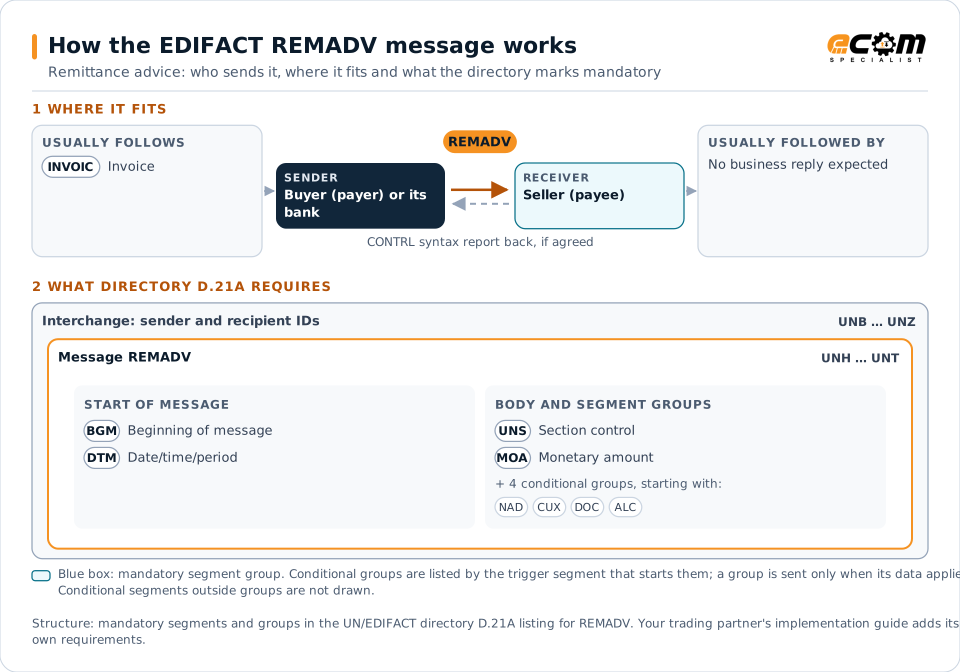
How to read this diagram: the top row shows who sends REMADV, to whom, and which messages usually come before and after it. The lower part shows what the directory D.21A itself requires: the envelopes around REMADV and the segments and segment groups it marks mandatory. Conditional groups are listed by their trigger segment rather than drawn in full. This is the directory's minimum, not a trading partner's requirement: a message implementation guide, such as an industry subset or a partner’s own guide, usually makes some conditional groups mandatory, restricts the codes and may use an older directory.
When it is used
- Explaining which invoices a payment covers
- Reporting deductions and adjustments taken
- Announcing a payment before funds arrive
Where it fits in the message flow
Structure
Mandatory segments in REMADV (directory D.21A)
In UN/EDIFACT directory D.21A, the REMADV message has 48 segment positions arranged in 14 segment groups. These are the segments and segment groups marked mandatory at message level, in order; a mandatory group is shown with the segment that starts it. Segments inside conditional groups are needed only when the group is used. This is the directory’s requirement, not your trading partner’s: each partner’s message implementation guide names the directory it uses, often an older one such as D.96A or D.01B where the structure can differ, makes some conditional segments mandatory and restricts the codes.
- UNH
- BGM
- DTM
- UNS
- MOA
- UNT
Practical example
REMADV in practice
A car parts distributor pays a supplier for 85 invoices in one bank transfer. Its payables system sends the supplier a REMADV listing each invoice, the amount paid, two credit notes offset and a deduction for a pricing difference. The supplier's cash application process matches the transfer to the advice and clears the invoices automatically.
Implementation
Implementation considerations for REMADV
- Reference invoice numbers exactly as the seller issued them.
- Give reasons for deductions so they can be investigated.
- Match the remittance total to the actual payment amount.
- Agree whether the advice travels directly or through the banks.
How ECOM helps
Automate REMADV with ECOM
Solution
Financial Document Automation
Automate invoices, remittances, payment files and bank statements from capture to posting.
Solution
Order-to-Cash Automation
Automate the flow from purchase order to payment across every customer channel.
Industry
Automotive
Schedules, ship notices, labels, self-billing and multi-plant routing for automotive suppliers.
Compare X12 and EDIFACT, or see answers to general questions in the EDI FAQ.
Related messages
Related finance messages
Need help with REMADV?
ECOM maps, tests and monitors EDIFACT messages for your trading partners and integrates them with your ERP.